When the Ebola Headline Hits: What I’m Actually Watching

When the Ebola Headline Hits: What I’m Actually Watching

By Aaron Asay, PA-C, DMSc

You saw the headline. Maybe it came up in your news feed this morning, or someone in a group chat sent it with a string of question marks. WHO has declared a public health emergency. JFK is screening flights from affected countries. And the question running through your head, whether you say it out loud or not, is: Is this going to be like COVID?

I understand that feeling. I’ve spent 25 years responding to outbreaks, disasters, and health crises, and I’ve watched what the first wave of media coverage does to people — it creates anxiety without context, and anxiety without context is where bad decisions get made. So let me give you what most of those headlines are leaving out.

What’s actually happening in 2026

WHO declared a public health emergency of international concern in May. Major US airports including JFK have begun screening travelers arriving from affected regions in the DRC. The outbreak is real, it is serious, and international responders are working on it.

The strain driving the 2026 outbreak is Bundibugyo virus — a distinct Ebola species from Zaire ebolavirus, which is the strain most people picture when they hear “Ebola.” That distinction matters more than it might seem. The vaccine you may have heard about — Ervebo, licensed in the US in 2019 — works against Zaire ebolavirus. It does not work against Bundibugyo. There is no licensed vaccine for Bundibugyo, no approved monoclonal antibody product, and no specific antiviral. The international response looks different this time, and understanding why helps you hold the news accurately rather than just anxiously.

Bundibugyo has caused two previous outbreaks: Uganda in 2007 and DRC in 2012. Neither received significant US media coverage, and neither crossed into the United States. That track record is relevant context for what you’re deciding to pay attention to right now.

What CDC is and isn’t saying

CDC currently assesses the risk to Americans as low. But the part most headlines skip is the next sentence: travel from an affected country is not by itself an epidemiologic risk factor.

That phrase is doing a lot of work. If a coworker traveled to the DRC last month, that travel alone doesn’t place you at risk. If your kid’s friend has a parent who just returned from an affected region, that also doesn’t create exposure. The Ebola transmission pathway is specific: direct contact with the body fluids of a symptomatic person, or with surfaces and objects contaminated by them. The groups who carry real exposure risk are healthcare workers, burial team members, laboratory workers, and household caregivers of sick patients — not casual contacts, not fellow plane passengers, not the neighbor whose cousin lives near Kinshasa.

Knowing this doesn’t mean you dismiss the outbreak. It means you hold an accurate model of what’s happening rather than a generalized one. There is a difference between “there is an active Ebola outbreak with real mortality” and “I am at risk of Ebola.” Both can exist at the same time. The first one is true. The second one, for most people reading this, isn’t.

Why “calm down, you’ll be fine” isn’t the answer

When people feel anxious about something like this, the worst thing a trusted source can do is wave it off. It tells the worried person that their feeling is wrong. It signals that you’re not engaging seriously with something real. And it sends them somewhere else to find answers — usually somewhere without clinical grounding.

I’ve seen this in disaster response. The communities that come through crises best are not the ones who weren’t scared. They’re the ones who had accurate information early and used it to make decisions. Fear plus facts is manageable. Fear without facts isn’t.

If the Ebola coverage is unsettling you this week, that’s not irrational. There’s a real outbreak. The vaccine that worked before doesn’t apply here. International response is more complicated because of it. All of that is true. What that feeling is telling you, if you’re willing to listen carefully, isn’t “panic.” It’s “pay attention.” And there’s something constructive to do with that.

What preparation actually looks like

When I work with families on emergency readiness, I start with the same question: what does your household do when the system doesn’t work?

That question applies whether the disruption is an active outbreak, a hurricane, a supply chain failure, or a routine illness that hits on a Sunday when urgent care is closed. The households that navigate disruptions best aren’t the ones who panicked when headlines got scary. They’re the ones who had already built a baseline: medications on hand, documentation in order, a clinical resource they trust.

Ebola doesn’t directly threaten most American households right now. What does threaten households — every week, quietly, without a news cycle behind it — is the absence of preparation for disruptions that are coming regardless of what’s happening in the DRC.

That’s what I think about when I see a headline like this. Not fear. Inventory.

If you want to build that baseline with clinical oversight from a team that takes this seriously, Jase is where we do that work. Appropriate medical preparation — before you need it.

👉 Support Jase Response


Aaron Asay, PA-C, DMSc, is a physician assistant with 25+ years of frontline emergency response experience, former firefighter and paramedic, military disaster rescue officer, and founder of Jase Response.

Lifesaving Solutions

Everyone should be empowered to care for themselves and their loved ones during the unexpected. Check out our recent lifesaving products today.

Recent Posts

Keeping you informed and safe.

Pink Eye: When You Actually Need Antibiotic Eye Drops

Pink Eye: When You Actually Need Antibiotic Eye Drops

Pink Eye: When You Actually Need Antibiotic Eye Drops By the Jase Medical Team It’s Monday morning, and your child wakes up with one eye crusted shut. You clean it up, get everyone out the door, and hope for the best. By 9:15, the school calls. Your child has pink...
read more
Controlled Substances in a Disaster

Controlled Substances in a Disaster

Controlled Substances in a Disaster: Why the Schedule on Your Prescription Changes Everything By the Jase Medical Team ou evacuated with four days of medication in your bag. Now you're two states from home, the pharmacy holding your prescription is closed, and you're...


read more

Join Our Newsletter

Our mission is to help you be more medically prepared. Join our newsletter and follow us on social media for health and safety tips each week!

The FDA’s BPC-157 Briefing Document Says Less Than It Sounds Like

No, FDA Isn’t Banning BPC-157

The July 2026 briefing document says less than it sounds like it says

By Dr. Shawn Rowland, MD, Founder and CEO of Jase

Every week a patient brings up BPC-157. Sometimes it’s a gym client asking about tendon healing, sometimes it’s someone who found it through a peptide forum for gut issues. So when FDA posted a nearly 70-page briefing document ahead of the Pharmacy Compounding Advisory Committee meeting on July 23 and 24, 2026, I read the whole thing.¹ It’s worth unpacking, because the headline version that will circulate (“FDA moves to ban BPC-157”) is not actually what the document says.

It also helps to know BPC-157 was not singled out. FDA reviewed seven peptides at this meeting, and its scientists recommended against adding all seven to the compounding list.² This is a document about how thin the evidence base is across a whole category, not a verdict aimed at one molecule.

What’s actually being decided

Two compounders, Wells Pharmacy Network and LDT Health Solutions, nominated BPC-157 (and its acetate salt form) for the 503A Bulks List, the list of substances a compounding pharmacy can legally use to make individualized prescriptions. Both nominations were withdrawn. FDA decided to evaluate the peptide anyway, on its own initiative, but narrowed the efficacy review to one specific use: ulcerative colitis. That narrowing matters. The agency explicitly did not evaluate BPC-157 for tendonitis, Crohn’s, or Celiac disease, because the nominators never submitted enough information for those uses to be reviewed at all.¹ So the efficacy question in front of the committee is about ulcerative colitis, not about everything patients are actually using the peptide for.

This is also not happening in a vacuum. BPC-157 spent two years on FDA’s Category 2 list of substances that raise significant safety concerns, came off that list in April 2026 as part of a broader reconsideration of restricted peptides, and now lands in front of this committee.³ The July meeting is one technical step inside a much larger, very public back-and-forth over peptide access.

What FDA actually found

Strip away the regulatory language and the case is this. There is no USP monograph for BPC-157 in either form. The two nominators couldn’t even agree with their own paperwork on whether they were nominating the free base or the acetate salt, and their certificates of analysis didn’t match what they wrote in the nomination¹. For efficacy, FDA found exactly one trial in UC patients, a 53 person rectal enema study that exists only as a conference abstract, with no real detail on inclusion criteria or statistical methods, and no statistically significant benefit over placebo¹. For human safety, the FAERS database returned three case reports, all involving injectable BPC-157. One was confounded by a second peptide the patient was also injecting, one could not be interpreted because almost no information was reported, and one involved a product that also contained TB-500, where the reaction returned when the patient restarted it but could not be pinned to either peptide.¹ Nobody has run a human pharmacokinetic study for oral, subcutaneous, nasal, or transdermal delivery, despite those being the four routes patients are actually using¹.

On the animal side, the picture is more reassuring than the headline suggests. BPC-157 wasn’t mutagenic in Ames assays, didn’t cause birth defects in pregnant rats at any tested dose, and produced no clearly drug-attributable serious events in the small human record that exists.The toxicology read is closer to “we don’t have enough information to rule out risk” than “we found a dangerous compound.”

Where I land on this

I built a telemedicine practice around the idea that patients deserve more access to care, not less. So I want to be precise about where I agree with FDA and where I do not.

The part FDA gets right is the quality question. A substance sold under one name while carrying two different chemical identities, with no monograph and no agreed impurity-testing standard, is a real problem, especially for injectable and nasal products where endotoxin and aggregation risk are genuine. FDA’s recommendation rests mostly here: its scientists call BPC-157 “not well-characterized” and point to missing data on impurities, aggregates, and sterility, not to a finding that the peptide failed.¹ That is a legitimate concern, and I am not going to pretend otherwise.

Here is where I part ways. A quality problem calls for a higher quality bar, not for pushing the substance out of the one channel where quality can be controlled. BPC-157 has been studied since 1993⁴ and has millions of views across social media and peptide forums. That demand is not waiting on a committee vote.

If BPC-157 comes off the 503A list, that demand doesn’t disappear. It moves to the channels FDA isn’t even discussing in this document: direct-to-consumer peptide sellers shipping vials labeled “research use only,” med spas with no physician oversight, and telehealth operations cutting corners on the very COA and purity testing that legitimate compounders are required to provide. The exact impurity and aggregation risk the agency is worried about gets worse, not better, once you push the substance out of a regulated pharmacy and into a supply chain with zero accountability.

If the goal is patient safety, the better path is tightening the quality bar inside the regulated channel: require validated impurity testing, require a real CoA before listing approval, and build a post-market surveillance mechanism through the outsourcing facility reporting structure that already exists. Pulling the substance off the list without a parallel path for legitimate use doesn’t solve the underlying problem. It just moves it somewhere nobody is watching.

What patients and prescribers can actually do:

The committee meets July 23 and 24. If you want your experience on the record, be clear-eyed about the calendar. The window to register to speak at the meeting has closed, and the deadline for written comments to reach the committee before it votes has passed. What is still open: FDA is accepting written comments through July 22 under docket FDA-2025-N-6895 at regulations.gov, and those comments go to the agency as it finalizes its decision after the meeting.⁵ A committee recommendation is not a final rule. The decision is not closed yet, and prescribers with real case experience, along with patients treated through licensed pharmacies, are exactly the input this record is thin on.


Sources:

  1. FDA Briefing Document, Pharmacy Compounding Advisory Committee Meeting, July 23-24, 2026 (BPC-157 free base and acetate). Docket FDA-2025-N-6895. https://www.fda.gov/media/193343/download
  2. FDA, 2026 Meeting Materials, Pharmacy Compounding Advisory Committee. https://www.fda.gov/advisory-committees/pharmacy-compounding-advisory-committee/2026-meeting-materials-pharmacy-compounding-advisory-committee
  3. FDA interim policy on compounding using bulk drug substances; removal of BPC-157 from the Category 2 list, April 2026. https://www.fda.gov/drugs/human-drug-compounding/certain-bulk-drug-substances-use-compounding-may-present-significant-safety-risks
  4. Sikiric P, et al. First description of BPC-157 (gastric pentadecapeptide), 1993; subsequent preclinical literature 1993-2024.
  5. Federal Register, Pharmacy Compounding Advisory Committee; Notice of Meeting; docket FDA-2025-N-6895 (comment and registration deadlines). https://www.federalregister.gov/documents/2026/04/16/2026-07361/


Lifesaving Solutions

Everyone should be empowered to care for themselves and their loved ones during the unexpected. Check out our recent lifesaving products today.

Recent Posts

Keeping you informed and safe.

Pink Eye: When You Actually Need Antibiotic Eye Drops

Pink Eye: When You Actually Need Antibiotic Eye Drops

Pink Eye: When You Actually Need Antibiotic Eye Drops By the Jase Medical Team It’s Monday morning, and your child wakes up with one eye crusted shut. You clean it up, get everyone out the door, and hope for the best. By 9:15, the school calls. Your child has pink...

read more
Controlled Substances in a Disaster

Controlled Substances in a Disaster

Controlled Substances in a Disaster: Why the Schedule on Your Prescription Changes Everything By the Jase Medical Team ou evacuated with four days of medication in your bag. Now you're two states from home, the pharmacy holding your prescription is closed, and you're...

read more

Join Our Newsletter

Our mission is to help you be more medically prepared. Join our newsletter and follow us on social media for health and safety tips each week!

Traveling With a PICC Line, an Ostomy, or a Refrigerated Medication: The Part Nobody Tells You

Traveling With a PICC Line, an Ostomy, or a Refrigerated Medication: 

The Part Nobody Tells You

By Cayla McGrath

It usually isn’t the patient who asks the question. It’s the daughter-in-law booking the flights, or the son who’s driving the logistics. The question is some version of: “My mom has a PICC line and an ostomy. She wants to fly out to see her sister this summer. Is that even realistic?”

The honest answer is: usually, yes. A stable patient with their care team in the loop can fly, drive, and even cruise. Travel itself is rarely the medical contraindication. What sends families back to Google is the next question: how do you actually get three weeks of IV supplies, dressing kits, and a refrigerated medication from point A to point B?

The gap in what’s available

Every resource that covers medically complex travel covers exactly one lane. The United Ostomy Associations of America has excellent travel guidance — if the patient has an ostomy and nothing else. The CDC Yellow Book chapter on travelers with chronic illness is thorough, authoritative, and written for clinicians. TSA’s medical screening guidance covers the airport checkpoint and stops there. Supplier websites tell you about their product’s travel compatibility and nobody else’s.

Nobody maps the full journey for the person managing two or three systems at once. Nobody asks the question that the logistics-planner in the family is actually asking: how do all of these things get there together?

The answer that most guidance gives, when it gives one at all, is “pack extra.” That’s genuinely bad advice when “extra” means two pouches a day plus weekly sterile dressing changes plus a refrigerated medication that can’t go unrefrigerated for more than a few hours. “Pack extra” at that level is a duffel bag.

The move most families don’t know exists

Here’s what actually works: the supplies don’t have to travel with the patient at all.

Home infusion pharmacies will often ship medications and supplies directly to the destination — a hotel, a family member’s address, a vacation rental. Many can also arrange a partner pharmacy near the destination, which matters most if a refrigerated medication is temperature-compromised in transit. Ostomy suppliers commonly ship next-day in discreet packaging anywhere in the country. Many offer travel kits — a compact set of supplies sized for delays rather than for the full trip.

None of this is guaranteed. Policies vary by supplier and by insurance plan. But the asking costs a phone call. The question to ask is simple: “Do you ship directly to a destination address? Do you have a partner network near where we’re going? Do you offer a travel kit?”

Timing matters more than anything else here. Two to three weeks ahead, ideally surfaced at a pre-travel care visit, is when these conversations happen effectively. If the package is going to a hotel, confirm with the front desk that they’re expecting it.

The contingency layer

Getting the existing supplies there is one part of the problem. The other part is what happens when something new develops while the patient is away from their regular clinical environment.

Travel disrupts immune systems. Disruption causes stress. Stress changes the baseline risk for infections — UTIs, skin infections, respiratory illnesses — that are easy to address when a provider is two miles away and complicated when urgent care is three states over and the flight home isn’t until Thursday.

A physician-prescribed antibiotic supply for clearly defined, common conditions is a different thing than self-diagnosing a complex illness. It’s the difference between the UTI that can be confirmed with symptoms alone and the situation that requires an in-person exam. We’ve built the JaseCase specifically for the gap between when a problem starts and when a provider is actually reachable. For families managing complex medical travel, that gap can be longer and more consequential than it would be at home.

To explore what’s covered and how it works, visit jase.com/collections/symptoms-and-scenarios


Cayla McGrath is a content strategist with Jase Medical. This post is for informational purposes only and does not constitute medical advice. Always consult a licensed healthcare provider before using any prescription medication.


Lifesaving Solutions

Everyone should be empowered to care for themselves and their loved ones during the unexpected. Check out our recent lifesaving products today.

Recent Posts

Keeping you informed and safe.

Pink Eye: When You Actually Need Antibiotic Eye Drops

Pink Eye: When You Actually Need Antibiotic Eye Drops

Pink Eye: When You Actually Need Antibiotic Eye Drops By the Jase Medical Team It’s Monday morning, and your child wakes up with one eye crusted shut. You clean it up, get everyone out the door, and hope for the best. By 9:15, the school calls. Your child has pink...

read more
Controlled Substances in a Disaster

Controlled Substances in a Disaster

Controlled Substances in a Disaster: Why the Schedule on Your Prescription Changes Everything By the Jase Medical Team ou evacuated with four days of medication in your bag. Now you're two states from home, the pharmacy holding your prescription is closed, and you're...
read more

Join Our Newsletter

Our mission is to help you be more medically prepared. Join our newsletter and follow us on social media for health and safety tips each week!

The Search Bar Isn’t a Doctor

The Search Bar Isn’t a Doctor:

Why Medically Reviewed Medication Cards Matter

By Cayla McGrath


It’s 2 a.m. Urgent care closed an hour ago, your doctor’s office won’t reopen until morning, and whatever is going on feels miserable enough that sleep isn’t happening. Maybe it’s the familiar burning sensation of a urinary tract infection you’ve had before. Maybe your child woke up sick while you’re traveling three days from the nearest clinic. Maybe you’re riding out a hurricane, roads are flooded, and getting to a pharmacy simply isn’t an option.

For many people, moments like these end the same way: opening a search bar.

Or opening the medicine cabinet.

You find three leftover azithromycin tablets from a previous illness and wonder if they’ll work. You type your symptoms into an online symptom checker. You search social media. You text a friend who’s “good with medical stuff.” The reality is that when access to healthcare disappears, most people don’t do nothing. They do something.

At Jase, we think it’s important to acknowledge that reality.

We’re not teaching people to self-diagnose, and we’re certainly not encouraging people to play doctor. But we also recognize that the standard advice most patients receive — “Don’t self-treat. See a provider.” — quietly assumes a provider is reachable. It assumes cell service works, urgent care is open, your physician is available, and the nearest pharmacy isn’t two counties away after a disaster.

Sometimes, those assumptions simply aren’t true.

The question then becomes less about whether someone will make a decision and more about what information they’ll use to make it. Will it come from an algorithm designed to keep you clicking? Will it come from a decade-old forum post? Will it come from whatever antibiotics happen to be left in the back of a medicine cabinet?

Or will it come from clinicians?

Interestingly, medicine already acknowledges that there are situations where guided self-treatment makes sense when access is the limiting factor. The CDC’s Yellow Book recommends standby treatment for travelers carrying antibiotics to self-treat moderate or severe travelers’ diarrhea. The American Urological Association supports self-start therapy for select patients who experience recurrent urinary tract infections. Wilderness medicine experts have long recommended that expedition medical kits include medications clearly labeled with indications, dosing instructions, warnings, and circumstances that require evacuation or professional care.

The common thread isn’t encouraging people to guess.

It’s providing guardrails.

Because intuition can be both remarkably accurate and surprisingly unreliable. Research suggests that women with recurrent, culture-confirmed urinary tract infections identify new infections with better than 85 percent accuracy. At the same time, studies suggest only about one in nine women correctly identify a classic yeast infection based on symptoms alone.

Both of those facts can be true.

People often know when something feels familiar. What they may not know is whether the medication they’re considering is the right one, what dose should be taken, how long it should be used, whether there are situations where it should be avoided entirely, or when symptoms have crossed the threshold from “reasonable contingency plan” to “you need medical evaluation.”

That’s exactly why Jase created medically reviewed medication cards.

Rather than asking patients to rely on memory or internet searches, the cards provide condition-specific guidance developed and reviewed by medical doctors, physician assistants, and pharmacists. Each card outlines the medication itself, recommended dosing, duration of use, common side effects, situations where the medication should not be taken, and signs that indicate someone should seek professional medical care instead.

In many ways, the cards spend just as much time talking about limitations as they do permissions. They don’t say, “You’re on your own.” They say, “Here’s what clinicians want you to know if you’re ever in a situation where we can’t immediately be reached.”

The visual itself makes the argument. Instead of relying on guesswork, patients have plain-language guidance already in their hands: the right drug, the right dose, the right duration, when to avoid taking it, and when to stop and seek care instead. For someone who is traveling, weathering a disaster, or facing a 2 a.m. moment without access to healthcare, that distinction matters.

For us, that’s what appropriate medical preparation really means.

It isn’t replacing your primary care physician. It isn’t encouraging people to diagnose complex illnesses at home. It isn’t stockpiling medications for every imaginable scenario.

It’s recognizing that life doesn’t always happen within business hours.

Travel happens. Storms happen. Disasters happen. Backcountry trips happen. Phones lose signal. Clinics close. Pharmacies run out of medications.

And when those moments come, we’d rather people have clinician-written guidance in their hands than a search bar on their screen.

That’s not permission to guess.

It’s permission to be thoughtfully prepared.

At Jase, we call that appropriate medical preparation.


Cayla McGrath is a content strategist with Jase Medical. This post is for informational purposes only and does not constitute medical advice. Always consult a licensed healthcare provider before using any prescription medication.


Lifesaving Solutions

Everyone should be empowered to care for themselves and their loved ones during the unexpected. Check out our recent lifesaving products today.

Recent Posts

Keeping you informed and safe.

Pink Eye: When You Actually Need Antibiotic Eye Drops

Pink Eye: When You Actually Need Antibiotic Eye Drops

Pink Eye: When You Actually Need Antibiotic Eye Drops By the Jase Medical Team It’s Monday morning, and your child wakes up with one eye crusted shut. You clean it up, get everyone out the door, and hope for the best. By 9:15, the school calls. Your child has pink...

read more
Controlled Substances in a Disaster

Controlled Substances in a Disaster

Controlled Substances in a Disaster: Why the Schedule on Your Prescription Changes Everything By the Jase Medical Team ou evacuated with four days of medication in your bag. Now you're two states from home, the pharmacy holding your prescription is closed, and you're...

read more

Join Our Newsletter

Our mission is to help you be more medically prepared. Join our newsletter and follow us on social media for health and safety tips each week!

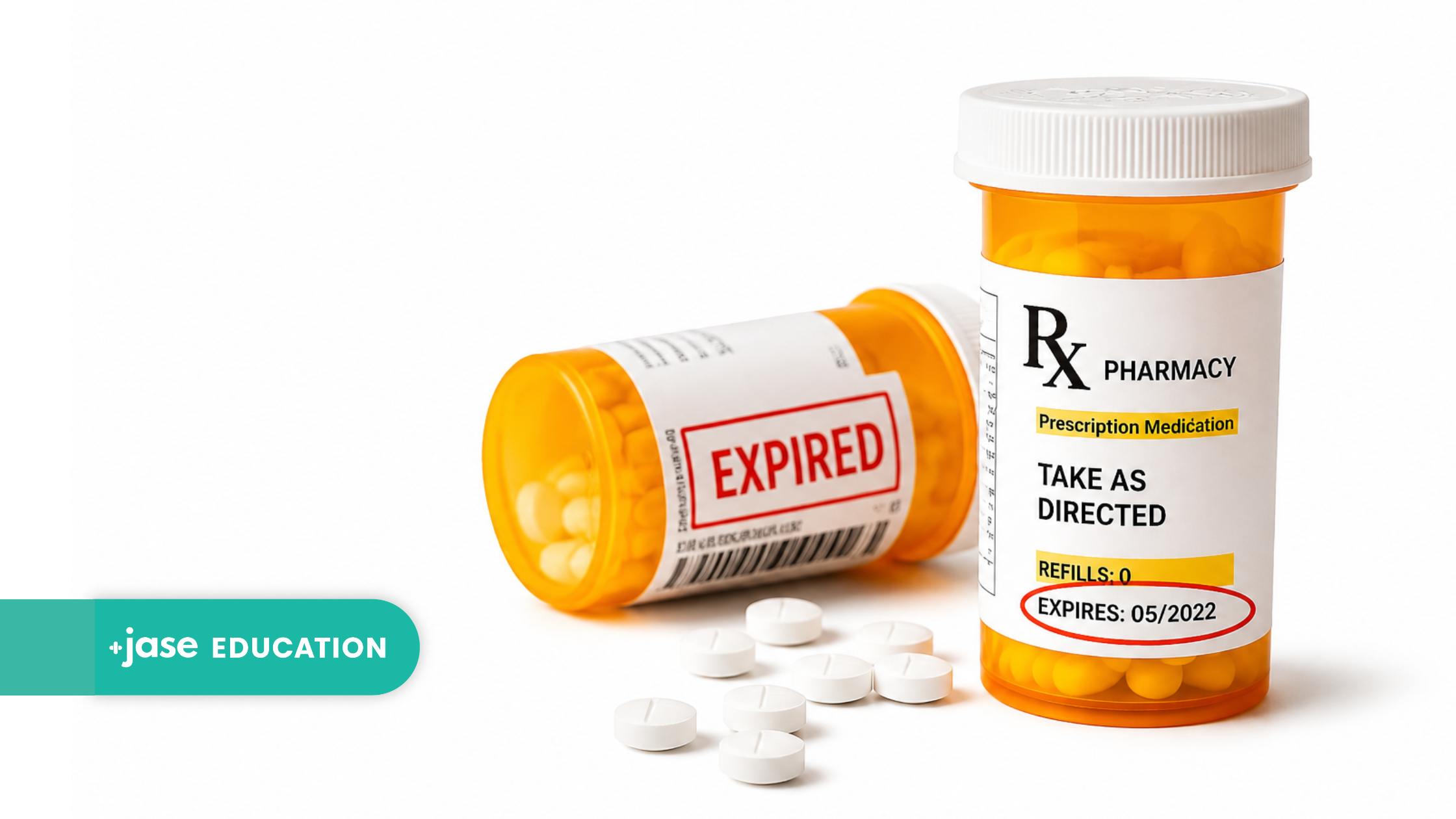
Why Expiration Dates Matter for Your Medication Supply

Why Expiration Dates Matter for Your Medication Supply

By Cayla McGrath

Consumer notice: A note on expiration dates. This article discusses published research on drug stability, including the FDA and Department of Defense Shelf Life Extension Program (SLEP). SLEP applies to federal stockpiles held under controlled, monitored storage and tested lot by lot. It does not apply to medications stored at home, and its findings do not extend the expiration date of any medication you own. FDA’s guidance to consumers is that expired medications should not be used. Jase Medical follows the manufacturer’s printed expiration date on every medication we dispense. Replace medications when they expire, and dispose of the expired supply following FDA’s disposal guidance.

If you’ve ever stood in front of your medicine cabinet holding a bottle a year past the printed date, you’ve heard two kinds of advice: “it’s probably fine” and “throw it out, it might be toxic.” The useful answer is simpler than either: replace it. Here is why the date matters, and how storage protects your medication until then.


What the expiration date means

The date on a medication bottle is the manufacturer’s commitment: the drug holds at least 90% of its labeled potency under the specified storage conditions up to that date. After that date, the manufacturer makes no guarantee, and there is no way to check a bottle at home.

What the stockpile research shows, and what it doesn’t

The most cited stability research comes from the FDA and Department of Defense Shelf Life Extension Program (SLEP), which tests medications held in federal stockpiles. Those stockpiles sit in climate-controlled warehouses under continuous monitoring, and each lot is tested before its dating is extended. FDA scientists who analyzed the program found wide variation between drugs and between lots of the same drug.

That is why SLEP results apply only to the specific lots tested. A bottle at home has none of those controls, and nobody can tell from looking at it whether it would have passed. FDA’s guidance to consumers is direct: don’t use expired medication.

How medications differ

Medications differ in how sensitive they are to heat, light, and moisture. Knowing which category a medication falls into tells you how to store it and which to replace first as expiration dates come due.

Tablets and capsules, such as ibuprofen, acetaminophen, and most antibiotics in pill form, are the most stable form when kept cool and dry, away from the bathroom.

Liquids, suspensions, and mixed medications are less stable. An amoxicillin suspension, once mixed, is labeled for 14 days. Liquid antibiotics, eye drops, and oral suspensions are not long-term supply items.

Narrow-window and refrigerated medications need the most care. Small potency changes matter clinically, and insulin stored improperly becomes unreliable. Follow their storage instructions exactly.

Storage is what you control

The bathroom medicine cabinet is one of the worst places in your home, with humidity and temperature swings from every shower. A cool, dry closet shelf is better, and an airtight container is better still.

Replace these right away, even before their printed date: mixed liquid suspensions, anything stored in heat or humidity, refrigerated items that may have warmed, and anything with visible changes such as discoloration, odor, or clumping. Replace everything else by its labeled expiration date.

Every Jase kit ships with storage guidance. A JaseCase stored properly and replaced at its labeled expiration dates gives you what you need when you need it. Jase offers refills for expired kit medications.

Learn more at jase.com/

Closing note: When a medication reaches its expiration date, replace it. Dispose of the expired supply following FDA’s guidance on expired medicines.


Cayla McGrath is a content strategist with Jase Medical. This post is for informational purposes only and does not constitute medical advice. Always consult a licensed healthcare provider before using any prescription medication.


Lifesaving Solutions

Everyone should be empowered to care for themselves and their loved ones during the unexpected. Check out our recent lifesaving products today.

Recent Posts

Keeping you informed and safe.

Pink Eye: When You Actually Need Antibiotic Eye Drops

Pink Eye: When You Actually Need Antibiotic Eye Drops

Pink Eye: When You Actually Need Antibiotic Eye Drops By the Jase Medical Team It’s Monday morning, and your child wakes up with one eye crusted shut. You clean it up, get everyone out the door, and hope for the best. By 9:15, the school calls. Your child has pink...

read more
Controlled Substances in a Disaster

Controlled Substances in a Disaster

Controlled Substances in a Disaster: Why the Schedule on Your Prescription Changes Everything By the Jase Medical Team ou evacuated with four days of medication in your bag. Now you're two states from home, the pharmacy holding your prescription is closed, and you're...

read more

Join Our Newsletter

Our mission is to help you be more medically prepared. Join our newsletter and follow us on social media for health and safety tips each week!

Power Outages are Getting Longer. Your Medication Plan Hasn’t Caught Up.

Power Outages Are Getting Longer.

Your Medication Plan Hasn’t Caught Up.

By Cayla McGrath

Most households’ mental model for a power outage goes something like this: the lights go out, the fridge holds for a few hours, the power comes back before anything important happens.

That mental model was built for a different era of outages.

Across the West, utilities have been quietly changing how they handle faults on the grid. In wildfire-prone areas, automatic reclosers that used to snap a line back on within seconds have been disabled. The logic is sound: re-energizing a line into dry brush is exactly how a small fault becomes a fire. So when a line goes down, a crew has to physically drive out, inspect the circuit, and clear it before power is restored. What used to be a three-second blip becomes a half-day outage. A real fault becomes days. Xcel’s shutoffs on the Colorado Front Range in December 2025 lasted days, not hours. Storms and grid strain are producing the same result in places that have never heard the term Red Flag.

For most households, a longer outage is an inconvenience. For a household where someone is managing temperature-sensitive medications, home oxygen, or a CPAP machine, the gap between “a few hours” and “a few days” is the gap between fine and a real problem. And that gap is quietly widening.

Here’s what every household should have in place before the next one.


Ask your pharmacist one specific question — and write down the answer

The most common piece of advice about medications and power outages is “keep them refrigerated.” That’s not actually useful guidance when the power is out.

The useful question is: how long is my specific medication safe at room temperature? Ask your pharmacist and write down the answer — it’s product-specific. The FDA guidance for insulin is that open vials and cartridges can be kept at room temperature — defined as 59–86°F — for up to 28 days for most products. But that assumes room temperature, not a house that’s warming up in July. And a pump reservoir, because insulin is exposed to body heat, has a much shorter window — typically around 48 hours. These numbers are product-specific and won’t show up in a general preparedness article. Your pharmacist has them.

The other thing to know: never freeze insulin. Freezing degrades insulin permanently and a vial that’s been frozen looks completely normal — there’s no visible change.

If someone in your household depends on a powered medical device, this conversation cannot wait

Home oxygen concentrators, ventilators, CPAP and BiPAP machines all run on electricity, and “the power is out” is not an acceptable answer if the device is life-sustaining.

If someone in your household depends on any of these devices, contact your equipment supplier before the next outage — not during it. Most home medical equipment suppliers have emergency backup plans that customers can set up in advance: backup battery systems, non-electric alternatives for oxygen, documentation for priority utility restoration. These plans require paperwork and sometimes lead time. A Sunday night outage is not when to find out they exist.

Enroll in your utility’s medical-baseline program

Your utility company almost certainly has a medical-baseline program that qualifies households with electricity-dependent medical needs for lower rates, priority notification during planned outages, and in some cases priority restoration. Enrollment requires a clinician to sign a form certifying the medical need. It takes a few minutes to request, and once it’s done, it’s in place for every outage that follows.

The HHS emPOWER program maintains a public database of electricity-dependent Medicare beneficiaries — over 4.6 million households across the US — and uses it to coordinate emergency response when outages happen at scale. Your local utility program is the household-level equivalent.

Keep a buffer supply and a written medication list

A 7-to-30-day supply of critical medications means that a several-day outage doesn’t immediately become a medication crisis. A written list — drug name, dose, prescriber, pharmacy — means that if you need emergency dispensing, you have the documentation to make it work. During a declared emergency, pharmacists in most states can dispense Schedule III through V medications without a new prescription, typically up to 30 days. That authority exists and pharmacists use it — but it requires documentation. For up to a 12-month supply of your chronic daily medication, check out JaseDaily. 

Where the JaseCase fits

The JaseCase is not a refrigerator substitute. What it covers is the second problem that can develop during a prolonged disruption: the acute infection that starts when healthcare access is interrupted. A UTI on day three of an outage. An ear infection when the pediatrician’s office isn’t taking same-day calls. A skin infection that needs treatment before it spreads.

The JaseCase is the contingency layer for those moments — a physician-prescribed, guidebook-supported supply of antibiotics for defined, common conditions, with Jase telehealth as the backstop when your regular provider isn’t reachable.

Learn more at jase.com/


Cayla McGrath is a content strategist with Jase Medical. This post is for informational purposes only and does not constitute medical advice. Always consult a licensed healthcare provider before using any prescription medication.


Lifesaving Solutions

Everyone should be empowered to care for themselves and their loved ones during the unexpected. Check out our recent lifesaving products today.

Recent Posts

Keeping you informed and safe.

Pink Eye: When You Actually Need Antibiotic Eye Drops

Pink Eye: When You Actually Need Antibiotic Eye Drops

Pink Eye: When You Actually Need Antibiotic Eye Drops By the Jase Medical Team It’s Monday morning, and your child wakes up with one eye crusted shut. You clean it up, get everyone out the door, and hope for the best. By 9:15, the school calls. Your child has pink...

read more
Controlled Substances in a Disaster

Controlled Substances in a Disaster

Controlled Substances in a Disaster: Why the Schedule on Your Prescription Changes Everything By the Jase Medical Team ou evacuated with four days of medication in your bag. Now you're two states from home, the pharmacy holding your prescription is closed, and you're...

read more

Join Our Newsletter

Our mission is to help you be more medically prepared. Join our newsletter and follow us on social media for health and safety tips each week!