
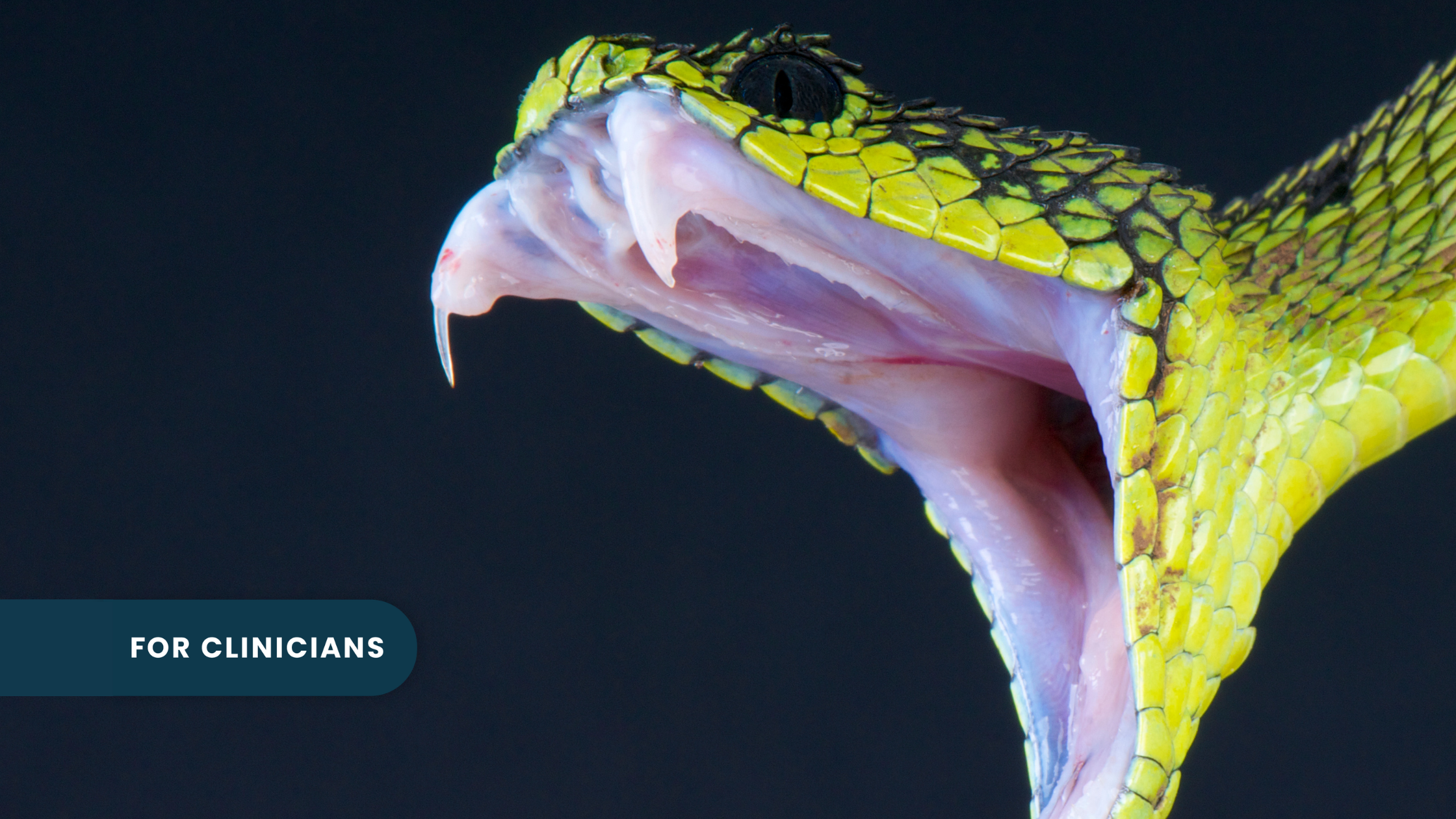
For Clinicians | Should You Suck Out Snake Venom? The Snakebite Myths Your Patients Still Believe
By Dr. Jamie Wilkey, PharmD, Director of Clinical Education
Medically reviewed and edited by Aaron Asay, PA-C, DMSc, FIBODM, FAWM
I really love gathering my little boys with me on the couch under a cozy blanket and watching the Disney show Something Bit Me! Snakebite might be the most mythologized emergency in first aid. Everyone seems to know what to do… and almost all of it is wildly wrong. The snakebite episodes keep proving the same thing: the wrong advice gets carried out where nobody can check it, miles from care, scared, with no cell signal. Today we’re covering the big snakebite myths, why each one fails, and what to tell our patients before a trip that keeps a bad bite from getting way, way, way worse.
One quick note before we start: everything here is about native North American pit vipers (rattlesnakes, copperheads, and cottonmouths). Coral snakes, exotic snakes, and bites outside the U.S. and Canada can need different management¹.
What happens when snakebite first aid goes wrong?
Season 1, Episode 8, “No Time to be Terrified,” is the one I still probably think about every day after watching it². A couple is hiking in California, 6 miles from the trailhead with no cell service, when a rattlesnake bites him through his shoe before he even sees it. The bite doesn’t look that bad. Then they do everything wrong, in order, like a slapstick comedy except it’s real life.
First, a tourniquet on his leg so the blood stops flowing up. Then they try to suck the venom out of his sweaty foot. (Thankfully, nobody had a knife for the famous X.) Then he runs for help on the bitten foot.
By the time he reached a hospital multiple hours later he’d need more than 100 vials of antivenom for his treatment over the next few days. The hospitals in the area ran out, and more had to be flown in from other hospitals. A bite that didn’t look that bad became a life-threatening injury.
And I have to admit, watching these freaky episodes I couldn’t always tell if they were doing the right thing. As a pharmacist I know antivenom needs to happen as soon as possible, but as for the first aid, I probably would have made the same mistakes! So this article is good advice for me too, since I hike with my dog daily in the Utah foothills, which have their fair share of rattlesnakes.
If a pharmacist on the couch can’t call it, our patients on the trail can’t either. Every move that couple made came from a movie or a campfire story, and our patients carry the same list into the backcountry.
Sucking out the venom + other myths
Here’s a list of the biggest snakebite myths and what’s inherently wrong with each one.
- Cutting an X over the bite. It removes nothing and adds a second wound on top of a venom that can already cause bleeding³.
- Sucking the venom out. It barely pulls anything out. In a human model using mock venom, a commercial suction extractor recovered 0.04% of the injected load⁴. Just say no.
- A tourniquet or tight band. Cutting off blood flow traps the venom in the limb and starves the tissue around it, and tourniquets can lead to gangrene and amputation⁵. Doing that is really hurting the limb you are trying so hard to save. The 2026 Wilderness Medical Society (WMS) guideline is clear: don’t apply one¹.
- Pressure immobilization. Some of us learned this snug elastic wrap from snakebite protocols in other parts of the world, like Australia. It was designed for different snakes with different venom, and it’s not recommended for North American pit vipers¹.
- Running for help. Venom from a bite on an arm or leg travels mostly through the lymphatic system, and working muscles pump lymph toward the rest of the body⁵. Every step on a bitten foot moves the venom along faster. When there’s any choice, being carried, driven, or flown out beats walking¹.
- Ice. It’s on the CDC’s “don’t do” list too³, and the WMS guideline lumps cold therapy in with the other techniques that can cause harm¹. Cold adds injury to tissue that the venom is already damaging.
- “It doesn’t look bad, so it’s probably a dry bite.” Some bites are dry, but it is impossible to tell from the wound itself. Lack of initial symptoms doesn’t mean that no venom was injected, and a bite with little early swelling can still progress over the next several hours¹. The CDC’s guidance is blunt: don’t wait for symptoms to appear to get help³.
Meds for a snake bite
Now here’s a pharmacy question I can answer! Can you take ibuprofen for the pain? Not on the trail. The CDC puts aspirin, ibuprofen, and naproxen on its snakebite don’t-take list³. Pit viper venom can already lower platelets and interfere with clotting¹, and an NSAID stacks more bleeding risk on top of it. The 2026 WMS guideline does add one bit of nuance: NSAIDs may be used cautiously for some copperhead bites when there’s no clotting problem and bleeding risk is low¹. But on a trail, nobody knows the species or the clotting status yet, so skip them.
Antibiotics are the other reflex, especially for anyone who’s read our bite-and-scratch article, where some animal bites do need them. A snakebite isn’t a dog bite. In a study of 2,748 rattlesnake bite patients, fewer than 1% developed an infection, and the authors concluded prophylactic antibiotics aren’t needed⁶. The WMS guideline agrees: save antibiotics for signs of infection. The exception is a wound that’s heavily contaminated or has been cut or tampered with by bad first aid¹. (One more reason to skip the X!)
Nothing in a home medical kit treats envenomation. Every medication in a JaseCase is prescribed after a licensed provider reviews the request, and it’s for emergency use only, after first seeking help from a qualified healthcare provider. For a snakebite, that help is antivenom, and only a hospital has it¹.
What actually helps after a snakebite?
Less than most people expect. Every myth above is a big, dramatic move, and every one makes the bite worse. This is a rare emergency where doing less helps you more! The boring, simple stuff, like sitting still and slipping off a ring, is the help. The WMS guideline’s field priority is getting the patient to definitive care promptly and safely¹, and first aid should never delay that. If the patient has trouble breathing, signs of anaphylaxis, or shock, treat those first while help is on the way.
What helps on the way:
- Call 911, or Poison Help at 1-800-222-1222, as soon as there’s signal. Poison centers can also help figure out which hospital should take the patient¹.
- Keep calm and keep the bitten limb still, loosely splinted at about heart level¹.
- Take off rings, watches, and anything tight before swelling starts³.
- Clean the bite with soap and water, cover it with a clean, dry dressing, and mark the edge of the swelling with the time¹,³. Re-mark it as it spreads.
- For clinicians with the training and gear: start IV or IO access in an unaffected limb¹.
For the clinicians: what to watch for
Don’t judge severity by the fang marks. Watch for spreading pain, swelling, redness, or bruising, and for systemic signs like low blood pressure, vomiting, neurologic changes, trouble breathing, or bleeding. Low platelets and clotting abnormalities can’t be checked in the field, which is one more reason a patient who looks fine still needs to get out¹.
At definitive care, expect serial exams and labs including a CBC with platelets, a basic metabolic panel, PT/INR, and fibrinogen. When there’s progressive swelling, systemic toxicity, or a clotting problem, the 2026 guideline favors giving antivenom early, ideally within 6 hours of the bite, though it can still help later¹.
Six miles in with no signal
Six miles in with no signal, there’s no perfect option. The WMS guideline says to use the safest and most efficient way to get the patient to definitive care¹. If walking out is the only way, the less exertion the better.
That couple’s story has one more lesson: the nearest hospital may not have enough antivenom. The guideline recommends consulting poison control or a toxicologist, and poison control can help coordinate getting antivenom sent from another facility¹.
What to tell patients before the trip
On the trail, care is all or none. Either the patient reaches an ER, or they’re on their own. The middle layer is getting care before the situation that needs it: a clinician’s guidance ahead of time, and for the conditions that allow it, an emergency supply prescribed after a provider’s review, for emergency use only after first seeking qualified care. For snakebite, there’s almost nothing physical to prepare ahead of time except knowledge (and choosing good hiking boots instead of tennis shoes). For this one, the preparation is the conversation, and the minute to have it is when a patient mentions a hike, a hunting trip, or a cabin weekend.
That minute is what appropriate medical preparation looks like for a snakebite, and part of it is knowing what a kit can’t do. We’re here for the times primary care isn’t there, and in no way a replacement for it. If you’d rather refer patients who want a trip-ready kit, you can send them to us at jase.com, where a licensed provider reviews every request before anything is prescribed. And we’ll keep publishing the clinical frameworks behind decisions like these.
The bottom line
Snakebite first aid is mostly about what not to do. The couple in that episode did everything they’d ever heard of, and almost every move made the bite worse. I think we remember sensational things like cutting an X over a snakebite and sucking out venom way better than other first aid tips. That, combined with feeling like we aren’t doing enough if we don’t do much in an emergency like a snakebite, keeps these myths alive. Well, that and Hollywood’s portrayal of snakebites!
Our patients deserve to be better prepared in their active lives than a campfire story. The best time is before the trip, likely in our office or pharmacy.
Sources
- Brandehoff N, Greene S, Benjamin J, et al. Wilderness Medical Society clinical practice guidelines for the treatment of pit viper envenomations in the United States and Canada: 2026 update. Wilderness Environ Med. Published online May 30, 2026. doi:10.1177/10806032261451823. https://journals.sagepub.com/doi/10.1177/10806032261451823
- Something Bit Me!, Season 1, Episode 8, “No Time to be Terrified.” National Geographic WILD, 2022. https://www.imdb.com/title/tt18339292/
- Centers for Disease Control and Prevention, NIOSH. Venomous Snakes at Work. Accessed September 2026. https://www.cdc.gov/niosh/outdoor-workers/about/venomous-snakes.html
- Alberts MB, Shalit M, LoGalbo F. Suction for venomous snakebite: a study of “mock venom” extraction in a human model. Ann Emerg Med. 2004;43(2):181-186. https://www.sciencedirect.com/science/article/abs/pii/S0196064403008138
- Parker-Cote J, Meggs WJ. First aid and pre-hospital management of venomous snakebites. Trop Med Infect Dis. 2018;3(2):45. https://pmc.ncbi.nlm.nih.gov/articles/PMC6073535/
- August JA, Boesen KJ, Hurst NB, Shirazi FM, Klotz SA. Prophylactic antibiotics are not needed following rattlesnake bites. Am J Med. 2018;131(11):1367-1371. https://www.sciencedirect.com/science/article/abs/pii/S0002934318305552
Lifesaving Solutions
Recent Posts
Keeping you informed and safe.
For Clinicians | Burn First Aid Without Running Water
For Clinicians | Burn First Aid Without Running Water By Dr. Jamie Wilkey, PharmD, Director of Clinical EducationMedically reviewed and edited by Aaron Asay, PA-C, DMSc, FIBODM, FAWM Every burn first-aid guide starts the same way: cool it under running water. That's...
What to Do If You’re Bitten by a Snake?
What to Do If You're Bitten by a Snake: Forget What the Movies Taught You By the Jase Medical Team If you're bitten by a venomous snake, forget almost everything the movies taught you about snakebite first aid. Don't cut an X over the fang marks. Don't suck out the...

How to Rehydrate Someone Properly When There Is No IV
How to Rehydrate Someone Properly When There Is No IV By the Jase Medical Team When someone is losing fluid from vomiting or diarrhea, rehydration isn't simply a matter of getting them to drink something. The type of fluid matters. The amount matters. And especially...
For Clinicians | Oral Rehydration When IV Fluids Aren’t Available
For Clinicians | Oral Rehydration When IV Fluids Aren't Available By Dr. Jamie Wilkey, PharmD, Director of Clinical EducationMedically reviewed and edited by Kristen Carpenter, PA-C Hi again, it's Jamie, your pharmacist who loves writing about appropriate medical...