
What to Do If Someone Is Choking: The New 2025 First Aid Guidelines
By the Jase Medical Team
Choking first aid changed in 2025. If an adult or child is severely choking, the American Heart Association now recommends starting with five back blows, followed by five abdominal thrusts.
If you learned the Heimlich maneuver years ago, that’s an important update worth knowing.
Imagine Thanksgiving dinner at your house. The family is gathered around the table, grandchildren are playing nearby, and someone has set a bowl of snacks within reach of the youngest kids.
Suddenly, a child goes quiet. They’re struggling to breathe, and no sound is coming out.
Would you know what to do?
Choking can become life-threatening within minutes. But recognizing the warning signs and knowing the right first aid steps can make a lifesaving difference before emergency responders arrive.
How Do You Know If Someone Is Really Choking?
Not every coughing episode requires emergency intervention.
If someone is coughing forcefully, speaking, crying, or making sounds, air is still moving through their airway.
If they can cough effectively, encourage them to keep coughing and watch closely.
Don’t immediately begin back blows or abdominal thrusts if they’re able to breathe and cough effectively. Those actions are intended for severe airway obstruction.
Signs of severe choking include:
- Being unable to speak, cry, or make sounds.
- Being unable to breathe or cough effectively.
- Making little or no sound while attempting to breathe.
- Clutching the throat, particularly in older children and adults.
- Developing bluish or grayish skin color as oxygen levels fall.
If someone cannot breathe, speak, or cough effectively, act immediately.
What Are the New Choking First Aid Steps for Adults and Children?
The American Heart Association’s 2025 resuscitation guidelines recommend alternating five back blows and five abdominal thrusts for a conscious adult or child older than one year who has severe choking.
Here’s the basic sequence:
- Give five back blows. Stand to the side and slightly behind the person, support their chest, and deliver five firm blows between the shoulder blades using the heel of your hand.
- Give five abdominal thrusts. Stand behind the person, place a fist just above the belly button, grasp it with your other hand, and deliver five quick inward and upward thrusts.
- Repeat the sequence. Continue alternating five back blows and five abdominal thrusts until the object comes out or the person becomes unresponsive.
Have someone call 911 immediately. If you’re alone, activate emergency services as soon as possible, ideally using your phone’s speaker function while providing assistance.
For someone who is pregnant or whose body size makes abdominal thrusts impractical, chest thrusts are used instead.
If the person becomes unresponsive, lower them carefully to a firm, flat surface and begin CPR, starting with chest compressions. Follow the emergency dispatcher’s instructions and use an AED if available.
These steps are worth learning in a hands-on class so you can practice the correct technique and positioning.
How to Help a Choking Baby Under One Year Old
Choking looks different in infants, and the first aid technique is different, too.
A baby can’t tell you that something is stuck in their throat. They may suddenly become quiet, struggle to cry, drool, or reach toward a caregiver.
Their skin may begin to change color if they’re not getting enough oxygen.
Never perform abdominal thrusts on a baby younger than one year.
For a conscious infant with severe choking, the recommended sequence is:
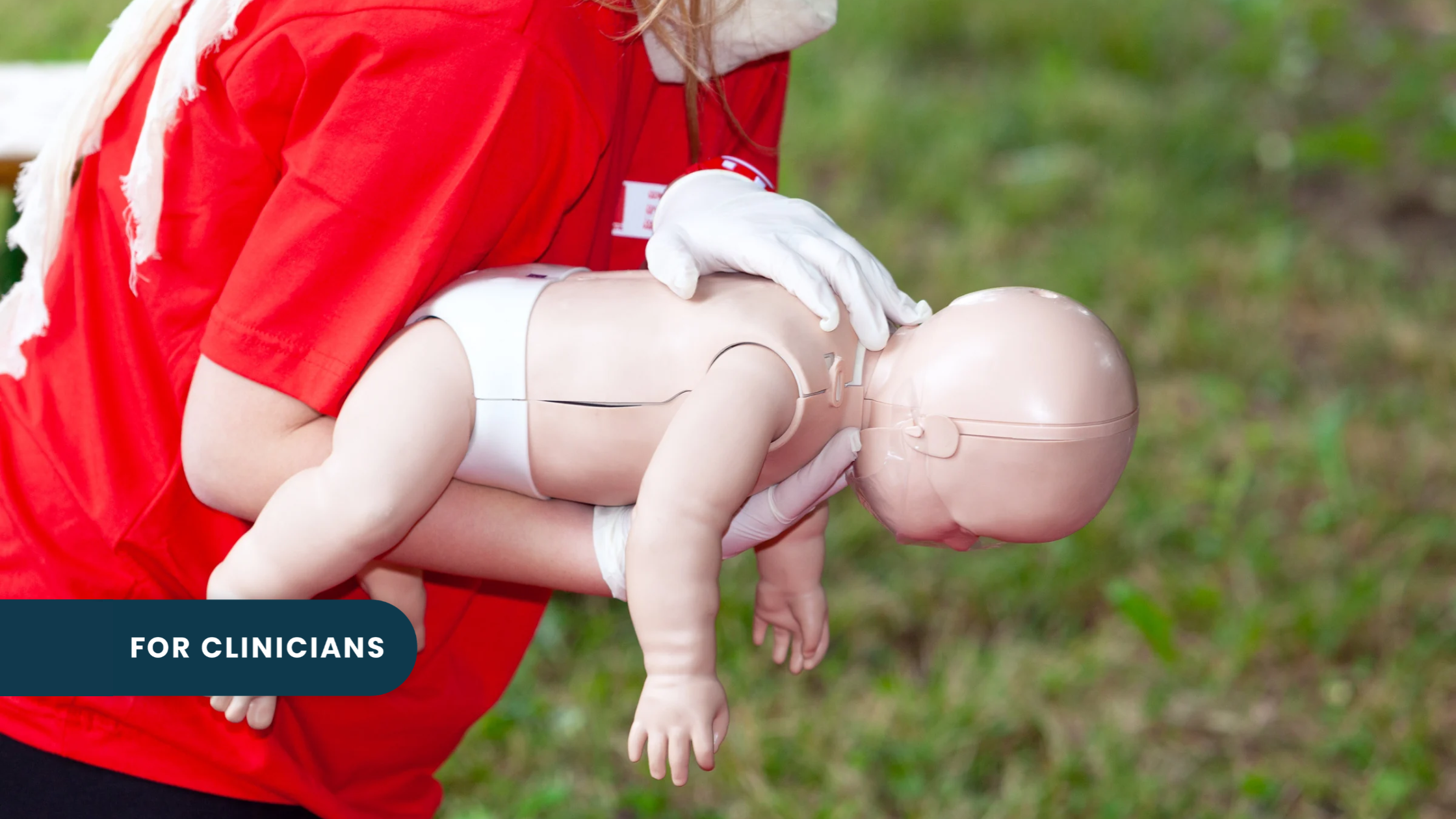
- Give five back blows. Support the baby’s head and neck while holding them face down along your forearm, with their head lower than their body. Deliver five firm blows between the shoulder blades using the heel of your hand.
- Give five chest thrusts. Carefully turn the baby face up while supporting the head and neck, keeping the head lower than the body. Use the heel of one hand to deliver five chest thrusts over the center of the chest, on the lower half of the breastbone.
- Repeat until the object comes out or the baby becomes unresponsive. Have someone call 911 immediately, or activate emergency services yourself as soon as possible.
If the baby becomes unresponsive, begin infant CPR and follow emergency dispatcher instructions.
The distinction to remember: Adults and children receive back blows and abdominal thrusts. Babies receive back blows and chest thrusts.
A Neighborhood Emergency That Made This Personal
For Aaron Asay, a longtime firefighter and disaster responder, choking isn’t simply a scenario from a training manual.
In his Off Duty Part V: Choking article, Aaron recounts an emergency involving a nine-month-old baby in his neighborhood who choked after an older sibling gave him a cheese puff.
It’s the kind of ordinary family moment that can turn frightening in seconds.
Small children are naturally curious, and older siblings often want to share their favorite snacks. But foods that seem harmless to an older child can create a choking hazard for a baby.
Aaron’s experience reinforces why choking first aid is something every parent, grandparent, babysitter, and caregiver should know.
You may never expect to use these skills, but when an emergency happens, there may not be time to look up the instructions.
One Thing You Should Never Do: Blind Finger Sweeps
When someone is choking, your instinct may be to reach into their mouth and try to pull out whatever is stuck.
But never blindly sweep your finger inside someone’s mouth.
Doing so can push the object deeper into the airway and make the obstruction worse.
If an object is clearly visible and can be safely removed, it may be appropriate to remove it. Otherwise, continue the recommended choking first aid steps.
This rule is especially important for babies and young children.
What About Anti-Choking Suction Devices?
You may have seen anti-choking suction devices advertised online or kept in family kitchens.
These devices are intended to help remove airway obstructions using suction.
In 2026, the FDA authorized a specific anti-choking suction device for certain patients, but its role is limited.
These devices are not a replacement for established choking first aid.
An authorized device is intended for use only when recommended back blows and thrusts have failed, and it must be used according to its specific instructions and age restrictions.
The authorization does not extend to babies under one year old.
For families, the most important preparation remains learning and practicing standard choking first aid.
Don’t delay back blows, thrusts, CPR, or calling emergency services while searching for a suction device.
Preventing Choking During Holiday Gatherings
Thanksgiving and other holiday celebrations often bring together several generations, busy kitchens, and plenty of food.
A few simple precautions can help reduce choking risks:
- Keep small snacks, hard candies, nuts, and other choking hazards out of reach of babies and toddlers.
- Make sure young children are seated and supervised while eating.
- Prepare foods in shapes and textures appropriate for each child’s age and developmental abilities.
- Encourage everyone to slow down, chew thoroughly, and avoid talking or laughing with a mouthful of food.
- Know which adults at the gathering have current CPR and first aid training.
Prevention matters, but even careful families can encounter unexpected emergencies.
That’s why knowing how to respond is just as important.
The Most Valuable First Aid Skill Is One You’ve Practiced
At Jase Medical, our family team of doctors, physician assistants, and pharmacists believes appropriate medical preparation includes knowing what to do when someone’s life is at risk.
The 2025 choking guideline update is a reminder that even familiar first aid skills can change as medical evidence evolves.
If your last CPR class was several years ago, now is a good time for a refresher.
Consider a hands-on first aid and CPR course through the American Heart Association or American Red Cross, particularly one that includes both adult and infant choking response.
You don’t need to be a medical professional to help save a life. But you do need to know what to do, and practicing ahead of time makes all the difference.
This holiday season, as your family gathers around the table, take a moment to make sure the people you love know the new choking first aid steps.
Because the best time to learn how to respond is long before anyone needs your help.
Medical disclaimer: This article provides general educational information and does not replace hands-on first aid training or emergency medical care. Call 911 or your local emergency number for severe choking and follow dispatcher instructions. First aid techniques differ by age, pregnancy status, and individual circumstances. Anyone who has experienced a serious choking episode should receive appropriate medical evaluation, especially if symptoms persist or abdominal thrusts were required.
Lifesaving Solutions
Recent Posts
Keeping you informed and safe.

Who Do You Help First in an Emergency? How to Prioritize Injuries When Every Second Counts
Who Do You Help First in an Emergency? How to Prioritize Injuries When Every Second Counts By the Jase Medical Team When two people are injured in an emergency, who should you help first? Start by checking the person who is quiet, unresponsive, or struggling to...

For Clinicians | Emergency Priorities: How First Responders Decide What Injuries to Manage First
For Clinicians | Emergency Priorities: How First Responders Decide What Injuries to Manage First Off Duty Series: Part 4 of 6 By Aaron Asay, PA-C, DMSc, FIBODM, FAWMMedically reviewed and edited by Dr. Jamie Wilkey, PharmD Off Duty is a six-part series on the...

Is It Safe to Help? What to Check First in an Emergency
Is It Safe to Help? What to Check First in an Emergency By the Jase Medical Team You see someone fall from a ladder. Or you're the first person to stop at a roadside accident. Maybe a family member suddenly collapses during a holiday gathering. Your first instinct is...

For Clinicians | Seeing the Emergency: Scene Safety and Triage
For Clinicians | Seeing the Emergency: Scene Safety and Triage Off Duty Series: Part 3 of 6 By Aaron Asay, PA-C, DMSc, FIBODM, FAWMMedically reviewed and edited by Dr. Jamie Wilkey, PharmD Off Duty is a six-part series on the emergencies clinicians end up handling...