
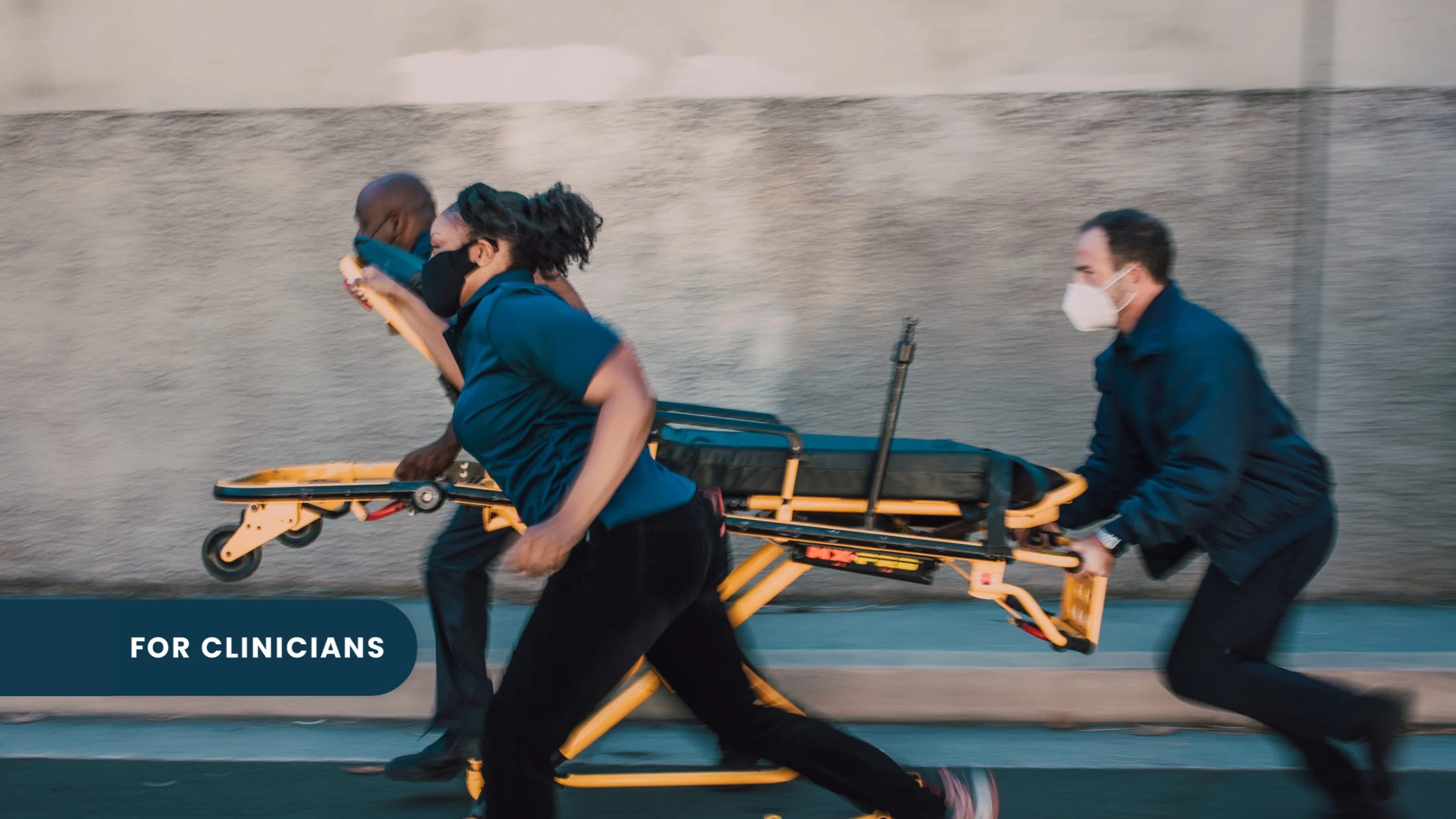
For Clinicians | Seeing the Emergency: Scene Safety and Triage
Off Duty Series: Part 3 of 6
By Aaron Asay, PA-C, DMSc, FIBODM, FAWM
Medically reviewed and edited by Dr. Jamie Wilkey, PharmD
Off Duty is a six-part series on the emergencies clinicians end up handling outside of work: a call from family overseas, a car crash, a choking baby, a bad bleed. Aaron Asay has spent his career in emergency, disaster, and austere medicine. Part 3 is about the minute before anyone touches the patient: whether the scene is safe, and who needs help first.
One of the most important skills a first responder can develop has nothing to do with tourniquets, CPR, or medical equipment.
It is learning to see the emergency.
When I worked as a firefighter, we were often dispatched to emergencies with very little information about what we were actually going to find. Dispatchers did their best to relay information provided by callers, but that information was often incomplete, inaccurate, or misunderstood by frightened witnesses trying to explain a chaotic situation.
One call in particular has stayed with me.
We were dispatched to a report of a person down. Arriving on scene, I saw an unresponsive individual lying on the ground. My immediate instinct was to run over and help. Before I could reach the patient, my captain stopped me.
The patient was lying in a pool of water.
What I had not recognized was that the water had become electrically energized. Had I stepped into it or touched the patient, I likely would have been injured as well. In rescue work there is an old saying: don’t become a victim. That lesson applies just as much to community responders as it does to firefighters, paramedics, and police officers. The first priority in any emergency is not rendering aid. It is determining whether the scene is safe enough to approach.
A victim who has fallen from a ladder may still be under live power lines. A vehicle crash may have leaking fuel or oncoming traffic. A person who appears injured may be located in an unstable structure, near a dangerous animal, or in an area affected by violence. While the desire to help is admirable, the ability to pause, assess, and recognize danger is what makes helping possible.
Before you can save a life, you must learn to see the emergency clearly. The first question may be, “What happened?” The very next question should be, “What can hurt me if I help?“
Emergency Priorities
Once you have determined that a scene is reasonably safe to approach, your attention shifts to the patient. This is where many people make their second mistake. They focus on the most obvious injury rather than the most dangerous one.
A broken arm may look dramatic. A bit of dark red blood on a light shirt can draw immediate attention. Someone yelling in pain often becomes the center of focus. Yet the patient who is most likely to die may be the one sitting quietly in the corner, struggling to breathe. It may be the person with severe internal bleeding and only a few visible signs of injury. It may be the unresponsive patient who is no longer protecting their airway.
One of the first lessons taught to emergency responders is triage. The term comes from a French word meaning “to sort.” In a disaster or emergency, responders must quickly determine who needs help first and what problem poses the greatest immediate threat to life.
The same principle applies whether there is one patient or twenty. The goal is not to diagnose every injury. The goal is to identify the conditions that kill people quickly.
As a community responder, there are four life threats that deserve your immediate attention:
- Massive bleeding
- Airway obstruction
- Cardiac arrest
- Exposure and hypothermia
These conditions can turn a survivable injury into a fatal one within minutes. Fortunately, they are also conditions where early recognition and simple interventions can make an enormous difference.
Before you learn how to treat these problems, you must first learn how to recognize them.
Most people look at a patient and see injuries. Skilled responders look at a patient and see priorities.
The 30-Second Assessment
When emergency personnel arrive on scene, they do not immediately begin treatment. They begin by gathering information. The good news is that you do not need advanced medical training to identify many life-threatening problems. In fact, a simple thirty-second assessment can reveal most of the conditions that demand immediate attention.
Start by observing before touching the patient.
- Can they walk?
- Can they talk?
- Can they follow simple instructions?
Someone who is walking and speaking is unlikely to be suffering from an immediate airway obstruction or cardiac arrest. They may still have serious injuries, but they have already told you something important about their condition¹.
Next, look for obvious signs of severe bleeding.
- Is blood pooling on the ground?
- Is clothing soaked with blood?
- Is there active bleeding that requires immediate action?
Then assess breathing.
- Is the person speaking normally?
- Are they struggling for air?
- Do you hear gurgling, choking, or abnormal breathing sounds?
Finally, consider their overall appearance.
- Are they alert? Confused?
- Pale?
- Sweating?
- Shivering?
- Do they appear to be getting better or worse?
You are not trying to make a diagnosis. You are looking for clues that identify immediate threats to life.
A useful principle is to focus on what can kill in minutes rather than what can wait for hours.
– A broken finger can wait.
– A blocked airway cannot.
– A painful ankle injury can wait.
Massive bleeding cannot.
The ability to quickly identify priorities is what separates panic from purposeful action. bIn a following article, we will look at how responders put those threats in order, starting with the first and most preventable cause of death in trauma: massive bleeding²,³.
Adapted from an article Aaron first published on his Substack, The HoboMed Field Journal, in June 2026.
Sources
- Chemical Hazards Emergency Medical Management (CHEMM). START Adult Triage Algorithm. US Department of Health and Human Services, Administration for Strategic Preparedness and Response. https://chemm.hhs.gov/incident-primer/triage/start-triage
- Davis JS, Satahoo SS, Butler FK, et al. An analysis of prehospital deaths: who can we save? J Trauma Acute Care Surg. 2014;77(2):213-218. https://pubmed.ncbi.nlm.nih.gov/25058244/
- Eastridge BJ, Mabry RL, Seguin P, et al. Death on the battlefield (2001-2011): implications for the future of combat casualty care. J Trauma Acute Care Surg. 2012;73(6 Suppl 5):S431-S437. https://pubmed.ncbi.nlm.nih.gov/23192066/
Lifesaving Solutions
Recent Posts
Keeping you informed and safe.
What to Do Before the Ambulance Arrives: Four First Aid Skills That Could Save a Life
What to Do Before the Ambulance Arrives: Four First Aid Skills That Could Save a Life By the Jase Medical Team The first few minutes of a medical emergency can change everything. And the person who makes the biggest difference before an ambulance arrives might not be...
For Clinicians | The First Hour: An Introduction to Community Crisis First Aid
For Clinicians | The First Hour: An Introduction to Community Crisis First Aid Off Duty Series: Part 2 of 6 By Aaron Asay, PA-C, DMSc, FIBODM, FAWMMedically reviewed and edited by Dr. Jamie Wilkey, PharmD Off Duty is a six-part series on the emergencies clinicians end...
Can You Get Rabies From a Dog Lick? What Travelers Need to Know
Can You Get Rabies From a Dog Lick? What Travelers Need to Know By the Jase Medical Team Can you get rabies from a dog licking you? Yes, if the animal's saliva comes into contact with broken skin or the moist membranes of your eyes, nose, or mouth. Most people...
For Clinicians | It Was Only a Lick: A Rabies Exposure Case Study Part 1
For Clinicians | It Was Only a Lick: A Rabies Exposure Case Study Off Duty Series: Part 1 of 6 By Aaron Asay, PA-C, DMSc, FIBODM, FAWMMedically reviewed and edited by Dr. Jamie Wilkey, PharmD, Director of Clinical Education Off Duty is a six-part series on the...