
For Clinicians | 2024 First Aid Guidelines
What Changed, and What Your Patients’ Kits Still Get Wrong
By Dr. Jamie Wilkey, PharmD — Director of Clinical Strategy, Jase
Medically reviewed and edited by Kristen Carpenter, PA-C
Your patient bought their first aid kit off an endcap, or from whichever online checklist looked credible. Nobody clinical was standing beside them when they did it. Pharmacists, go look at the kit on your own shelves this week. There’s a good chance it has hydrogen peroxide in it.
Patients tend to assume that buying a first aid kit means they are covered. “Well, it’s better than nothing!” They read a list, buy the box, put it under a truck seat or in a closet, and do not open it again until something goes wrong.
In 2024, the American Heart Association and the American Red Cross published the first comprehensive revision of first aid treatment recommendations since 2010¹. Yet some retail kits still ship to the previous standard and online search results still describe the outdated items.
For a quick real life example, take good ol’ baby aspirin. Many patients still have an 81- mg bottle in the cabinet, and that may be the bottle they’ll grab when a family member’s chest starts hurting. But one 81 mg tablet is below the dose the guidelines recommend in suspected cardiac chest pain. Fixing that takes fifteen seconds in the office or at the counter.
This article covers several changes in the 2024 guidelines, a few common beliefs patients’ kits continue to reinforce, and the larger preparedness gap that first aid guidelines were never designed to fill.
What changed in the 2024 first aid guidelines?
The 2024 document is the first comprehensive revision since 2010, following focused updates in 2015, 2019, and 2020.¹ The writing group identified several new or substantially revised topics: opioid overdose, bleeding control, open chest wounds, spinal motion restriction, hypothermia, frostbite, presyncope, anaphylaxis, snakebite, oxygen administration, and pulse oximetry, with pediatric guidance where it applies.¹ Earlier recommendations remain in effect unless the 2024 document specifically updates them.
Two of those changes reach into the box your patients already own.
Bleeding control: One manufactured windlass tourniquet is now a line item in the Red Cross minimum contents table for a first aid kit.² Not a tactical upgrade. The minimum. But putting one in the kit is only useful if the patient knows when and how to apply it.
Opioid overdose: When a person with a suspected opioid overdose is unresponsive and not breathing normally, the guidelines call for activation of EMS, high-quality CPR with compressions and ventilation, and naloxone.¹ Those actions may overlap. Naloxone is not in the minimum contents table.²
Nobody owns the seam
Those updates reveal a larger problem. Patients do not separate first aid, disaster preparedness, and medication planning. They expect one kit to cover all three. Four quick corrections can make the kit more useful, but they also show where its limits begin.
Two separate bodies of guidance address different parts of the same household emergency plan.
- On the injury side, the first aid guidelines and Stop the Bleed address immediate care: direct pressure, wound packing, and tourniquet use.³ No mention of prescriptions.
- On the disaster side, the federal preparedness guidance tells families to keep a written medication list with diagnosis, dosage, frequency, supply needs and allergies, plus a cooler for anything requiring refrigeration.⁴ It says little about how to effectively irrigate a wound or control severe bleeding.
Nobody at home is sorting injury guidance from disaster guidance. There’s one box on hand, and they expect it to cover whatever comes up.
Patients ask what’s reasonable to keep at home, and neither body of guidance tells you as the provider or pharmacist what’s reasonable to authorize in advance, or where the boundary sits between preparing a patient and writing an inappropriate prescription.
Quick reference: four corrections
Four points cover much of what patients need to know when this subject comes up in the clinic or at the pharmacy counter.
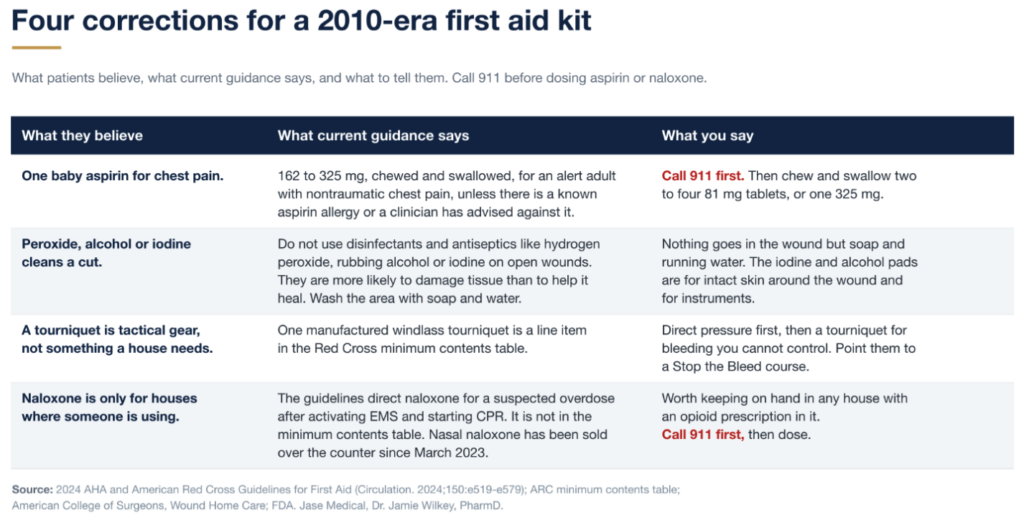
Three involve time-sensitive emergencies in which the right response can save a life. The peroxide correction is less dramatic, but it can prevent avoidable tissue injury and delayed healing.
The layer the kit was never built to hold
This next part is not strictly a first aid question, which is why no first aid guideline answers it.
Some families have the pill bottles and nothing useful for a wound. Others have gauze for days and no plan for the medications they take every morning.
Household medical preparedness has at least three layers. The first is immediate first aid: the supplies and skills used for bleeding, burns, wounds, sprains, and other acute problems. The second is continuity: current chronic prescriptions, an updated medication and allergy list, and a plan for storage or refrigeration.⁴ The third is individualized contingency planning for predictable problems when timely care is unavailable. In selected cases, that may include short-course medication prescribed in advance after a licensed clinician reviews the patient and provides condition-specific instructions.
That third layer is not part of the AHA/Red Cross first aid guidelines. It is a separate clinical decision, and stored medication should be used only under the instructions provided and when qualified medical assistance cannot be reached promptly.
The missing clinical layer
Underneath all four corrections is a structural problem. A household gets one of two things: they reach a clinician, or they work with whatever is in a box assembled to someone else’s checklist. Little formal guidance addresses the space between those options, which is how an endcap product ends up deciding what a family has on hand when something goes wrong.
That clinical layer has a name: individualized medical preparation. It is work completed before an emergency for a limited set of circumstances that may not wait for business hours.A tourniquet and naloxone illustrate the broader principle that useful emergency interventions must often be obtained—and understood—before they are needed. The first aid guidelines do not extend that principle to advance prescribing, but they demonstrate why preparation matters.
This is not a replacement for primary care. Complex diagnoses, ongoing conditions, and clinical uncertainty belong in the exam room. The appropriate role of advance planning is narrower: a defined set of circumstances, a patient screened in advance, clear instructions, and a plan for what requires direct care.
If you’d rather refer
Some of you would rather not write for this at all, which is a reasonable place to land. When a patient asks and you don’t want to be the one deciding what’s appropriate to keep on hand, send them to us at Jase.com. A licensed provider reviews every request and determines if a prescription is appropriate, so the referral is a clinical handoff and not a way around a visit.
We’ll keep publishing where we draw lines, what evidence we’re using, and the criteria behind a no. If we’re going to name a clinical category, the framework should be public enough for other clinicians to scrutinize and argue with.
The bottom line
The guidelines moved in 2024, but many patients’ kits did not move with them. An emergency is the wrong time to discover that the aspirin instructions are incomplete, the tourniquet is missing or unfamiliar, or the only wound cleaner in the box is peroxide.
Tell your patients to spend fifteen minutes with the kit they already own. Check the dates, replace what’s expired, take out what doesn’t belong in a wound, and make sure they know how to use what remains. They may not need a bigger kit. They need a current one and a plan they understand.
Sources
- Hewett Brumberg EK, Douma MJ, Alibertis K, et al; American Heart Association and American Red Cross. 2024 American Heart Association and American Red Cross Guidelines for First Aid. Circulation. 2024;150(24):e519-e579.
- Minimum Contents for American Red Cross First Aid Kit, Table 2, 2024 AHA and American Red Cross Guidelines for First Aid. cpr.heart.org
- Stop the Bleed. American College of Surgeons Committee on Trauma. stopthebleed.org
- Tips for Medication. Ready.gov, Federal Emergency Management Agency.
- Wound Home Care. American College of Surgeons. facs.org
- FDA Approves First Over-the-Counter Naloxone Nasal Spray. US Food and Drug Administration, March 29, 2023.
Lifesaving Solutions
Recent Posts
Keeping you informed and safe.
For Clinicians | Burn First Aid Without Running Water
For Clinicians | Burn First Aid Without Running Water By Dr. Jamie Wilkey, PharmD, Director of Clinical EducationMedically reviewed and edited by Aaron Asay, PA-C, DMSc, FIBODM, FAWM Every burn first-aid guide starts the same way: cool it under running water. That's...

What to Do If You’re Bitten by a Snake?
What to Do If You're Bitten by a Snake: Forget What the Movies Taught You By the Jase Medical Team If you're bitten by a venomous snake, forget almost everything the movies taught you about snakebite first aid. Don't cut an X over the fang marks. Don't suck out the...

For Clinicians | Should You Suck Out Snake Venom?
For Clinicians | Should You Suck Out Snake Venom? The Snakebite Myths Your Patients Still Believe By Dr. Jamie Wilkey, PharmD, Director of Clinical EducationMedically reviewed and edited by Aaron Asay, PA-C, DMSc, FIBODM, FAWM I really love gathering my little boys...

How to Rehydrate Someone Properly When There Is No IV
How to Rehydrate Someone Properly When There Is No IV By the Jase Medical Team When someone is losing fluid from vomiting or diarrhea, rehydration isn't simply a matter of getting them to drink something. The type of fluid matters. The amount matters. And especially...