For Clinicians | After the Tick Bite: The Tick Decides the Risk
For Clinicians | After the Tick Bite: The Tick Decides the Risk

By Dr. Jamie Wilkey, PharmD, Director of Clinical Education
Medically reviewed and edited by Aaron Asay, PA-C, DMSc, FIBODM, FAWM

Ticks have been on my radar my whole life. I grew up in Wyoming, where there are very few trees around (and those that exist are either aspens or pine trees), so needless to say,  a treehouse in my yard wasn’t an option. Instead, I had a fort out on the hill in my backyard in the sagebrush: a hole in the ground with planks over the top. Even then playing in the sagebrush all day I kept an eye out for ticks. I’ve never had a tick bite (knock on wood), which feels kind of amazing, because our family cabin has ticks everywhere and I still hike in the Utah mountains most mornings.

This article is for the clinicians helping outdoor people like me who just can’t stay away from the outdoors. We’ll cover basic tick identification, what a Lyme rash really looks like, when to test and treat, and the tick bite that ends in a red-meat allergy instead of an infection.

Which tick was it?

Whether it comes up in the office or at the pharmacy counter, start with two questions: what did the tick look like, and where was the patient when it bit?

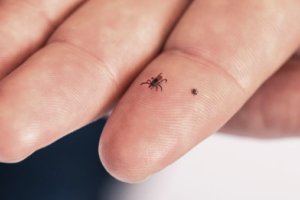
  • Blacklegged tick (deer tick): carries Lyme. Common in the Northeast, mid-Atlantic, and upper Midwest, with a western cousin along the Pacific coast¹. The nymph is about the size of a poppy seed, so most patients never notice the bite².
  • Lone star tick: the adult female has one white spot on her back. Common in the South, East, and Midwest.³ It doesn’t carry Lyme, but it’s the main cause of alpha-gal syndrome¹,⁴.
  • Rocky Mountain wood tick: the common tick in the Rocky Mountain states³. It doesn’t carry Lyme¹(So my sagebrush fort was safe, at least from Lyme, whew!).However, it can transmit other serious infections, including Rocky Mountain spotted fever, Colorado tick fever, and tularemia.
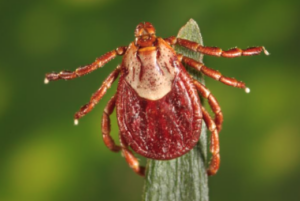
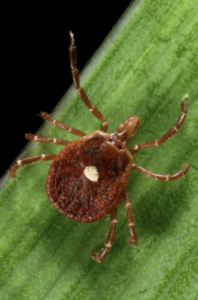
[IMAGES: row of three, PHIL 28383, PHIL 8676, PHIL 10865]
Blacklegged tick, adult female (left) and nymph (right). Photo: CDC/Lauren Bishop.
Lone star tick, adult female. Photo: CDC/James Gathany.
Rocky Mountain wood tick. Photo: CDC/James Gathany.
Source for all: CDC Public Health Image Library.

If the patient can’t name the tick, their geographic exposure can help narrow the possibilities, although tick species and their ranges may overlap.

What does a Lyme rash actually look like?

Most of us learned the Lyme rash as a bull’s-eye presentation. In the US, most erythema migrans (EM) rashes are evenly red, or reddest in the center, with no rings at all²,⁵. A typical EM is diagnosed on sight ⁶.

The rash is the bacteria spreading outward through the skin from the bite, which is why it grows². What to look for:

  • A red patch at the bite site that keeps expanding over several days, sometimes to 12 inches or more
  • Shows up 3 to 30 days after the bite, about a week on average
  • Warm to the touch, but rarely itchy or painful⁷.

A small red bump right after the bite that looks like a mosquito bite and fades in a day or two is a bite reaction, not Lyme⁷.

Should you test a typical EM?

No. For a typical EM rash, skip the blood test and treat ⁶.

The rash shows up before the immune system has made enough antibodies to measure. If you were to test 10 patients with a fresh rash, 6 to 8 of them would come back negative⁸. Antibody testing has limited sensitivity during early localized Lyme disease, so a negative result does not exclude infection. When a patient has a typical erythema migrans rash and credible exposure, treatment should not wait for laboratory confirmation.

Two more tests to skip after a tick bite ⁶:

  • Testing the tick itself for Lyme bacteria. A positive or negative tick doesn’t predict whether the patient gets infected. (Identifying the species is still useful.)
  • Testing a patient who has no symptoms.

Save the blood test for a rash that doesn’t look typical. If that first draw is negative, IDSA suggests a second sample taken later to catch the antibodies as they rise⁶.
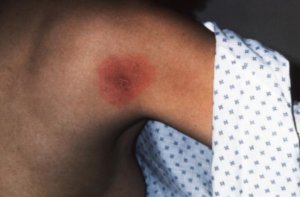
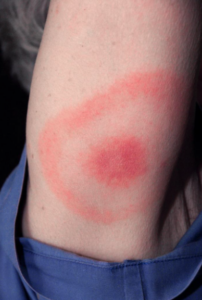
[IMAGES: side by side, PHIL 9875 and PHIL 14474]
The Lyme rash everyone pictures (left) and a more typical one (right). Photos: CDC/James Gathany (left), CDC (right). Source: CDC Public Health Image Library.

How long do you treat a Lyme rash?

Treat a typical EM with 10 days of doxycycline, or 14 days of amoxicillin or cefuroxime ⁶. Longer courses aren’t recommended. Azithromycin for 7 days is the backup for patients who can’t take doxycycline or a beta-lactam ⁶. Doxycycline isn’t off-limits for young kids anymore, either. IDSA notes a growing consensus that courses of up to 14 days are safe in young children (plus, newer research casts doubt on that old tooth-staining worry ⁶).

Doxycycline counseling is the same as always: take it with a full glass of water and wear sunscreen⁹,¹⁰. And finish the course as written, even after the rash fades.

What about a single dose of doxycycline right after the bite? It’s an option for a high-risk bite within 72 hours of removing the tick, and the criteria are strict. We walked through who qualifies in our July article on doxycycline uses.

What is alpha-gal syndrome?

Alpha-gal is a sugar found in most mammals, but not in people, birds, or fish. A tick bite, most often from a lone star tick, can sensitize the immune system to it⁴,¹¹. Lone star ticks aren’t the only suspect, though: Maine has reported a case after a blacklegged tick bite¹². It’s an allergy, not an infection, so antibiotics don’t treat or prevent it. The doxycycline from the last section does nothing here.

Consider alpha-gal when a patient has hives, stomach symptoms, or anaphylaxis 2 to 6 hours after eating red meat or dairy¹¹,¹³. The delay is a big part of why it gets missed. So is unfamiliarity: in a CDC survey of 1,500 clinicians, about 4 in 10 had never heard of it ¹³. 

The workup is an alpha-gal IgE blood test, read alongside the history, because a positive result alone doesn’t make the diagnosis¹⁴. From there, it’s avoidance, an allergist, and an epinephrine plan for anyone with systemic reactions¹⁵,¹⁶.

Pharmacists, something good for you to keep in mind as well: some medications made with gelatin can trigger a reaction¹.Not every patient reacts to dairy, gelatin, or mammalian-derived medications. Avoidance recommendations should be individualized according to reaction history and allergy evaluation.

Where the gap is after a tick bite


Most tick bites don’t happen conveniently next to a clinic during office hours. They happen on a trail, at a cabin, or on a hunting trip. And right now, care after a bite is all or none: the patient reaches a clinician while it still matters, or they’re left with a rash, an internet search, and a bull’s-eye picture that doesn’t match what’s on their leg.

That missing middle is the work we do. We call it appropriate medical preparation: teaching patients what to watch for before they head out, with a clinician-built plan for when care isn’t reachable. It’s in no way a replacement for primary care. It’s for the times when primary care isn’t there.

Tick bites are part of that work. Doxycycline is in every JaseCase, and its card covers two tick situations: the single preventive dose, only when every criterion on the card is met, and the 10-day course for an EM rash. Both are for emergency use only, after the patient has first tried to reach a qualified healthcare provider.

If you’d rather not prescribe in this space, you can refer patients to us. A licensed provider reviews every request and writes every prescription. And we’ll keep publishing how we draw these lines, the same way we did here.

The bottom line
Ask which tick made the bite and where it happened. Diagnose a typical Lyme rash on sight, and don’t wait for a bull’s-eye or a positive test to treat it. Skip testing the tick, and skip testing the patient with no symptoms. Think alpha-gal when a lone star bite is followed by delayed reactions to red meat, and remember antibiotics won’t touch it.

People who love the outdoors aren’t going to stay inside, and I’m one of them. To refer a patient, visit Jase.com, where a licensed provider reviews every request.


Sources

  1. CDC. How Lyme disease spreads. Updated September 24, 2024. https://www.cdc.gov/lyme/causes/index.html
  2. Nadelman RB. Erythema migrans. Infect Dis Clin North Am. 2015;29(2):211-239. https://doi.org/10.1016/j.idc.2015.02.001
  3. CDC. Where ticks live. Updated July 30, 2025. https://www.cdc.gov/ticks/about/where-ticks-live.html
  4. CDC. About alpha-gal syndrome. Updated January 5, 2026. https://www.cdc.gov/alpha-gal-syndrome/about/index.html
  5. Smith RP, Schoen RT, Rahn DW, et al. Clinical characteristics and treatment outcome of early Lyme disease in patients with microbiologically confirmed erythema migrans. Ann Intern Med. 2002;136(6):421-428. https://doi.org/10.7326/0003-4819-136-6-200203190-00005
  6. Lantos PM, Rumbaugh J, Bockenstedt LK, et al. Clinical practice guidelines by the Infectious Diseases Society of America (IDSA), American Academy of Neurology (AAN), and American College of Rheumatology (ACR): 2020 guidelines for the prevention, diagnosis, and treatment of Lyme disease. Clin Infect Dis. 2021;72(1):e1-e48. https://doi.org/10.1093/cid/ciaa1215
  7. CDC. Signs and symptoms of untreated Lyme disease. Updated May 15, 2024. https://www.cdc.gov/lyme/signs-symptoms/index.html
  8. Horn EJ, Menefee B, Schotthoefer AM, et al. Evaluation of standard and modified two-tiered testing algorithms using well-characterized early Lyme disease samples. J Clin Microbiol. 2026;64(5):e0118725. https://doi.org/10.1128/jcm.01187-25
  9. MedlinePlus. Doxycycline. Revised May 15, 2026. https://medlineplus.gov/druginfo/meds/a682063.html
  10. Medsafe (New Zealand Medicines and Medical Devices Safety Authority). Oesophagitis with doxycycline and others. Prescriber Update. 2003;24(2):30. https://www.medsafe.govt.nz/profs/puarticles/doxoesoph.htm
  11. CDC. Alpha-gal syndrome for healthcare providers. April 12, 2022. https://stacks.cdc.gov/view/cdc/131343
  12. Saunders EF, Sohail H, Myles DJ, et al. Alpha-gal syndrome after Ixodes scapularis tick bite and statewide surveillance, Maine, USA, 2014–2023. Emerg Infect Dis. 2025;31(4). https://doi.org/10.3201/eid3104.241265
  13. Carpenter A, Drexler NA, McCormick DW, et al. Health care provider knowledge regarding alpha-gal syndrome: United States, March–May 2022. MMWR Morb Mortal Wkly Rep. 2023;72(30):809-814. https://doi.org/10.15585/mmwr.mm7230a1
  14. CDC. Clinical diagnosis and testing (alpha-gal syndrome). Updated January 5, 2026. https://www.cdc.gov/alpha-gal-syndrome/hcp/diagnosis-testing/index.html
  15. Nationwide Children’s Hospital. Alpha-gal syndrome (AGS): clinical FAQ for health care professionals. October 2025. https://pediatricsnationwide.org/wp-content/uploads/2026/04/W2043400-RUSH_Alpha-Gal-Syndrome_Clinical-FAQ-for-Providers_FINAL.pdf
  16. CDC. Managing alpha-gal syndrome. Updated January 5, 2026. https://www.cdc.gov/alpha-gal-syndrome/managing/index.html


Lifesaving Solutions

Everyone should be empowered to care for themselves and their loved ones during the unexpected. Check out our recent lifesaving products today.

Recent Posts

Keeping you informed and safe.

Diabetes Sick-Day Rules in a Disaster

Diabetes Sick-Day Rules in a Disaster

Diabetes Sick-Day Rules in a Disaster By the Jase Medical Team Diabetes sick-day rules are usually written for an ordinary week. You get the flu. Your stomach is upset. You check your blood sugar more often, keep drinking fluids, follow your medication plan, and call...
read more
For Clinicians | Diabetes Sick-Day Rules in a Disaster

For Clinicians | Diabetes Sick-Day Rules in a Disaster

For Clinicians | Diabetes Sick-Day Rules in a Disaster By Dr. Jamie Wilkey, PharmD, Director of Clinical EducationMedically reviewed and edited by Kristen Carpenter, PA-C Diabetes is already hard to manage. Sick days just make everything worse. And a sick day in a...
read more
Burns in a Blackout

Burns in a Blackout

Burns in a Blackout: First Aid When the Tap Doesn't Run By the Jase Medical Team Almost every burn first aid guide starts with the same instruction: cool the burn under clean, cool running water. But what happens when the tap doesn't run? For households that rely on a...
read more

Join Our Newsletter

Our mission is to help you be more medically prepared. Join our newsletter and follow us on social media for health and safety tips each week!

Diabetes Sick-Day Rules in a Disaster

Diabetes Sick-Day Rules in a Disaster

By the Jase Medical Team

Diabetes sick-day rules are usually written for an ordinary week.

You get the flu. Your stomach is upset. You check your blood sugar more often, keep drinking fluids, follow your medication plan, and call your healthcare provider if certain symptoms or numbers appear.

But what happens when the phone doesn’t work?

A hurricane, prolonged power outage, wildfire, flood, or boil-water advisory can make diabetes harder to manage at exactly the same time healthcare becomes harder to reach. Vomiting and diarrhea can cause dehydration. Heat can affect hydration and blood sugar. Missed meals can complicate medication management. Other illnesses, infections, or medications prescribed for an acute condition can affect glucose, too.

That’s why diabetes sick-day rules should be written down before the disaster, not explained for the first time during it.

First: Don’t Stop Insulin on Your Own

If you use insulin, one of the most important sick-day principles is that becoming sick does not mean you should simply stop taking it.

Illness can actually increase blood sugar even when you’re eating less than usual. Your body releases stress hormones while fighting an infection or other illness, and those hormones can push glucose higher.

Exactly how much insulin you need may depend on your diabetes type, glucose readings, ketones, food intake, hydration, and the individualized instructions you’ve received from your healthcare team.

So the rule isn’t to improvise.

Do not stop or change your insulin without following your prescribed sick-day plan or receiving guidance from a qualified healthcare professional.

We’ve covered the importance of maintaining access to insulin and other time-sensitive medications separately in our guide to which medications cannot wait during an emergency.

The Harder Question: What About Your Other Medications?

This is where diabetes sick-day planning gets more complicated.

Many adults with type 2 diabetes aren’t managing one medication. You may take several medications for diabetes along with medications for blood pressure, heart disease, kidney protection, or other chronic conditions.

During an illness involving dehydration, vomiting, diarrhea, or significantly reduced food and fluid intake, a healthcare provider may want certain medications temporarily held. The concern can include dehydration, kidney function, low blood sugar, or other complications depending on the medication and your health history.

In the UK, clinicians sometimes teach this concept using the acronym SADMANS, which refers to several medication classes that may require special consideration during a dehydrating illness.

The acronym is less important than the problem it reveals: your sick-day medication plan may involve prescriptions from more than one clinician, and nobody should be trying to sort that out for the first time while sick during a power outage.

Should You Stop Metformin or Jardiance When You’re Sick?

These are exactly the kinds of questions to answer with your prescriber or pharmacist before you need the answer.

People searching for “metformin sick-day rules” or “Jardiance sick-day rules” will find general recommendations online. But whether a medication should be held, when it should be restarted, and what monitoring is appropriate depends on the medication, the illness, your hydration, kidney function, glucose control, and your individual medical history.

Don’t create your own stop-and-restart schedule from a generic internet list.

Instead, ask your healthcare provider or pharmacist to review all of your regular medications and identify which, if any, require different instructions when you’re dehydrated, vomiting, having diarrhea, or unable to eat and drink normally.

Then write those instructions down.

Any decision to hold, restart, or change a prescription medication should follow instructions from your licensed healthcare provider. If you cannot reach your regular provider during an emergency, try to reach another qualified healthcare professional whenever possible before changing your medication regimen.

Your Sick-Day Plan Should Live With Your Medication List

A medication list tells someone what you take.

A sick-day plan tells you what your prescriber wants you to do when normal conditions change.

Ideally, the two should stay together.

Your written plan should make it easy to find your usual diabetes medications and doses, how often your healthcare team wants you checking glucose when you’re sick, whether and when they want you checking ketones, what they want you to do if you cannot eat or drink normally, and which symptoms or readings mean you need medical care.

If any of your medications have special sick-day instructions, those should be written beside the medication rather than left to memory.

This is especially useful for people whose medication list spans multiple conditions or prescribers.

Ketones Aren’t Only a Type 1 Diabetes Conversation

Ketones are most strongly associated with type 1 diabetes, but some people with type 2 diabetes may also need ketone monitoring during illness, particularly depending on their medications and individual risk factors.

Your healthcare provider should tell you whether you need ketone testing as part of your sick-day plan, when they want you to test, and what results require action.

This matters because diabetic ketoacidosis, or DKA, is a medical emergency. It can develop when the body does not have enough effective insulin and begins producing high levels of ketones.

Symptoms can include nausea, vomiting, abdominal pain, excessive thirst, frequent urination, unusual fatigue, confusion, and rapid or deep breathing.

If your diabetes plan includes ketone testing, make sure you understand it before you’re sick.

Know the Numbers That Mean It’s Time to Go

A written plan should also make clear where home management ends.

The American Diabetes Association advises contacting a healthcare provider or seeking emergency care for concerning sick-day situations, including persistent vomiting or diarrhea, moderate to large ketones, and very high glucose readings that aren’t responding as expected.

For example, ADA sick-day guidance identifies vomiting or diarrhea lasting more than four hours and glucose above 300 mg/dL on two readings despite correction as reasons to contact your provider or go to the emergency room. Moderate to large ketones are another warning sign requiring prompt attention.

Your own healthcare team may give you different or additional thresholds based on your diabetes and medical history.

The important part during a disaster is that you already know those thresholds.

If you cannot keep fluids down, are becoming severely dehydrated, have significant ketones, are confused or unusually drowsy, have difficulty breathing, or have another severe or rapidly worsening symptom, don’t wait for normal clinic operations to resume.

A disaster can change how difficult it is to reach care. It doesn’t make a diabetes emergency less urgent.

Illness Isn’t the Only Thing That Can Push Blood Sugar Around

Disasters tend to stack problems on top of one another.

Maybe you’re eating differently because the refrigerator lost power. Maybe extreme heat is affecting your hydration. Maybe a stomach illness is making it difficult to keep fluids down. Maybe wildfire smoke triggered a COPD or asthma exacerbation, and you’ve been prescribed a corticosteroid as part of your respiratory treatment.

Corticosteroids can raise blood glucose, sometimes significantly.

That doesn’t mean you should avoid a medication your healthcare provider has determined you need. It means your diabetes plan should account for the possibility that another illness or treatment could change your glucose management.

If you have diabetes alongside asthma, COPD, or another chronic condition that may require acute treatment, ask your healthcare team how those plans interact before an emergency.

The Best Time to Write Your Diabetes Sick-Day Rules Is When You’re Well

You don’t need to create a complicated disaster protocol.

Start with one question at your next appointment or pharmacy consultation:

“If I’m sick, dehydrated, and can’t reach you, what do you want me to do with each of these medications?”

Bring your complete medication list.

Ask how often you should check glucose when sick. Ask whether you should check ketones and under what circumstances. Ask which medications, if any, have special sick-day instructions. Ask exactly what conditions need to be met before a medication that was held can be restarted. And ask which numbers or symptoms mean you should stop trying to manage the situation at home and seek care.

Then put those instructions on paper and keep them with your medication list.

At Jase Medical, our family team of medical doctors, PAs, and pharmacists focuses on appropriate medical preparation held to high clinical standards. JaseCase provides physician-prescribed contingency medications for specific medical situations after review by a licensed provider. These medications are intended for emergency use after first trying to reach a qualified healthcare provider and should be used only according to the instructions provided.

JaseCase doesn’t replace your diabetes medications or your individualized diabetes care plan. But the same principle behind appropriate medical preparation applies here: make the decision with the right healthcare professional before the moment when reaching them becomes difficult.

Because diabetes sick-day rules shouldn’t depend on the phone working.

The plan should already be in your hands.

The Jase Medical Team is a family team of medical doctors, PAs, and pharmacists focused on appropriate medical preparation that complements, rather than replaces, the healthcare professionals you already trust.

This article is for informational purposes only and does not constitute individualized medical advice. Do not stop, restart, or change prescription medications based solely on this article. Work with your healthcare provider or pharmacist to develop an individualized diabetes sick-day plan, and seek prompt medical care for severe or rapidly worsening symptoms.


The Jase Medical Team is a family team of medical doctors, PAs, and pharmacists focused on appropriate medical preparation: clinically grounded readiness that complements, rather than replaces, the healthcare professionals you already trust.

This article was prepared by the Jase Medical content team for informational purposes only and does not constitute medical advice. Prescription requirements, emergency dispensing rules, insurance coverage, and controlled-substance regulations vary by medication, jurisdiction, and individual circumstances. Consult a licensed healthcare provider or pharmacist regarding your specific medications.

Lifesaving Solutions

Everyone should be empowered to care for themselves and their loved ones during the unexpected. Check out our recent lifesaving products today.

Recent Posts

Keeping you informed and safe.

Diabetes Sick-Day Rules in a Disaster

Diabetes Sick-Day Rules in a Disaster

Diabetes Sick-Day Rules in a Disaster By the Jase Medical Team Diabetes sick-day rules are usually written for an ordinary week. You get the flu. Your stomach is upset. You check your blood sugar more often, keep drinking fluids, follow your medication plan, and call...

read more
For Clinicians | Diabetes Sick-Day Rules in a Disaster

For Clinicians | Diabetes Sick-Day Rules in a Disaster

For Clinicians | Diabetes Sick-Day Rules in a Disaster By Dr. Jamie Wilkey, PharmD, Director of Clinical EducationMedically reviewed and edited by Kristen Carpenter, PA-C Diabetes is already hard to manage. Sick days just make everything worse. And a sick day in a...

read more
Burns in a Blackout

Burns in a Blackout

Burns in a Blackout: First Aid When the Tap Doesn't Run By the Jase Medical Team Almost every burn first aid guide starts with the same instruction: cool the burn under clean, cool running water. But what happens when the tap doesn't run? For households that rely on a...
read more

Join Our Newsletter

Our mission is to help you be more medically prepared. Join our newsletter and follow us on social media for health and safety tips each week!

For Clinicians | Diabetes Sick-Day Rules in a Disaster

For Clinicians | Diabetes Sick-Day Rules in a Disaster

By Dr. Jamie Wilkey, PharmD, Director of Clinical Education
Medically reviewed and edited by Kristen Carpenter, PA-C

Diabetes is already hard to manage. Sick days just make everything worse. And a sick day in a disaster, when healthcare isn’t readily available, compounds the hardship. Put the three together and it’s 1 + 1 + 1. For someone’s health, that doesn’t equal 3.
It equals 20. 

And the disaster itself counts as its own 1, even before anyone gets sick. In a Puerto Rico cohort of adults who didn’t have diabetes, new cases showed up at about twice the pre-storm rate in the years spanning Hurricanes Irma and Maria¹.

Disaster guidance for diabetes focuses mostly on a supply list (have plenty of insulin on hand and stored properly!). Sick days barely come up as a management topic. That’s a big gap when about 40 million Americans have diabetes, 2.1 million of them type 1². Their care really does change in a disaster, whether that’s a hurricane or a week when they can’t reach their clinic or pharmacy. We have to address that.

Today we’ll cover:

  • what a diabetes sick day is
  • which medications pause (+ why insulin never pauses)
  • how ketones work, and why a normal meter reading can fool you
  • what to look for in the OTC aisle
  • how to write the plan before storm season

What is a diabetes sick day?

I’m including this here to start because even as a pharmacist I have to admit (abashedly) that I didn’t know much about this topic. 99% of my diabetic counseling focused on medications in general and blood sugar testing.

A diabetes sick day is any illness that changes how the body handles glucose, fluids, or medications: a stomach bug, a fever, a UTI, or a really rough flu. The hormones the body releases to fight illness push blood sugar up ³…. even in a patient who has barely eaten all day. Vomiting, diarrhea, and fever drain fluid, and the kidneys feel it first. That’s where the medication problems start.  Several of the drugs these patients take every day either depend on the kidneys or make dehydration worse. And when insulin runs short, the body breaks down fat for fuel and starts making ketones.

Sick-day rules exist to catch all of that early: check glucose more often, keep fluids going, check ketones, and call when the numbers cross a line. The ADA’s patient guide ends with “call your doctor or go to the ER” ⁴. Yep, every version ends there, which doesn’t really work.

A disaster amplifies everything. Bad water brings on vomiting and diarrhea. Heat causes dehydration. Meals get skipped. Smoke or mold sets off someone’s asthma, and the steroid burst that settles their breathing raises glucose on its own (we covered that in our asthma and COPD flare article). The clinic is often closed, flooded, or not picking up, so care isn’t available.

Which medications pause on a diabetes sick day?

Canadian clinicians teach the pause list as SADMANS, a Diabetes Canada mnemonic ⁵, and UK sick-day cards carry close versions of it⁶,⁷. Each class gets much riskier when a patient is dehydrated or not eating, and most of the list comes back to the kidney’s filter, which needs pressure to work. Picture a garden hose with me for the kidneys. Blood volume is the water from the spigot. When the water runs low, the kidney keeps the spray going two ways: it holds the inflow open, and it puts a thumb over the end of the hose so pressure builds inside, where the filtering happens. That’ll help you picture how the SADMANS medications affect the patient’s kidney.

  • S: sulfonylureas like glipizide and glimepiride keep pushing insulin out when the patient isn’t eating. Some linger as kidney function drops.
  • A: ACE inhibitors like lisinopril shut off angiotensin II, and angiotensin II is the kidney’s thumb. Take it away from a dehydrated patient and filtering pressure drops.
  • D: diuretics like HCTZ and furosemide turn the spigot down further on a patient who’s already losing fluid.
  • M: metformin doesn’t hurt the kidneys, but they’re its only way out. When they slow down, metformin builds up, and so does the risk of lactic acidosis.
  • A: ARBs like losartan take the thumb off the same way ACE inhibitors do.
  • N: NSAIDs like ibuprofen and naproxen kink the hose near the spigot by blocking the prostaglandins that hold the inflow open. (Spigot down, hose kinked, thumb off: that’s the triple whammy from our drug interactions article)
  • S: SGLT2 inhibitors like Jardiance and Farxiga pull glucose and water out through the urine, deepening dehydration, and raise DKA risk, sometimes with a normal glucose (more on that next).

GLP-1 drugs like semaglutide aren’t in the mnemonic, but the ADA Standards note they may need holding when GI symptoms are significant ⁸.

SADMANS isn’t a US guideline, and the evidence behind sick-day lists is mostly expert opinion⁵. The ADA Standards say to consider holding metformin and SGLT2 inhibitors when the patient can’t keep up with eating and drinking or kidney injury is a concern ⁸, and Jardiance’s label says to withhold it, if possible, in situations that could predispose to ketoacidosis ⁹. The ADA’s patient guide says to keep taking diabetes medications as prescribed unless the doctor advises otherwise ⁴. That “unless” is our job. Which pills pause for which patient, and when they restart (UK practice is usually after 24 to 48 hours of normal eating and drinking⁶, are prescriber decisions that belong in the written plan. The plan is for emergency use only, after the patient has tried to reach their prescriber or pharmacist first.

And just to be clear here, insulin never pauses. Basal insulin keeps going even when the patient isn’t eating⁸. Mealtime doses follow the food¹⁰, and the total dose can change while they’re sick ³, which is exactly the kind of adjustment that belongs in the plan. Stopping basal insulin because they can’t eat is the classic road to DKA, and in type 1 that road is short. (For keeping insulin cool when the power’s out, see our insulin storage article.)

Who owns the sick-day conversation?

The ADA already tells patients to make a sick-day action plan with their doctor before they ever get sick ⁴. I don’t think many of us are having that conversation, in the office or at the pharmacy. In more than 10 years as a pharmacist, I’ve had five or fewer of them. I’m not proud of that at all, but patients rarely, if ever, proactively brought up the topic. At my busy 24-hour pharmacy, counseling got to the single most important thing a patient needs to start the medication (and sick days didn’t usually make the cut). 

Part of the problem is that nobody owns the med list. The pills that pause on a sick day often come from two prescribers: metformin and an SGLT2 inhibitor from primary care, lisinopril and a diuretic from cardiology. Each prescriber may only see their half. The pharmacy profile shows every prescription filled there, from every prescriber, and our interaction software checks across all of it.

That makes this a pharmacy counter conversation as much as an office one. For a patient on metformin, Jardiance, lisinopril, and HCTZ, here’s how it would sound coming from me:

“When you’re sick, it can really change your diabetes and your medications and you have to be extra careful. Here’s what to know in a nutshell. If you’re throwing up or can’t keep fluids down, some of your pills may need to pause until you’ve been eating and drinking normally for a day or two. For you, that’s probably all four, but your doctor makes that call, so let’s ask them to put it in writing now. I’ll send a fax requesting that right now.  Because you’re on Jardiance, check your ketones when you’re sick, even if your sugar looks normal. Call your doctor or the pharmacy first. If you can’t reach anyone, these symptoms mean you need to get to emergency care ASAP: throwing up or diarrhea for more than 4 hours, moderate or large ketones, or a sugar over 300 twice.“

How ketones work, and why a normal meter reading can fool you

Ketones are what the liver makes from fat when cells can’t get enough insulin to use glucose. A little after a long fast is normal. When insulin runs short in a dehydrated patient, ketones build faster than the body clears them. Then the blood turns acidic, and that’s DKA (diabetic ketoacidosis).

On an SGLT2 inhibitor, the kidneys keep dumping glucose into the urine, so the meter can read 150 while ketones climb. Jardiance’s label warns that glucose at presentation can sit below what we’d expect for DKA, for example under 250 ⁹, and the ADA defines euglycemic DKA as DKA with a glucose under 200 ¹¹. The glucose number stops being a warning light, so an SGLT2 user’s plan needs to be checking ketones when sick, whatever the meter reads.

The tool matters too. There are two main ketones in the blood, and urine strips only see one of them. In DKA, most of the ketones are the other kind¹², so a strip can read low while the real level is high. That’s why the ADA wants at-risk SGLT2 users to have a blood ketone meter¹³. From what I’ve seen working in the pharmacy a lot of urine strips and keto meters are being bought up by the keto, weight-loss, and muscle-building crowds, so they can be kind of hard to find sometimes. (Funny twist, since the ADA also tells us to steer SGLT2 users away from keto eating¹³.) Put the strips, or a blood meter, on the written plan and make sure that patients actually have some on hand so they’re handy before they are needed.

The Wilderness Medical Society tells insulin users heading into the backcountry to carry a ketone kit, and it treats DKA as an emergency that calls for evacuation¹⁴. A hurricane week at home isn’t the backcountry, but it shares the part the guideline is written around: limited access to care. Moderate or large ketones means to get to emergency care, not wait for the phone.

What to look for in the OTC aisle

The ADA’s guide tells patients to work out which OTC medications are safe with their doctor before they get sick ⁴, but it doesn’t say which ones. The pharmacist is the natural person to fill in that blank. Every pick comes back to the two questions from the pause list: what it does to the kidneys, and what it does to glucose.

  • Ibuprofen and naproxen are the N in SADMANS, and they hide in combination products (one 12-hour sinus product pairs naproxen with pseudoephedrine). The plan should name the swap for pain and fever, usually acetaminophen if the liver allows.
  • Pseudoephedrine’s Drug Facts tell anyone with diabetes to ask a doctor before using it¹⁵. 
  • The ADA’s guide says to alternate water and electrolyte drinks ⁴, and sugar isn’t automatically the enemy. A patient who can’t eat still needs about 50 grams of carbohydrate every 4 hours ³, and regular juice or soda may be how they get it.
  • Glucose tabs or gel are on the ADA’s sick-day supply list ⁴, and they matter most for anyone on a sulfonylurea or insulin who can’t eat.

Like everything else on the plan, these are emergency-use answers, for when the patient has tried to reach their pharmacist or prescriber first and can’t get through.

How to write the plan before storm season

The ADA’s guide already lists what belongs in a sick-day plan ⁴. The disaster version fills in every line with this patient’s medication names and strengths written on paper, kept with their medication list:

  • Which of their pills pause, by name, and when each one restarts
  • For insulin users, the basal dose that keeps going and how to adjust mealtime and correction doses
  • How often to check glucose and ketones, and with what (urine strips or a blood meter)
  • The OTC picks for fever and pain, congestion, fluids, and lows
  • The numbers that mean get to emergency care when no one answers:
    • vomiting or diarrhea for more than 4 hours
    • moderate or large ketones, or the blood ketone number you set
    • glucose over 300 on two readings despite corrections
    • fever over 101°F lasting more than 24 hours
    • signs of dehydration, like dizziness or dark urine
  • Who to call first, their number, and when they are reachable: the prescriber or the pharmacy

The plan is for emergency use only, after the patient has tried those calls and can’t get through.

The bottom line

Sick-day care for diabetes is all or nothing right now. Either the clinic or the pharmacy picks up, or the patient is alone with four bottles and a meter just guessing and winging it with what they look up online. A written plan is the missing middle layer: the decision made ahead of time by the person who should make it, ready for the day nobody answers. That’s appropriate medical preparation at its simplest. It’s in no way a replacement for primary care; we’re here for the times when primary care isn’t there. Our team of physicians, PAs, and pharmacists is building the version of this plan for the week the clinic’s phone is dead, and we’ll publish the framework as we go.

Before the next storm, write the plan for every patient on an SGLT2 inhibitor, metformin, or insulin. Pharmacists, start it at the counter.

A sick day in a disaster will never be easy. A plan on paper keeps 1 + 1 + 1 a lot closer to 3.


Sources

  1. Martínez-Lozano M, Noboa C, Alvarado-González G, Joshipura KJ. Hurricanes Irma and Maria and diabetes incidence in Puerto Rico. BMC Public Health. 2023;23:1019. https://pmc.ncbi.nlm.nih.gov/articles/PMC10227808/
  2. Centers for Disease Control and Prevention. National Diabetes Statistics Report. Updated September 16, 2026. https://www.cdc.gov/diabetes/php/data-research/index.html
  3. Centers for Disease Control and Prevention. Managing sick days. Updated May 15, 2024. https://www.cdc.gov/diabetes/living-with/managing-sick-days.html
  4. American Diabetes Association. Sick Day Guide for People with Diabetes (patient version). September 2025. Based on the Standards of Care in Diabetes-2025. https://professional.diabetes.org/sites/dpro/files/2025-09/SickDayGuide_Final.pdf
  5. Watson KE, Dhaliwal K, McMurtry E, et al. Sick day medication guidance for people with diabetes, kidney disease, or cardiovascular disease: a systematic scoping review. Kidney Med. 2022;4(9):100491. https://pmc.ncbi.nlm.nih.gov/articles/PMC9420951/
  6. Healthcare Improvement Scotland. Medicines sick day guidance card, version 4. 2026. https://www.healthcareimprovementscotland.scot/wp-content/uploads/2026/05/Medicines-sick-day-guidance-card-A6-June-2026.pdf
  7. Northern Ireland Formulary. Sick day rules. Accessed October 5, 2026. https://niformulary.hscni.net/formulary/6-0-endocrine/6-1-drugs-used-in-diabetes/6-1-2-antidiabetic-drugs/sick-day-rules/
  8. American Diabetes Association Professional Practice Committee for Diabetes. 6. Glycemic goals, hypoglycemia, and hyperglycemic crises: Standards of Care in Diabetes-2026. Diabetes Care. 2026;49(Suppl 1):S132-S149. https://pmc.ncbi.nlm.nih.gov/articles/PMC12690178/
  9. Jardiance (empagliflozin) prescribing information. Boehringer Ingelheim Pharmaceuticals; revised January 2026. DailyMed. https://dailymed.nlm.nih.gov/dailymed/drugInfo.cfm?setid=faf3dd6a-9cd0-39c2-0d2e-232cb3f67565
  10. RxFiles. Protecting the kidneys. September 2025. https://www.rxfiles.ca/RxFiles/uploads/documents/SADMANS-Rx.pdf
  11. American Diabetes Association Professional Practice Committee for Diabetes. 16. Diabetes care in the hospital: Standards of Care in Diabetes-2026. Diabetes Care. 2026;49(Suppl 1):S339-S355. doi:10.2337/dc26-S016
  12. Umpierrez GE, et al. Hyperglycemic crises in adults with diabetes: a consensus report. Diabetes Care. 2024;47(8):1257-1275. https://pmc.ncbi.nlm.nih.gov/articles/PMC11272983/
  13. American Diabetes Association Professional Practice Committee for Diabetes. 9. Pharmacologic approaches to glycemic treatment: Standards of Care in Diabetes-2026. Diabetes Care. 2026;49(Suppl 1):S183-S215. https://pmc.ncbi.nlm.nih.gov/articles/PMC12690185/
  14. VanBaak KD, et al. Wilderness Medical Society clinical practice guidelines for diabetes management. Wilderness Environ Med. 2019;30(4 Suppl):S121-S140. Written for wilderness athletes; recommendations cited: carry a ketone testing kit (grade 1B), and evacuate for DKA or HHS (grade 1A). https://pmc.ncbi.nlm.nih.gov/articles/PMC7510348/
  15. Sudafed Sinus Congestion 12 Hour (pseudoephedrine HCl) Drug Facts label. Kenvue; revised November 8, 2024. DailyMed. https://dailymed.nlm.nih.gov/dailymed/drugInfo.cfm?setid=d600b5d5-7d95-4ad6-a95b-6d73502743d7


Lifesaving Solutions

Everyone should be empowered to care for themselves and their loved ones during the unexpected. Check out our recent lifesaving products today.

Recent Posts

Keeping you informed and safe.

Diabetes Sick-Day Rules in a Disaster

Diabetes Sick-Day Rules in a Disaster

Diabetes Sick-Day Rules in a Disaster By the Jase Medical Team Diabetes sick-day rules are usually written for an ordinary week. You get the flu. Your stomach is upset. You check your blood sugar more often, keep drinking fluids, follow your medication plan, and call...

read more
For Clinicians | Diabetes Sick-Day Rules in a Disaster

For Clinicians | Diabetes Sick-Day Rules in a Disaster

For Clinicians | Diabetes Sick-Day Rules in a Disaster By Dr. Jamie Wilkey, PharmD, Director of Clinical EducationMedically reviewed and edited by Kristen Carpenter, PA-C Diabetes is already hard to manage. Sick days just make everything worse. And a sick day in a...

read more
Burns in a Blackout

Burns in a Blackout

Burns in a Blackout: First Aid When the Tap Doesn't Run By the Jase Medical Team Almost every burn first aid guide starts with the same instruction: cool the burn under clean, cool running water. But what happens when the tap doesn't run? For households that rely on a...
read more

Join Our Newsletter

Our mission is to help you be more medically prepared. Join our newsletter and follow us on social media for health and safety tips each week!

Burns in a Blackout

Burns in a Blackout: First Aid When the Tap Doesn’t Run

By the Jase Medical Team

Almost every burn first aid guide starts with the same instruction: cool the burn under clean, cool running water.

But what happens when the tap doesn’t run?

For households that rely on a well, a power outage can also mean losing the electric pump that moves water through the house. At the same time, blackouts can introduce new burn risks as families start using candles, generators, space heaters, camp stoves, and other backup sources of light, heat, and cooking.

After Hurricane Ida, generator and cooking accidents accounted for 56% of storm-related burns treated at one New Orleans burn center, and most of those patients were admitted to the hospital.

So burn first aid during a blackout requires a slightly different plan. The fundamentals haven’t changed. Cool the burn, protect it, and know when it needs medical care. What changes is how you accomplish that when the usual faucet isn’t available.

First, Forget the Home Remedies

Before we get to the water problem, there are a few things that should never become the substitute.

Don’t put ice directly on a burn. Extreme cold can further damage already injured tissue. You want to cool the burn, not freeze it.

And skip the butter, oil, toothpaste, and other kitchen or bathroom remedies that tend to get passed down through generations. Greasy substances can trap heat against the skin and make the burn harder to assess and clean.

Butter does roughly the same thing for a burn that it does for a steak. It isn’t first aid.

For a fresh thermal burn, the goal is much less dramatic: clean, cool water.

What If You Don’t Have Running Water?

Running water is convenient because it continuously carries heat away from the injured tissue. But losing the faucet doesn’t mean you should skip cooling altogether.

If you have access to clean, cool water, use it to cool the burn. That might mean clean bottled water, stored potable water, or another safe source of cool water available in the home.

The water should be cool, not icy.

If you’re using a limited supply rather than a running faucet, the practical goal is still to cool the injured area without making the person excessively cold. This is especially important for children and for larger burns, where prolonged cooling can contribute to hypothermia.

Don’t sacrifice drinking water recklessly during a prolonged outage, but don’t assume that burn cooling only counts if the water comes directly from a faucet. If clean, cool water is available, it can still be useful.

A Few Seconds of Cooling Isn’t Enough

This is another place where common first aid habits can fall short.

Someone burns a hand on a hot pan, holds it under water for ten seconds, decides it still hurts, and moves on to finding a cream or bandage.

Cooling needs more time than that.

The American Burn Association recommends cooling thermal burns with clean, cool running water for at least five minutes. International burn guidance commonly recommends approximately 20 minutes of cooling, and research supports a meaningful benefit from adequate cool running water first aid.

The exact duration recommendations differ somewhat between guidelines, but the practical lesson is the same: don’t treat burn cooling as a quick rinse.

And if you couldn’t cool the burn immediately, don’t assume you missed your chance. Research suggests cooling can still provide benefit when started later, potentially up to several hours after the injury.

That matters during an outage. Maybe the burn happened while you were away from the house. Maybe clean water wasn’t immediately accessible. Maybe the first priority was getting away from the fire or shutting down the source of the injury.

Once the immediate danger is controlled and clean, cool water becomes available, cooling the burn may still be worthwhile.

After Cooling, Keep It Simple

Once the burn has been adequately cooled, remove jewelry, watches, or tight clothing near the injured area if they aren’t stuck to the skin. Swelling can develop quickly, and something that fits comfortably now may become constricting later.

Don’t pull away clothing or material that has adhered to the burn.

Then cover the area loosely with a clean, dry cloth or appropriate clean dressing. The goal is to protect the injured skin without wrapping it tightly.

For a small, superficial burn, that basic care may be enough while you monitor how it develops. But not every burn belongs in the home care category, and a blackout doesn’t change the threshold for getting help.

Some Burns Can’t Wait for the Power to Come Back

If the lights are out, roads are difficult, or the nearest urgent care is closed, it’s tempting to lower the threshold for what you’re willing to manage at home.

With serious burns, don’t.

Burns that are deep, extensive, or located in certain high-risk areas need professional evaluation. Burns involving the face, hands, feet, genitals, perineum, or major joints deserve particular attention because even a relatively small injury in these areas can affect function or require specialized care.

As a simple household reference, a burn larger than the injured person’s hand deserves medical attention. Deep burns, burns with white, charred, leathery, or numb areas, electrical burns, and chemical burns also require prompt evaluation.

Smoke exposure changes the situation too. Burns around the face or mouth, soot around the nose or mouth, coughing, hoarseness, difficulty breathing, or suspected smoke inhalation can signal an airway injury that isn’t visible from the outside.

Young children also deserve a lower threshold for evaluation. Their smaller bodies make both burn severity and problems such as hypothermia more consequential.

If you’re looking at the burn and wondering whether it’s serious enough to make the drive despite the outage, location, depth, size, age, and breathing symptoms matter more than whether the lights are on.

What About Blisters?

Blisters can develop with partial-thickness burns, often called second-degree burns. They don’t automatically mean a burn requires hospitalization, but they do tell you that the injury extends deeper than simple surface redness.

Avoid deliberately popping or peeling the blisters at home. The skin provides protection to the tissue underneath, and opening it creates another pathway for contamination.

Large or extensive blistering, significant pain, worsening swelling, signs of infection, or blistering involving high-risk areas such as the hands, face, feet, or major joints should prompt medical evaluation.

When you’re uncertain about the depth of a burn, let a healthcare professional make that assessment rather than trying to classify it from an online photo or description.

Preventing the Blackout Burn Is Easier Than Treating It

Power outages change normal household routines, and that’s often where the burn risk comes from.

Use flashlights or battery-powered lighting instead of candles whenever possible. Keep portable heaters well away from furniture, bedding, curtains, and anything else that can burn. If you’re using a generator, let it cool before adding fuel. Gasoline spilled onto a hot generator can ignite.

Generators also introduce another danger that may not produce a burn at all: carbon monoxide. They should never be operated inside a home, garage, or other enclosed space. We’ve covered that risk separately in our guide to carbon monoxide after a storm, including why early symptoms can be mistaken for the flu or heat exhaustion.

A few minutes of planning before an outage is easier than trying to improvise around heat, flame, fuel, and darkness once the power is already gone.

Medical Readiness Is Knowing What You Can Handle at Home

Burn first aid is a good example of why medical preparedness isn’t simply a matter of owning more supplies.

A first aid kit can’t make a deep burn superficial. A medication can’t undo an electrical injury. And nothing you keep in a cabinet changes the urgency of smoke inhalation.

What preparation can do is help you make better decisions before stress starts making them for you.

At Jase Medical, we’re a family team of medical doctors, PAs, and pharmacists focused on appropriate medical preparation held to high clinical standards. That includes knowing what can reasonably be managed at home when normal access to care is disrupted and recognizing the point where home care needs to stop.

JaseCase provides physician-prescribed contingency medications for specific medical situations after review by a licensed provider. Those medications are intended for emergency use after first trying to reach a qualified healthcare provider. They don’t replace professional treatment for a serious burn.

So if the lights go out and someone gets burned, remember the basics. Cool it with clean, cool water if available. Skip the ice and home remedies. Cover it loosely. Then look at the burn itself, not the blackout, to decide whether it’s time to go in.

Because the power may be able to wait until morning.

A serious burn can’t.


The Jase Medical Team is a family team of medical doctors, PAs, and pharmacists focused on appropriate medical preparation: clinically grounded readiness that complements, rather than replaces, the healthcare professionals you already trust.

This article was prepared by the Jase Medical content team for informational purposes only and does not constitute medical advice. Prescription requirements, emergency dispensing rules, insurance coverage, and controlled-substance regulations vary by medication, jurisdiction, and individual circumstances. Consult a licensed healthcare provider or pharmacist regarding your specific medications.

Lifesaving Solutions

Everyone should be empowered to care for themselves and their loved ones during the unexpected. Check out our recent lifesaving products today.

Recent Posts

Keeping you informed and safe.

Diabetes Sick-Day Rules in a Disaster

Diabetes Sick-Day Rules in a Disaster

Diabetes Sick-Day Rules in a Disaster By the Jase Medical Team Diabetes sick-day rules are usually written for an ordinary week. You get the flu. Your stomach is upset. You check your blood sugar more often, keep drinking fluids, follow your medication plan, and call...

read more
For Clinicians | Diabetes Sick-Day Rules in a Disaster

For Clinicians | Diabetes Sick-Day Rules in a Disaster

For Clinicians | Diabetes Sick-Day Rules in a Disaster By Dr. Jamie Wilkey, PharmD, Director of Clinical EducationMedically reviewed and edited by Kristen Carpenter, PA-C Diabetes is already hard to manage. Sick days just make everything worse. And a sick day in a...

read more
Burns in a Blackout

Burns in a Blackout

Burns in a Blackout: First Aid When the Tap Doesn't Run By the Jase Medical Team Almost every burn first aid guide starts with the same instruction: cool the burn under clean, cool running water. But what happens when the tap doesn't run? For households that rely on a...

read more

Join Our Newsletter

Our mission is to help you be more medically prepared. Join our newsletter and follow us on social media for health and safety tips each week!

For Clinicians | Burn First Aid Without Running Water

For Clinicians | Burn First Aid Without Running Water

By Dr. Jamie Wilkey, PharmD, Director of Clinical Education
Medically reviewed and edited by Aaron Asay, PA-C, DMSc, FIBODM, FAWM

Every burn first-aid guide starts the same way: cool it under running water. That’s the one thing you can’t count on in a power outage, when homes on a well lose the pump, or at a campsite miles from the nearest faucet. Burns are already the most common injury in my house full of boys, and they’re hard enough to manage with running water. Without it, they feel so much harder. Today we’re covering where these burns come from, how long to cool one, how to do it without a tap, and which burns must be escalated to a provider no matter what.

Where do these burns come from?

Mostly from the heat sources we bring in when the usual ones aren’t there. In a power outage, that’s a candle lit for light, a space heater pulled too close to the couch, a pot of water on a camp stove, or fuel spilled on a generator that’s still hot. (That same generator is behind our carbon monoxide article, same outage, different injury.) After Hurricane Ida, generator and cooking accidents caused 56% of the storm-related burns treated at two New Orleans hospitals, and 78% of all those burn patients were admitted¹. Those high admission rates tell you these burns are serious stuff.

Outdoors the campfire is the big culprit. Interestingly, the most dangerous stage of the fire is the one that looks like it is put out. In a review of children burned by recreational fires, 40% fell into and another 30% crawled or walked onto the remnants of a fire that hadn’t been fully put out. The same study found a small charcoal fire stayed hot enough to burn at least 16 hours after it was lit². Hands and feet were the most common places those burns were incurred.

How do you cool a burn without a tap?

Cooling really matters here. In a human model, burns kept getting deeper after the heat was gone, and 20 minutes of cooling at 16°C (about 60°F) saved about a quarter of the skin’s deeper layer³. If that doesn’t make sense, picture a pan you just pulled off the stove. The flame is off, but the pan keeps cooking whatever it’s touching. Burned skin holds heat the same way.

How long? The Wilderness Medical Society’s 2025 burn guideline, written for remote and low-resource settings like a blackout or a campsite, recommends 20 minutes of cool running water for burns covering less than 10% of the body¹⁰. A 2022 systematic review backs the number: 20 minutes of cooling within the first 3 hours lowered the odds of needing a skin graft or surgery⁵. The American Burn Association’s patient page says at least 5 minutes⁴. That’s a minimum. The target is 20. Twenty minutes is roughly one good ‘ol sitcom episode.

All of that evidence comes from running water, which is exactly what a blackout or a campsite takes away. So, in our disaster scenario without a running tap the patient has to rebuild the water flow with what they have available:

  • Pour clean, cool water slowly and steadily over the burn from a jug, a bottle, or a camp water bag.
  • If there’s enough water but no way to keep it flowing, immerse the burn in a basin, pot, or cooler of cool water. WMS lists immersion as acceptable when running water isn’t available¹⁰.
  • Keep it cool, not cold, around 53 to 64°F¹⁰. No ice, which can worsen the damage⁴.
  • If water is scarce, a clean cloth soaked in cool water and swapped out often is the fallback. It’s less reliable than flow⁶, and it still cools and is better than nothing.

Watch the patient’s temperature along with the burn. Twenty minutes of cool water on a cold night, in a house with no heat, or at a campsite can drop a person’s core temperature, and WMS notes hypothermia is more common with larger burns and in older patients¹⁰. When hypothermia is a real risk, WMS suggests not cooling the burn in the field at all¹⁰. Short of that, cool only the burned area and keep the rest of the person covered and warm.

And don’t fret too much if that burn can’t be cooled right away. It can still be cooled late, so if the water shows up 30 minutes later, please use it.

What do you put on a burn?

First of all, nothing greasy on a fresh burn. The American Burn Association says to skip butter, oils, and ointments, because they trap heat⁴. Toothpaste is the other household remedy people sometimes use, and it doesn’t cool either. The British Red Cross notes that its menthol can feel cool on the surface without actually helping⁷.

Once the burn is cooled, cover it loosely with sterile gauze or a clean cloth⁴. If care is less than a day away, that’s all it needs. WMS says no antibiotic ointment or special dressing is required when definitive care is within 12 to 24 hours¹⁰.

Ointment earns its place after cooling, when care is delayed. For a deep partial-thickness burn (wet or waxy, with mottled color) that has to be managed in the field, or when getting to care will take a while, WMS recommends antibiotic ointment or honey¹⁰. Those deeper burns carry a much higher infection risk¹⁰, and they’re on the referral list below regardless. The ointment covers the gap until the patient gets there. Oral antibiotics aren’t part of this: WMS says not to use them prophylactically for burns, because they can raise the risk of a later resistant infection¹⁰.

For pain, start with over-the-counter analgesics, which WMS recommends as the first treatment¹⁰. Ibuprofen helps with both pain and swelling. Acetaminophen treats the pain. No aspirin for anyone under 19, obviously⁸.

And leave the blisters alone. MedlinePlus says to avoid breaking them⁸, and WMS agrees for most situations¹⁰. That fluid-filled roof is the body’s own dressing, and it matters even more when clean water and clean hands are in short supply. WMS makes one field exception: if a blister limits movement of a joint or sits where it would keep the person from hiking out, it suggests draining it through a small hole¹⁰.

Which burns can’t wait?

Some burns go to care no matter what the power grid or the camping trip is doing. The American Burn Association’s 2025 referral guidelines call for immediate burn center consultation, with transfer considered, for⁹:

  • Full-thickness burns
  • Partial-thickness burns covering 10% or more of the body
  • Deep burns of the face, hands, feet, genitals, perineum, or over a joint
  • Burns in patients with other medical conditions or other injuries
  • Pain that isn’t controlled
  • Any suspected inhalation injury, including facial burns, singed facial hair, or smoke exposure
  • All chemical burns, high-voltage electrical injuries, and lightning

Every pediatric burn (14 and under, or under 30 kg) may benefit from referral, and any burn that might be deep, at any size, warrants a consult⁹. That toddler with a campfire burn on their hand checks two boxes at once.

The ABA’s patient guidance uses size to help parents know when to stop self-treating and get to care ASAP: don’t delay care for a burn larger than a hand⁴. If the burn is on the face, hands, feet, or a joint, comes from a chemical or electricity, involves smoke, or is on a child, it gets care now, power outage or not.

What to tell patients before storm season or a trip

Burn first aid assumes running tap water to cool that ouchy burn. Plenty of families find out it’s missing at the worst possible moment. The middle layer of healthcare between “run it under the faucet” and “drive to the ER” is a plan made ahead of time. For patients on a well, in rural areas, running a generator, or heading out camping, that plan comes down to two questions: where would the cooling water come from, and which burns go straight to care? That’s a two-minute conversation in your office or your pharmacy before storm season or the trip.

That’s appropriate medical preparation for burns: the first-aid steps worked out before anyone needs them, and a clear line where first aid stops. We’re here for the times primary care isn’t there, and in no way a replacement for it. If you’d rather hand the preparation conversation off, you can refer patients to us at Jase.com. A licensed provider reviews every request before anything is prescribed, and every medication we dispense is for emergency use only, after first seeking help from a qualified healthcare provider. We’ll keep publishing how we draw these lines, including where first aid self-care ends and care begins.

I’ve switched tenses in this article where it feels like I’m writing to the patient, but this is for you as healthcare professionals to communicate with patients before the disaster happens. 

The bottom line

Burn first aid without a tap comes down to a few moves. Cool the burn for 20 minutes with whatever clean, cool water is on hand, poured slowly or in a basin, and keep the rest of the person warm while you do it. Also, remove any clothing or jewelry like rings that could exacerbate the problem like swelling or contribute to infection. Keep anything greasy off a fresh burn, cover it loosely, and leave blisters intact unless one keeps the person from moving. Save antibiotic ointment for a deep burn after it’s cooled, when care is delayed. And know which burns go to care no matter what.


Sources

  1. Kopari NM, Rivera M, Phelan HA III, Kearns RD, Carter JE. 570 Burn-related injuries treated at two Gulf Coast hospitals following a Category 4 hurricane. J Burn Care Res. 2022;43(Suppl 1):S121. https://academic.oup.com/jbcr/article/43/Supplement_1/S121/6552619
  2. Cahill TJ, Rode H, Millar AJ. Ashes to ashes: thermal contact burns in children caused by recreational fires. Burns. 2008;34(8):1153-1157. https://pubmed.ncbi.nlm.nih.gov/18789590/
  3. Wright EH, Tyler M, Vojnovic B, Pleat J, Harris A, Furniss D. Human model of burn injury that quantifies the benefit of cooling as a first aid measure. Br J Surg. 2019;106(11):1472-1479. https://pubmed.ncbi.nlm.nih.gov/31441049/
  4. American Burn Association. Burn First Aid. https://www.ameriburn.org/patients/burn-first-aid
  5. Griffin B, Cabilan CJ, Ayoub B, Xu HG, Palmieri T, Kimble R, Singer Y. The effect of 20 minutes of cool running water first aid within three hours of thermal burn injury on patient outcomes: a systematic review and meta-analysis. Australas Emerg Care. 2022;25(4):367-376. https://pubmed.ncbi.nlm.nih.gov/35688782/
  6. Yuan J, Wu C, Holland AJ, et al. Assessment of cooling on an acute scald burn injury in a porcine model. J Burn Care Res. 2007;28(3):514-520. https://pubmed.ncbi.nlm.nih.gov/17438497/
  7. British Red Cross. Learn first aid for burns. https://www.redcross.org.uk/first-aid/learn-first-aid/burns
  8. MedlinePlus Medical Encyclopedia. Burns. Reviewed April 9, 2026. https://medlineplus.gov/ency/article/000030.htm
  9. American Burn Association. Burn Center Referral Guidelines (2025). https://ameriburn.org/resources/burn-center-referral-guidelines/
  10. Bitter CC, Storkan M, Overmiller A, Respicio JA, McGowan T, Park A, Culhane JT. Wilderness Medical Society Clinical Practice Guideline on Care of Burns in the Wilderness. Wilderness Environ Med. 2025;36(4):549-558. https://journals.sagepub.com/doi/10.1177/10806032251345768. Recommendations cited, with grades: cool running water for 20 minutes for burns under 10% TBSA (strong recommendation, moderate-quality evidence); no field cooling when hypothermia is a risk (weak, low); blisters left intact in most situations (weak, low); drainage through a small window when a blister limits joint movement or self-evacuation (weak, low); antibiotic ointment or honey on deep partial-thickness burns when field management is attempted or evacuation is delayed (strong, moderate); over-the-counter analgesics as initial pain treatment (strong, moderate).


Lifesaving Solutions

Everyone should be empowered to care for themselves and their loved ones during the unexpected. Check out our recent lifesaving products today.

Recent Posts

Keeping you informed and safe.

Diabetes Sick-Day Rules in a Disaster

Diabetes Sick-Day Rules in a Disaster

Diabetes Sick-Day Rules in a Disaster By the Jase Medical Team Diabetes sick-day rules are usually written for an ordinary week. You get the flu. Your stomach is upset. You check your blood sugar more often, keep drinking fluids, follow your medication plan, and call...

read more
For Clinicians | Diabetes Sick-Day Rules in a Disaster

For Clinicians | Diabetes Sick-Day Rules in a Disaster

For Clinicians | Diabetes Sick-Day Rules in a Disaster By Dr. Jamie Wilkey, PharmD, Director of Clinical EducationMedically reviewed and edited by Kristen Carpenter, PA-C Diabetes is already hard to manage. Sick days just make everything worse. And a sick day in a...

read more
Burns in a Blackout

Burns in a Blackout

Burns in a Blackout: First Aid When the Tap Doesn't Run By the Jase Medical Team Almost every burn first aid guide starts with the same instruction: cool the burn under clean, cool running water. But what happens when the tap doesn't run? For households that rely on a...

read more

Join Our Newsletter

Our mission is to help you be more medically prepared. Join our newsletter and follow us on social media for health and safety tips each week!