
For Clinicians | After the Tick Bite: The Tick Decides the Risk
By Dr. Jamie Wilkey, PharmD, Director of Clinical Education
Medically reviewed and edited by Aaron Asay, PA-C, DMSc, FIBODM, FAWM
Ticks have been on my radar my whole life. I grew up in Wyoming, where there are very few trees around (and those that exist are either aspens or pine trees), so needless to say, a treehouse in my yard wasn’t an option. Instead, I had a fort out on the hill in my backyard in the sagebrush: a hole in the ground with planks over the top. Even then playing in the sagebrush all day I kept an eye out for ticks. I’ve never had a tick bite (knock on wood), which feels kind of amazing, because our family cabin has ticks everywhere and I still hike in the Utah mountains most mornings.
This article is for the clinicians helping outdoor people like me who just can’t stay away from the outdoors. We’ll cover basic tick identification, what a Lyme rash really looks like, when to test and treat, and the tick bite that ends in a red-meat allergy instead of an infection.
Which tick was it?
Whether it comes up in the office or at the pharmacy counter, start with two questions: what did the tick look like, and where was the patient when it bit?
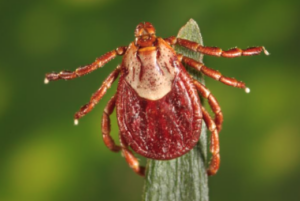
- Blacklegged tick (deer tick): carries Lyme. Common in the Northeast, mid-Atlantic, and upper Midwest, with a western cousin along the Pacific coast¹. The nymph is about the size of a poppy seed, so most patients never notice the bite².
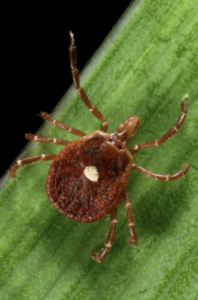
- Lone star tick: the adult female has one white spot on her back. Common in the South, East, and Midwest.³ It doesn’t carry Lyme, but it’s the main cause of alpha-gal syndrome¹,⁴.
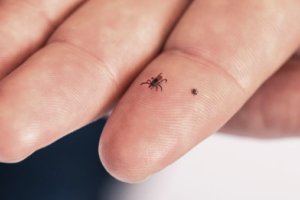
- Rocky Mountain wood tick: the common tick in the Rocky Mountain states³. It doesn’t carry Lyme¹(So my sagebrush fort was safe, at least from Lyme, whew!).However, it can transmit other serious infections, including Rocky Mountain spotted fever, Colorado tick fever, and tularemia.
[IMAGES: row of three, PHIL 28383, PHIL 8676, PHIL 10865]
Blacklegged tick, adult female (left) and nymph (right). Photo: CDC/Lauren Bishop.
Lone star tick, adult female. Photo: CDC/James Gathany.
Rocky Mountain wood tick. Photo: CDC/James Gathany.
Source for all: CDC Public Health Image Library.
If the patient can’t name the tick, their geographic exposure can help narrow the possibilities, although tick species and their ranges may overlap.
What does a Lyme rash actually look like?
Most of us learned the Lyme rash as a bull’s-eye presentation. In the US, most erythema migrans (EM) rashes are evenly red, or reddest in the center, with no rings at all²,⁵. A typical EM is diagnosed on sight ⁶.
The rash is the bacteria spreading outward through the skin from the bite, which is why it grows². What to look for:
- A red patch at the bite site that keeps expanding over several days, sometimes to 12 inches or more
- Shows up 3 to 30 days after the bite, about a week on average
- Warm to the touch, but rarely itchy or painful⁷.
A small red bump right after the bite that looks like a mosquito bite and fades in a day or two is a bite reaction, not Lyme⁷.
Should you test a typical EM?
No. For a typical EM rash, skip the blood test and treat ⁶.
The rash shows up before the immune system has made enough antibodies to measure. If you were to test 10 patients with a fresh rash, 6 to 8 of them would come back negative⁸. Antibody testing has limited sensitivity during early localized Lyme disease, so a negative result does not exclude infection. When a patient has a typical erythema migrans rash and credible exposure, treatment should not wait for laboratory confirmation.
Two more tests to skip after a tick bite ⁶:
- Testing the tick itself for Lyme bacteria. A positive or negative tick doesn’t predict whether the patient gets infected. (Identifying the species is still useful.)
- Testing a patient who has no symptoms.
Save the blood test for a rash that doesn’t look typical. If that first draw is negative, IDSA suggests a second sample taken later to catch the antibodies as they rise⁶.
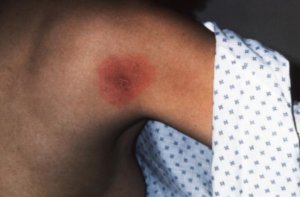
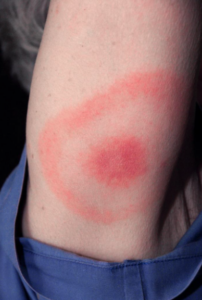
[IMAGES: side by side, PHIL 9875 and PHIL 14474]
The Lyme rash everyone pictures (left) and a more typical one (right). Photos: CDC/James Gathany (left), CDC (right). Source: CDC Public Health Image Library.
How long do you treat a Lyme rash?
Treat a typical EM with 10 days of doxycycline, or 14 days of amoxicillin or cefuroxime ⁶. Longer courses aren’t recommended. Azithromycin for 7 days is the backup for patients who can’t take doxycycline or a beta-lactam ⁶. Doxycycline isn’t off-limits for young kids anymore, either. IDSA notes a growing consensus that courses of up to 14 days are safe in young children (plus, newer research casts doubt on that old tooth-staining worry ⁶).
Doxycycline counseling is the same as always: take it with a full glass of water and wear sunscreen⁹,¹⁰. And finish the course as written, even after the rash fades.
What about a single dose of doxycycline right after the bite? It’s an option for a high-risk bite within 72 hours of removing the tick, and the criteria are strict. We walked through who qualifies in our July article on doxycycline uses.
What is alpha-gal syndrome?
Alpha-gal is a sugar found in most mammals, but not in people, birds, or fish. A tick bite, most often from a lone star tick, can sensitize the immune system to it⁴,¹¹. Lone star ticks aren’t the only suspect, though: Maine has reported a case after a blacklegged tick bite¹². It’s an allergy, not an infection, so antibiotics don’t treat or prevent it. The doxycycline from the last section does nothing here.
Consider alpha-gal when a patient has hives, stomach symptoms, or anaphylaxis 2 to 6 hours after eating red meat or dairy¹¹,¹³. The delay is a big part of why it gets missed. So is unfamiliarity: in a CDC survey of 1,500 clinicians, about 4 in 10 had never heard of it ¹³.
The workup is an alpha-gal IgE blood test, read alongside the history, because a positive result alone doesn’t make the diagnosis¹⁴. From there, it’s avoidance, an allergist, and an epinephrine plan for anyone with systemic reactions¹⁵,¹⁶.
Pharmacists, something good for you to keep in mind as well: some medications made with gelatin can trigger a reaction¹.Not every patient reacts to dairy, gelatin, or mammalian-derived medications. Avoidance recommendations should be individualized according to reaction history and allergy evaluation.
Where the gap is after a tick bite
Most tick bites don’t happen conveniently next to a clinic during office hours. They happen on a trail, at a cabin, or on a hunting trip. And right now, care after a bite is all or none: the patient reaches a clinician while it still matters, or they’re left with a rash, an internet search, and a bull’s-eye picture that doesn’t match what’s on their leg.
That missing middle is the work we do. We call it appropriate medical preparation: teaching patients what to watch for before they head out, with a clinician-built plan for when care isn’t reachable. It’s in no way a replacement for primary care. It’s for the times when primary care isn’t there.
Tick bites are part of that work. Doxycycline is in every JaseCase, and its card covers two tick situations: the single preventive dose, only when every criterion on the card is met, and the 10-day course for an EM rash. Both are for emergency use only, after the patient has first tried to reach a qualified healthcare provider.
If you’d rather not prescribe in this space, you can refer patients to us. A licensed provider reviews every request and writes every prescription. And we’ll keep publishing how we draw these lines, the same way we did here.
The bottom line
Ask which tick made the bite and where it happened. Diagnose a typical Lyme rash on sight, and don’t wait for a bull’s-eye or a positive test to treat it. Skip testing the tick, and skip testing the patient with no symptoms. Think alpha-gal when a lone star bite is followed by delayed reactions to red meat, and remember antibiotics won’t touch it.
People who love the outdoors aren’t going to stay inside, and I’m one of them. To refer a patient, visit Jase.com, where a licensed provider reviews every request.
Sources
- CDC. How Lyme disease spreads. Updated September 24, 2024. https://www.cdc.gov/lyme/causes/index.html
- Nadelman RB. Erythema migrans. Infect Dis Clin North Am. 2015;29(2):211-239. https://doi.org/10.1016/j.idc.2015.02.001
- CDC. Where ticks live. Updated July 30, 2025. https://www.cdc.gov/ticks/about/where-ticks-live.html
- CDC. About alpha-gal syndrome. Updated January 5, 2026. https://www.cdc.gov/alpha-gal-syndrome/about/index.html
- Smith RP, Schoen RT, Rahn DW, et al. Clinical characteristics and treatment outcome of early Lyme disease in patients with microbiologically confirmed erythema migrans. Ann Intern Med. 2002;136(6):421-428. https://doi.org/10.7326/0003-4819-136-6-200203190-00005
- Lantos PM, Rumbaugh J, Bockenstedt LK, et al. Clinical practice guidelines by the Infectious Diseases Society of America (IDSA), American Academy of Neurology (AAN), and American College of Rheumatology (ACR): 2020 guidelines for the prevention, diagnosis, and treatment of Lyme disease. Clin Infect Dis. 2021;72(1):e1-e48. https://doi.org/10.1093/cid/ciaa1215
- CDC. Signs and symptoms of untreated Lyme disease. Updated May 15, 2024. https://www.cdc.gov/lyme/signs-symptoms/index.html
- Horn EJ, Menefee B, Schotthoefer AM, et al. Evaluation of standard and modified two-tiered testing algorithms using well-characterized early Lyme disease samples. J Clin Microbiol. 2026;64(5):e0118725. https://doi.org/10.1128/jcm.01187-25
- MedlinePlus. Doxycycline. Revised May 15, 2026. https://medlineplus.gov/druginfo/meds/a682063.html
- Medsafe (New Zealand Medicines and Medical Devices Safety Authority). Oesophagitis with doxycycline and others. Prescriber Update. 2003;24(2):30. https://www.medsafe.govt.nz/profs/puarticles/doxoesoph.htm
- CDC. Alpha-gal syndrome for healthcare providers. April 12, 2022. https://stacks.cdc.gov/view/cdc/131343
- Saunders EF, Sohail H, Myles DJ, et al. Alpha-gal syndrome after Ixodes scapularis tick bite and statewide surveillance, Maine, USA, 2014–2023. Emerg Infect Dis. 2025;31(4). https://doi.org/10.3201/eid3104.241265
- Carpenter A, Drexler NA, McCormick DW, et al. Health care provider knowledge regarding alpha-gal syndrome: United States, March–May 2022. MMWR Morb Mortal Wkly Rep. 2023;72(30):809-814. https://doi.org/10.15585/mmwr.mm7230a1
- CDC. Clinical diagnosis and testing (alpha-gal syndrome). Updated January 5, 2026. https://www.cdc.gov/alpha-gal-syndrome/hcp/diagnosis-testing/index.html
- Nationwide Children’s Hospital. Alpha-gal syndrome (AGS): clinical FAQ for health care professionals. October 2025. https://pediatricsnationwide.org/wp-content/uploads/2026/04/W2043400-RUSH_Alpha-Gal-Syndrome_Clinical-FAQ-for-Providers_FINAL.pdf
- CDC. Managing alpha-gal syndrome. Updated January 5, 2026. https://www.cdc.gov/alpha-gal-syndrome/managing/index.html
Lifesaving Solutions
Recent Posts
Keeping you informed and safe.
Diabetes Sick-Day Rules in a Disaster
Diabetes Sick-Day Rules in a Disaster By the Jase Medical Team Diabetes sick-day rules are usually written for an ordinary week. You get the flu. Your stomach is upset. You check your blood sugar more often, keep drinking fluids, follow your medication plan, and call...
For Clinicians | Diabetes Sick-Day Rules in a Disaster
For Clinicians | Diabetes Sick-Day Rules in a Disaster By Dr. Jamie Wilkey, PharmD, Director of Clinical EducationMedically reviewed and edited by Kristen Carpenter, PA-C Diabetes is already hard to manage. Sick days just make everything worse. And a sick day in a...
Burns in a Blackout
Burns in a Blackout: First Aid When the Tap Doesn't Run By the Jase Medical Team Almost every burn first aid guide starts with the same instruction: cool the burn under clean, cool running water. But what happens when the tap doesn't run? For households that rely on a...
For Clinicians | Burn First Aid Without Running Water
For Clinicians | Burn First Aid Without Running Water By Dr. Jamie Wilkey, PharmD, Director of Clinical EducationMedically reviewed and edited by Aaron Asay, PA-C, DMSc, FIBODM, FAWM Every burn first-aid guide starts the same way: cool it under running water. That's...