
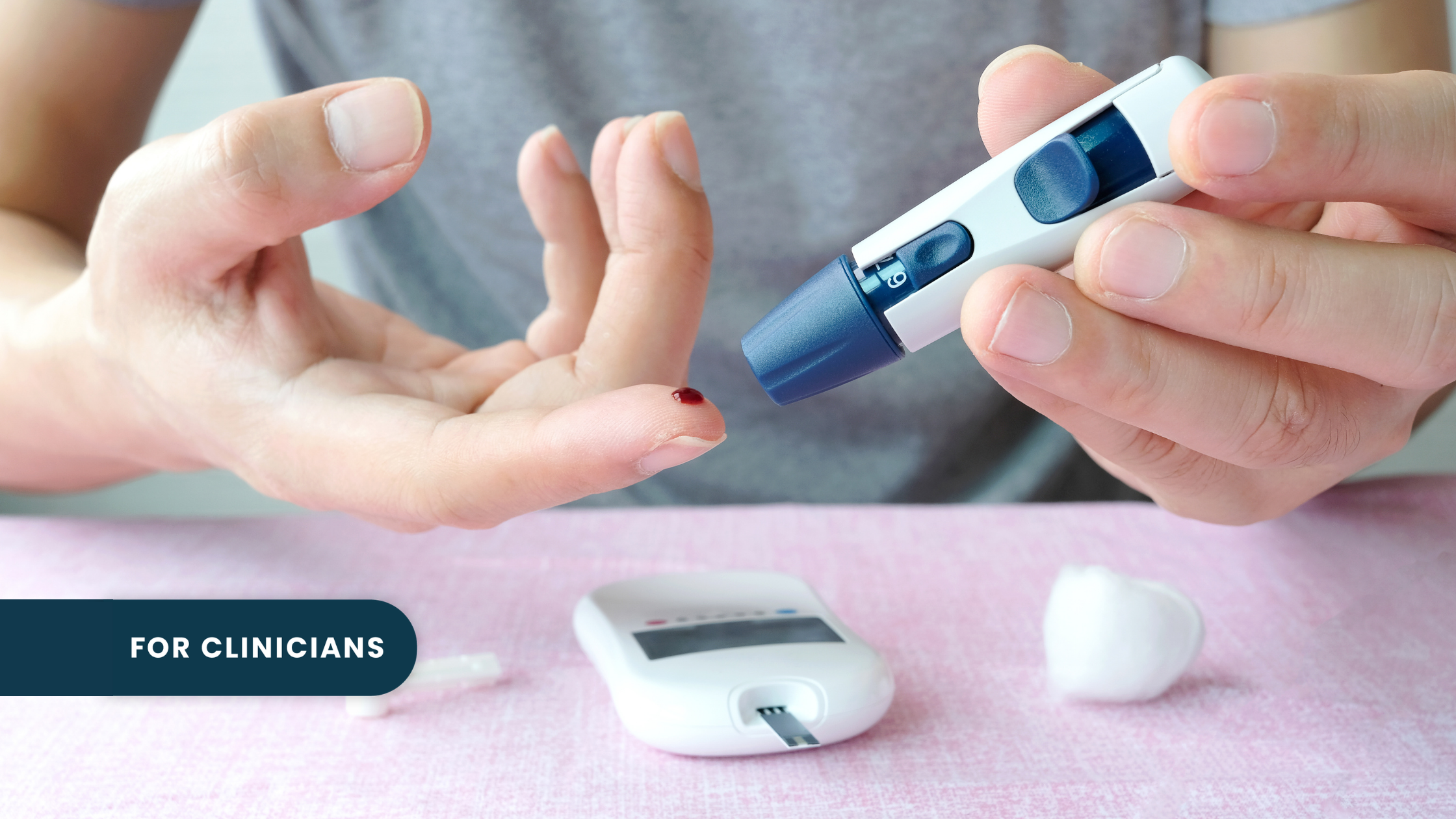
For Clinicians | Diabetes Sick-Day Rules in a Disaster
By Dr. Jamie Wilkey, PharmD, Director of Clinical Education
Medically reviewed and edited by Kristen Carpenter, PA-C
Diabetes is already hard to manage. Sick days just make everything worse. And a sick day in a disaster, when healthcare isn’t readily available, compounds the hardship. Put the three together and it’s 1 + 1 + 1. For someone’s health, that doesn’t equal 3.
It equals 20.
And the disaster itself counts as its own 1, even before anyone gets sick. In a Puerto Rico cohort of adults who didn’t have diabetes, new cases showed up at about twice the pre-storm rate in the years spanning Hurricanes Irma and Maria¹.
Disaster guidance for diabetes focuses mostly on a supply list (have plenty of insulin on hand and stored properly!). Sick days barely come up as a management topic. That’s a big gap when about 40 million Americans have diabetes, 2.1 million of them type 1². Their care really does change in a disaster, whether that’s a hurricane or a week when they can’t reach their clinic or pharmacy. We have to address that.
Today we’ll cover:
- what a diabetes sick day is
- which medications pause (+ why insulin never pauses)
- how ketones work, and why a normal meter reading can fool you
- what to look for in the OTC aisle
- how to write the plan before storm season
What is a diabetes sick day?
I’m including this here to start because even as a pharmacist I have to admit (abashedly) that I didn’t know much about this topic. 99% of my diabetic counseling focused on medications in general and blood sugar testing.
A diabetes sick day is any illness that changes how the body handles glucose, fluids, or medications: a stomach bug, a fever, a UTI, or a really rough flu. The hormones the body releases to fight illness push blood sugar up ³…. even in a patient who has barely eaten all day. Vomiting, diarrhea, and fever drain fluid, and the kidneys feel it first. That’s where the medication problems start. Several of the drugs these patients take every day either depend on the kidneys or make dehydration worse. And when insulin runs short, the body breaks down fat for fuel and starts making ketones.
Sick-day rules exist to catch all of that early: check glucose more often, keep fluids going, check ketones, and call when the numbers cross a line. The ADA’s patient guide ends with “call your doctor or go to the ER” ⁴. Yep, every version ends there, which doesn’t really work.
A disaster amplifies everything. Bad water brings on vomiting and diarrhea. Heat causes dehydration. Meals get skipped. Smoke or mold sets off someone’s asthma, and the steroid burst that settles their breathing raises glucose on its own (we covered that in our asthma and COPD flare article). The clinic is often closed, flooded, or not picking up, so care isn’t available.
Which medications pause on a diabetes sick day?
Canadian clinicians teach the pause list as SADMANS, a Diabetes Canada mnemonic ⁵, and UK sick-day cards carry close versions of it⁶,⁷. Each class gets much riskier when a patient is dehydrated or not eating, and most of the list comes back to the kidney’s filter, which needs pressure to work. Picture a garden hose with me for the kidneys. Blood volume is the water from the spigot. When the water runs low, the kidney keeps the spray going two ways: it holds the inflow open, and it puts a thumb over the end of the hose so pressure builds inside, where the filtering happens. That’ll help you picture how the SADMANS medications affect the patient’s kidney.
- S: sulfonylureas like glipizide and glimepiride keep pushing insulin out when the patient isn’t eating. Some linger as kidney function drops.
- A: ACE inhibitors like lisinopril shut off angiotensin II, and angiotensin II is the kidney’s thumb. Take it away from a dehydrated patient and filtering pressure drops.
- D: diuretics like HCTZ and furosemide turn the spigot down further on a patient who’s already losing fluid.
- M: metformin doesn’t hurt the kidneys, but they’re its only way out. When they slow down, metformin builds up, and so does the risk of lactic acidosis.
- A: ARBs like losartan take the thumb off the same way ACE inhibitors do.
- N: NSAIDs like ibuprofen and naproxen kink the hose near the spigot by blocking the prostaglandins that hold the inflow open. (Spigot down, hose kinked, thumb off: that’s the triple whammy from our drug interactions article)
- S: SGLT2 inhibitors like Jardiance and Farxiga pull glucose and water out through the urine, deepening dehydration, and raise DKA risk, sometimes with a normal glucose (more on that next).
GLP-1 drugs like semaglutide aren’t in the mnemonic, but the ADA Standards note they may need holding when GI symptoms are significant ⁸.
SADMANS isn’t a US guideline, and the evidence behind sick-day lists is mostly expert opinion⁵. The ADA Standards say to consider holding metformin and SGLT2 inhibitors when the patient can’t keep up with eating and drinking or kidney injury is a concern ⁸, and Jardiance’s label says to withhold it, if possible, in situations that could predispose to ketoacidosis ⁹. The ADA’s patient guide says to keep taking diabetes medications as prescribed unless the doctor advises otherwise ⁴. That “unless” is our job. Which pills pause for which patient, and when they restart (UK practice is usually after 24 to 48 hours of normal eating and drinking⁶, are prescriber decisions that belong in the written plan. The plan is for emergency use only, after the patient has tried to reach their prescriber or pharmacist first.
And just to be clear here, insulin never pauses. Basal insulin keeps going even when the patient isn’t eating⁸. Mealtime doses follow the food¹⁰, and the total dose can change while they’re sick ³, which is exactly the kind of adjustment that belongs in the plan. Stopping basal insulin because they can’t eat is the classic road to DKA, and in type 1 that road is short. (For keeping insulin cool when the power’s out, see our insulin storage article.)
Who owns the sick-day conversation?
The ADA already tells patients to make a sick-day action plan with their doctor before they ever get sick ⁴. I don’t think many of us are having that conversation, in the office or at the pharmacy. In more than 10 years as a pharmacist, I’ve had five or fewer of them. I’m not proud of that at all, but patients rarely, if ever, proactively brought up the topic. At my busy 24-hour pharmacy, counseling got to the single most important thing a patient needs to start the medication (and sick days didn’t usually make the cut).
Part of the problem is that nobody owns the med list. The pills that pause on a sick day often come from two prescribers: metformin and an SGLT2 inhibitor from primary care, lisinopril and a diuretic from cardiology. Each prescriber may only see their half. The pharmacy profile shows every prescription filled there, from every prescriber, and our interaction software checks across all of it.
That makes this a pharmacy counter conversation as much as an office one. For a patient on metformin, Jardiance, lisinopril, and HCTZ, here’s how it would sound coming from me:
“When you’re sick, it can really change your diabetes and your medications and you have to be extra careful. Here’s what to know in a nutshell. If you’re throwing up or can’t keep fluids down, some of your pills may need to pause until you’ve been eating and drinking normally for a day or two. For you, that’s probably all four, but your doctor makes that call, so let’s ask them to put it in writing now. I’ll send a fax requesting that right now. Because you’re on Jardiance, check your ketones when you’re sick, even if your sugar looks normal. Call your doctor or the pharmacy first. If you can’t reach anyone, these symptoms mean you need to get to emergency care ASAP: throwing up or diarrhea for more than 4 hours, moderate or large ketones, or a sugar over 300 twice.“
How ketones work, and why a normal meter reading can fool you
Ketones are what the liver makes from fat when cells can’t get enough insulin to use glucose. A little after a long fast is normal. When insulin runs short in a dehydrated patient, ketones build faster than the body clears them. Then the blood turns acidic, and that’s DKA (diabetic ketoacidosis).
On an SGLT2 inhibitor, the kidneys keep dumping glucose into the urine, so the meter can read 150 while ketones climb. Jardiance’s label warns that glucose at presentation can sit below what we’d expect for DKA, for example under 250 ⁹, and the ADA defines euglycemic DKA as DKA with a glucose under 200 ¹¹. The glucose number stops being a warning light, so an SGLT2 user’s plan needs to be checking ketones when sick, whatever the meter reads.
The tool matters too. There are two main ketones in the blood, and urine strips only see one of them. In DKA, most of the ketones are the other kind¹², so a strip can read low while the real level is high. That’s why the ADA wants at-risk SGLT2 users to have a blood ketone meter¹³. From what I’ve seen working in the pharmacy a lot of urine strips and keto meters are being bought up by the keto, weight-loss, and muscle-building crowds, so they can be kind of hard to find sometimes. (Funny twist, since the ADA also tells us to steer SGLT2 users away from keto eating¹³.) Put the strips, or a blood meter, on the written plan and make sure that patients actually have some on hand so they’re handy before they are needed.
The Wilderness Medical Society tells insulin users heading into the backcountry to carry a ketone kit, and it treats DKA as an emergency that calls for evacuation¹⁴. A hurricane week at home isn’t the backcountry, but it shares the part the guideline is written around: limited access to care. Moderate or large ketones means to get to emergency care, not wait for the phone.
What to look for in the OTC aisle
The ADA’s guide tells patients to work out which OTC medications are safe with their doctor before they get sick ⁴, but it doesn’t say which ones. The pharmacist is the natural person to fill in that blank. Every pick comes back to the two questions from the pause list: what it does to the kidneys, and what it does to glucose.
- Ibuprofen and naproxen are the N in SADMANS, and they hide in combination products (one 12-hour sinus product pairs naproxen with pseudoephedrine). The plan should name the swap for pain and fever, usually acetaminophen if the liver allows.
- Pseudoephedrine’s Drug Facts tell anyone with diabetes to ask a doctor before using it¹⁵.
- The ADA’s guide says to alternate water and electrolyte drinks ⁴, and sugar isn’t automatically the enemy. A patient who can’t eat still needs about 50 grams of carbohydrate every 4 hours ³, and regular juice or soda may be how they get it.
- Glucose tabs or gel are on the ADA’s sick-day supply list ⁴, and they matter most for anyone on a sulfonylurea or insulin who can’t eat.
Like everything else on the plan, these are emergency-use answers, for when the patient has tried to reach their pharmacist or prescriber first and can’t get through.
How to write the plan before storm season
The ADA’s guide already lists what belongs in a sick-day plan ⁴. The disaster version fills in every line with this patient’s medication names and strengths written on paper, kept with their medication list:
- Which of their pills pause, by name, and when each one restarts
- For insulin users, the basal dose that keeps going and how to adjust mealtime and correction doses
- How often to check glucose and ketones, and with what (urine strips or a blood meter)
- The OTC picks for fever and pain, congestion, fluids, and lows
- The numbers that mean get to emergency care when no one answers:
- vomiting or diarrhea for more than 4 hours
- moderate or large ketones, or the blood ketone number you set
- glucose over 300 on two readings despite corrections
- fever over 101°F lasting more than 24 hours
- signs of dehydration, like dizziness or dark urine
- Who to call first, their number, and when they are reachable: the prescriber or the pharmacy
The plan is for emergency use only, after the patient has tried those calls and can’t get through.
The bottom line
Sick-day care for diabetes is all or nothing right now. Either the clinic or the pharmacy picks up, or the patient is alone with four bottles and a meter just guessing and winging it with what they look up online. A written plan is the missing middle layer: the decision made ahead of time by the person who should make it, ready for the day nobody answers. That’s appropriate medical preparation at its simplest. It’s in no way a replacement for primary care; we’re here for the times when primary care isn’t there. Our team of physicians, PAs, and pharmacists is building the version of this plan for the week the clinic’s phone is dead, and we’ll publish the framework as we go.
Before the next storm, write the plan for every patient on an SGLT2 inhibitor, metformin, or insulin. Pharmacists, start it at the counter.
A sick day in a disaster will never be easy. A plan on paper keeps 1 + 1 + 1 a lot closer to 3.
Sources
- Martínez-Lozano M, Noboa C, Alvarado-González G, Joshipura KJ. Hurricanes Irma and Maria and diabetes incidence in Puerto Rico. BMC Public Health. 2023;23:1019. https://pmc.ncbi.nlm.nih.gov/articles/PMC10227808/
- Centers for Disease Control and Prevention. National Diabetes Statistics Report. Updated September 16, 2026. https://www.cdc.gov/diabetes/php/data-research/index.html
- Centers for Disease Control and Prevention. Managing sick days. Updated May 15, 2024. https://www.cdc.gov/diabetes/living-with/managing-sick-days.html
- American Diabetes Association. Sick Day Guide for People with Diabetes (patient version). September 2025. Based on the Standards of Care in Diabetes-2025. https://professional.diabetes.org/sites/dpro/files/2025-09/SickDayGuide_Final.pdf
- Watson KE, Dhaliwal K, McMurtry E, et al. Sick day medication guidance for people with diabetes, kidney disease, or cardiovascular disease: a systematic scoping review. Kidney Med. 2022;4(9):100491. https://pmc.ncbi.nlm.nih.gov/articles/PMC9420951/
- Healthcare Improvement Scotland. Medicines sick day guidance card, version 4. 2026. https://www.healthcareimprovementscotland.scot/wp-content/uploads/2026/05/Medicines-sick-day-guidance-card-A6-June-2026.pdf
- Northern Ireland Formulary. Sick day rules. Accessed October 5, 2026. https://niformulary.hscni.net/formulary/6-0-endocrine/6-1-drugs-used-in-diabetes/6-1-2-antidiabetic-drugs/sick-day-rules/
- American Diabetes Association Professional Practice Committee for Diabetes. 6. Glycemic goals, hypoglycemia, and hyperglycemic crises: Standards of Care in Diabetes-2026. Diabetes Care. 2026;49(Suppl 1):S132-S149. https://pmc.ncbi.nlm.nih.gov/articles/PMC12690178/
- Jardiance (empagliflozin) prescribing information. Boehringer Ingelheim Pharmaceuticals; revised January 2026. DailyMed. https://dailymed.nlm.nih.gov/dailymed/drugInfo.cfm?setid=faf3dd6a-9cd0-39c2-0d2e-232cb3f67565
- RxFiles. Protecting the kidneys. September 2025. https://www.rxfiles.ca/RxFiles/uploads/documents/SADMANS-Rx.pdf
- American Diabetes Association Professional Practice Committee for Diabetes. 16. Diabetes care in the hospital: Standards of Care in Diabetes-2026. Diabetes Care. 2026;49(Suppl 1):S339-S355. doi:10.2337/dc26-S016
- Umpierrez GE, et al. Hyperglycemic crises in adults with diabetes: a consensus report. Diabetes Care. 2024;47(8):1257-1275. https://pmc.ncbi.nlm.nih.gov/articles/PMC11272983/
- American Diabetes Association Professional Practice Committee for Diabetes. 9. Pharmacologic approaches to glycemic treatment: Standards of Care in Diabetes-2026. Diabetes Care. 2026;49(Suppl 1):S183-S215. https://pmc.ncbi.nlm.nih.gov/articles/PMC12690185/
- VanBaak KD, et al. Wilderness Medical Society clinical practice guidelines for diabetes management. Wilderness Environ Med. 2019;30(4 Suppl):S121-S140. Written for wilderness athletes; recommendations cited: carry a ketone testing kit (grade 1B), and evacuate for DKA or HHS (grade 1A). https://pmc.ncbi.nlm.nih.gov/articles/PMC7510348/
- Sudafed Sinus Congestion 12 Hour (pseudoephedrine HCl) Drug Facts label. Kenvue; revised November 8, 2024. DailyMed. https://dailymed.nlm.nih.gov/dailymed/drugInfo.cfm?setid=d600b5d5-7d95-4ad6-a95b-6d73502743d7
Lifesaving Solutions
Recent Posts
Keeping you informed and safe.

Burns in a Blackout
Burns in a Blackout: First Aid When the Tap Doesn't Run By the Jase Medical Team Almost every burn first aid guide starts with the same instruction: cool the burn under clean, cool running water. But what happens when the tap doesn't run? For households that rely on a...
For Clinicians | Burn First Aid Without Running Water
For Clinicians | Burn First Aid Without Running Water By Dr. Jamie Wilkey, PharmD, Director of Clinical EducationMedically reviewed and edited by Aaron Asay, PA-C, DMSc, FIBODM, FAWM Every burn first-aid guide starts the same way: cool it under running water. That's...

What to Do If You’re Bitten by a Snake?
What to Do If You're Bitten by a Snake: Forget What the Movies Taught You By the Jase Medical Team If you're bitten by a venomous snake, forget almost everything the movies taught you about snakebite first aid. Don't cut an X over the fang marks. Don't suck out the...

For Clinicians | Should You Suck Out Snake Venom?
For Clinicians | Should You Suck Out Snake Venom? The Snakebite Myths Your Patients Still Believe By Dr. Jamie Wilkey, PharmD, Director of Clinical EducationMedically reviewed and edited by Aaron Asay, PA-C, DMSc, FIBODM, FAWM I really love gathering my little boys...