
For Clinicians | What Summer Heat Actually Does to Your Patients’ Medications
By Dr. Jamie Wilkey, PharmD — Director of Clinical Strategy, Jase
Medically reviewed by Kristen Carpenter, PA-C — Clinical Advisory Board Member
Most patients don’t call about how to store their medications. They Google it. They land on WebMD or a Reddit thread, depending on what SEO surfaces that morning, and they read whatever shows up first. The one exception is cold-chain medications. Insulin and GLP-1 questions do come into the office or the pharmacy, usually right before a vacation or right after a fridge incident, because the bottle says “refrigerate” in big letters and the patient knows it costs a lot. Everything else, the prescription bottle just says “store at room temperature” and the patient extrapolates from there.
But medications are some of the most valuable, fragile things in the average household that don’t play well with a boiling hot summer. A 90-day supply of a maintenance drug, an EpiPen, a JaseCase on the shelf, a vial of insulin in the door of the fridge: these are the household items that matter most on the day something goes wrong, and they’re surprisingly easy to degrade. Summer is hard on all of them. Heat, humidity, light, and the slow accumulation of a parked-car afternoon all chip at potency in ways the label doesn’t quite explain. A brush-up on the basics is overdue: so we have something clean to say when a patient does ask, and because every prescribing clinician should be able to answer this kind of question without scrambling.
So we wrote the answer. Below is everything that actually matters about summer medication storage: what heat does, where patients should keep their medications at home, the room-temperature windows for refrigerated medications that most labels underestimate, how to travel with all of it, and the cold-chain devices worth knowing by name. Read it yourself, or send the link to patients with a lot of questions.
What does heat actually do to medications?
Heat speeds up the chemical breakdown of the active ingredient. The molecule degrades faster than it would at room temperature, the medication loses potency, and the same pill or vial does less of what it’s supposed to do. For tablets and capsules, prolonged heat can also soften capsule shells and damage the stabilizers that keep the active ingredient intact between manufacture and ingestion. For biologics and protein medications like insulin and monoclonal antibodies, proteins unfold under heat and the medication loses activity in a way that’s harder to reverse than potency loss in a tablet.
The risk is almost always reduced potency, not toxicity. The medication does less, not something different. That distinction carries the rest of this article.
USP storage definitions are simpler than the label suggests:
- Room temperature: 68 to 77°F
- Brief excursions to 86°F: explicitly tolerated
- Sustained above 86°F: stability concerns start
- Sustained above 104°F: real degradation territory for most medications
The frame that carries every storage conversation is brief excursion vs. sustained exposure. Most of us learned this in some form in school, but the prescription label doesn’t carry the math; it just says “store at room temperature” and stops there.
The most useful number anyone can carry: a 2018 ASU and UC San Diego study found that on a 100°F day in direct sun, a car interior reaches an average of 116°F within an hour.¹ Dashboards hit 157°F. Even on a 72°F day, a closed car parked in the sun can reach 117°F within 60 minutes. About 80% of the temperature rise happens in the first 30 minutes.² The car isn’t a controlled-room-temperature environment. It’s an oven with windows.
For most medications, what actually matters is the answer to two questions: how hot did it get, and for how long. A single afternoon on a hot passenger seat is closer to “excursion” than “sustained exposure” for most solid oral dosage forms in their original packaging. A summer in the glove compartment is the opposite. The line to teach patients, and the one to keep in our own heads, is the difference between an excursion and a season.
Where should medications actually live at home?
The two most popular places to store medications are also two of the worst: the bathroom medicine cabinet and the kitchen counter or cabinet. Each fails for a different reason.
Bathrooms run hot and humid. Measured temperatures range from 57 to 89°F and relative humidity from 33 to 100%, with shower steam pushing the high end well past pharmaceutical tolerances.³ Pills absorb water and capsule shells soften. Dissolution profiles shift and pharmacokinetics get less predictable. The “don’t store meds in the bathroom” advice is one of the few storage rules that’s actually right, even if most patients haven’t heard it explained.
Kitchens fail differently. Measured temperatures range from 61 to 97°F. Cooking heat and sink humidity spike unpredictably; an open oven or a warm dishwasher can push the room well above room-temperature thresholds in minutes.³ A 2023 case report documented enzalutamide degrading in a patient’s kitchen at sustained temperatures of 32 to 34°C, a real outcome from a perfectly normal storage location.⁴ Kitchens look benign on a 70°F morning. The medications inside don’t stay benign through a few weeks of summer.
Glove compartments and garages are the worst of the lot in summer. Glove compartment heat accumulates and is documented as unsuitable for any drug storage. Garages in heat-wave conditions routinely exceed 104°F for days at a time, which is the threshold where stability concerns become guarantees.
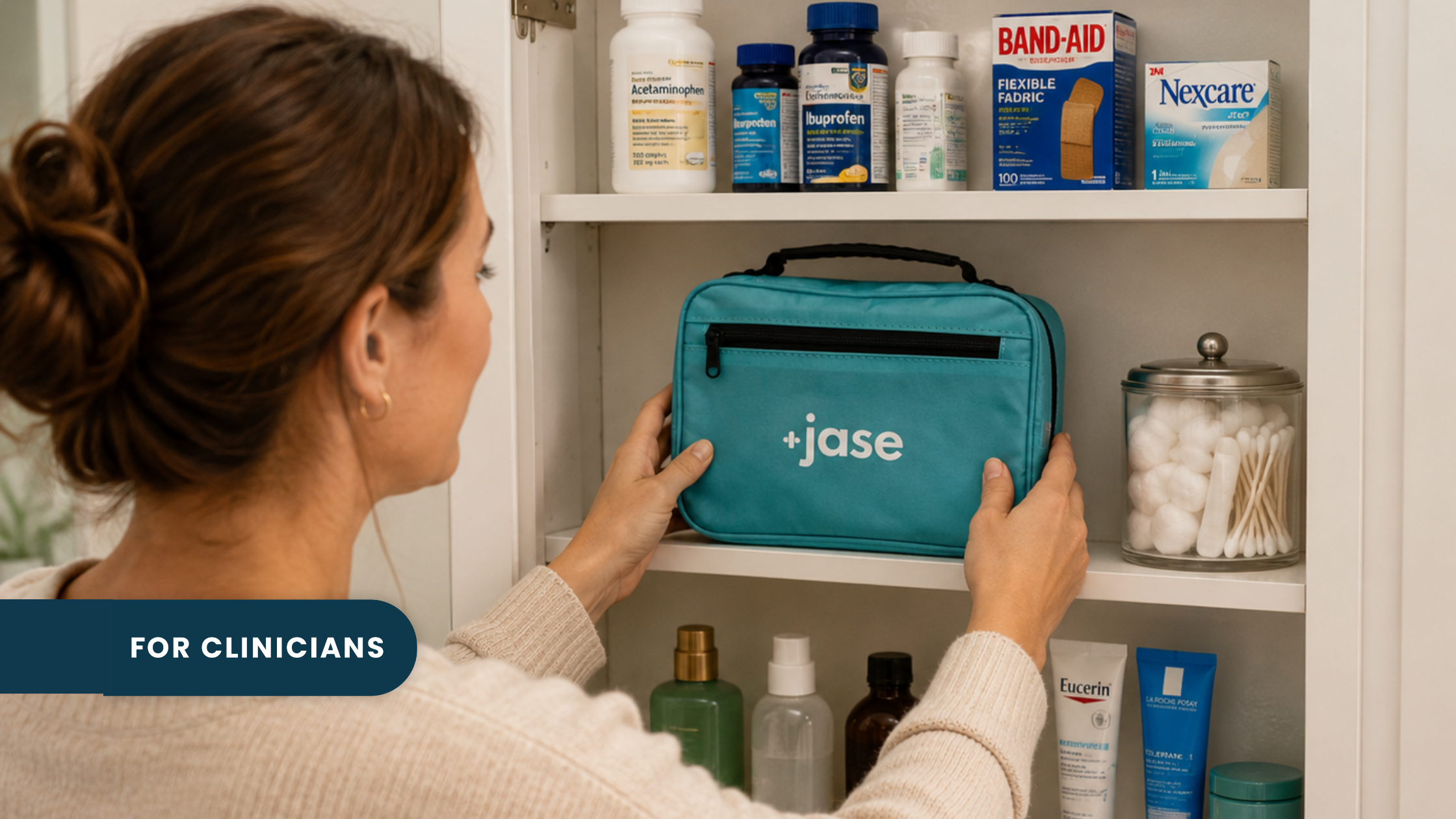
The FDA’s recommended locations are mundane on purpose: a bedroom dresser drawer, a closet shelf, a storage box, or a kitchen cabinet that’s away from the stove and the sink.⁵ The dresser drawer is the consistent winner: cool, dark, dry, and out of reach of shower steam. A JaseCase belongs there too. The kit is room-temperature stable as designed; it just needs a sensible address.
Mail-order pharmacy and the summer porch
Mail-order pharmacy is now standard for millions of patients, and that matters in summer. A package leaving an Express Scripts or OptumRx fulfillment center in July spends hours in a non-climate-controlled truck, then more hours sitting on a porch in the sun before anyone brings it inside.
Internal package temperatures in summer delivery trucks and on porches have been measured at over 100°F in 2024 investigations.⁶ For solid oral medications in original packaging, a single hot transit is closer to “excursion” than “sustained exposure” and usually doesn’t matter. For biologics and refrigerated medications, every hour above label tolerance matters.
We ship by mail too. If a Jase package lands on a 95°F porch, the right move is to bring it inside as soon as it arrives, not when the lawn gets watered or the dog gets walked. Pharmacy counters see the back end of the same problem: patients picking up a prescription, walking to a hot car, running errands for two more hours before they get home. The trip from that pharmacy counter to the drawer at home matters too.
What does light do to medications?
UV light degrades the active ingredient in many medications the same way heat does, just through a different mechanism. The amber tint on prescription bottles is the simplest defense pharma has built into the supply chain: it blocks the wavelengths most likely to break down photosensitive drugs. The bottles are orange for a reason. It isn’t aesthetic or because pharmacists love the color orange.
Ciprofloxacin and metronidazole both carry explicit “protect from light” guidance. Doxycycline does too, and adds patient phototoxicity on top: the exaggerated sunburn from minimal sun exposure that we warn patients about at prescription or pickup.⁷ The same UV that’s bad for the patient is also bad for the drug.
The practical implication: keep antibiotics in their original packaging until use. Pill organizers are fine for daily-use chronic medications taken every morning, but they’re a poor home for an antibiotic that might sit there for months. Original amber bottle or original blister pack.
Does refrigerating medications make them last longer?
The patient logic is easy to reconstruct: cold keeps food fresh longer, so cold should keep pills fresh longer. Old antibiotics, expensive maintenance meds, anything the patient wants to “stay good” ends up in the refrigerator door next to the ketchup. Ask anyone who has done a brown-bag medication review.
The chemistry instinct isn’t wrong. Cold does slow degradation. The problem is everything else about a refrigerator. It’s a high-humidity box, and every trip out of it sets a cold bottle in a warm room, where condensation forms on and inside the container. For tablets and capsules, moisture is a worse enemy than mild warmth: hygroscopic tablets absorb water, capsule shells soften, and dissolution shifts, the same failure mode as the bathroom shelf. Aspirin is the classic example. Hydrolysis breaks it into salicylic acid and acetic acid, which is why an old bottle smells faintly of vinegar.
Two more points worth having ready at the counter:
- Refrigeration doesn’t extend the expiration date. Stability testing assumes room temperature, and the date on the bottle is the date no matter where it sits. The cold may slow the chemistry a little, but the patient can’t bank that time, and the moisture exposure can outrun whatever it adds.
- Some medications actively don’t tolerate cold. Clarithromycin suspension is the standard counterexample: refrigerate it and it thickens and turns intensely bitter, which is why the label says not to. Amoxicillin suspension, meanwhile, goes in the fridge for taste. The label decides, not the drug category.
Refrigerate what the label tells you to refrigerate, nothing else.
Everything else does better in the drawer.
How long do refrigerated medications last at room temperature?
Insulin and GLP-1s are the top medications that patients ask about the most, with the refrigerated biologics (Humira, Dupixent, Enbrel) close behind. Anything that lives in the fridge gets the patient’s full attention, because the bottle says so and the price tag enforces the lesson. The question we get most often is the one with the cleanest answer: how long can this sit at room temperature?
Room-temperature windows at or below 86°F (30°C):
- NovoLog (insulin aspart): 28 days
- Levemir (insulin detemir): 42 days
- Toujeo (insulin glargine U-300): 56 days
- Humira (adalimumab): 14 days
- Dupixent (dupilumab): 14 days
- Enbrel (etanercept): 30 days, in original carton
- Insulin in a pump at body temperature: 7 days
These windows are conservative. The 2025 Cureus review of 150 FDA-approved refrigerated medications found that around 60% are stable at room temperature for between a week and a month, often longer than the label permits.⁸ The labeled window is what we use for patient guidance because it’s what the manufacturer will stand behind. Real-world stability is usually more generous. We stay on the label, but we don’t pretend it’s the only data.
The fridge isn’t a free pass either. A 230-patient sensor study found that about a quarter of household refrigerators expose insulin to sub-freezing temperatures, usually on the back wall or on the shelf next to the freezer.⁹ Average exposure is roughly three hours per month, which adds up over a year. The safe spot is the middle of the fridge, on a center shelf, away from the freezer wall. Where you store it matters as much as whether you store it.
Does a hot car ruin an EpiPen?
Almost certainly not, if it was an afternoon. A 2016 systematic review in Annals of Allergy, Asthma & Immunology analyzed brief heat and cold excursions and found that single short exposures to temperatures outside the labeled range do not produce meaningful epinephrine degradation, and do not warrant replacing the auto-injector.¹⁰ Brief freezing did not show significant degradation either, though the label still says don’t freeze for a separate reason: a frozen glass syringe can crack.
Sustained heat is the real problem. Bench studies show meaningful degradation after 240 hours at 70°C, the kind of exposure that comes from leaving an auto-injector in a glove compartment for a whole season, not an afternoon at a soccer game.¹⁰
A brief excursion doesn’t degrade the drug. Sustained exposure does. An EpiPen that spent four hours in a car on a 100°F day and then went back into the dresser drawer is almost certainly still fine. One that lived in the glove compartment from June through August is not.
Navigating TSA with insulin and other refrigerated medications
At security, the most common mistake travelers make is surrendering a gel ice pack because it’s slushy. The TSA medical-screening rules are explicit: gel ice packs in any state, even partially melted or fully thawed, are allowed if they’re medically necessary and declared.¹¹ Insulin coolers do not have to be frozen solid at screening. Liquid medications, including insulin and GLP-1 injectables, are also exempt from the 3.4-ounce limit on carry-on liquids. Pharmacists and prescribers field most of the travel questions; the instruction that matters most is the one most travelers don’t know to give: declare, don’t surrender.
A few consumer products exist for keeping refrigerated medications cool on a trip including evaporative cooling wallets, battery-powered cooling caps, and small temperature sensors that drop into any case or fridge and report to a phone app. Useful as a verification layer when a patient wants to know whether their cooler held, or whether the hotel fridge dropped below freezing overnight.
The bottom line
Summer is hard on medications because most patients don’t think about storage as part of the prescription. The basics carry most of the weight: keep medications in their original packaging, in a cool dry drawer away from the bathroom and the kitchen and the car, and bring mail-order packages inside as soon as they arrive. Cold-chain medications get their own playbook: room-temp windows on the label, a cooling wallet or cap on the road, and gel packs declared at TSA.
This is what we mean by appropriate medical preparation: the everyday work that makes a household ready before the day something goes wrong. It’s a complement to primary care, not a substitute. Send this to your patients ahead of the busy, hot summer travel days.
Sources
- Vanos JK et al. Evaluating the impact of solar radiation on pediatric heat balance within enclosed, hot vehicles. Temperature, 2018. https://news.asu.edu/20180516-discoveries-asu-study-hot-cars-can-hit-deadly-temperatures-within-one-hour
- McLaren C, Null J, Quinn J. Heat stress from enclosed vehicles: moderate ambient temperatures cause significant temperature rise in enclosed vehicles. Pediatrics, 2005;116(1):e109-12. https://www.kidsandcars.org/document_center/download/hot-cars/2005-07-01-heat-stress-enclosed-veh-study.pdf
- Household storage temperature and humidity ranges for kitchens and bathrooms. PMC8326694. https://pmc.ncbi.nlm.nih.gov/articles/PMC8326694/
- Enzalutamide degradation in a household kitchen at sustained temperatures of 32-34°C: case report, 2023. PMC10192985. https://pmc.ncbi.nlm.nih.gov/articles/PMC10192985/
- US Food and Drug Administration. Don’t Be Tempted to Use Expired Medicines. https://www.fda.gov/drugs/safe-disposal-medicines/dont-be-tempted-use-expired-medicines
- Mail-order pharmacy heat investigations: Advisory Board, 2024 (https://www.advisory.com/daily-briefing/2024/08/19/mail-order-drugs); North Carolina Health News, 2024 (https://www.northcarolinahealthnews.org/2024/08/22/extreme-heat-mail-order-medicine-temperature-tracking/)
- Drug storage and stability: photosensitive medications and packaging considerations. em-consulte. https://www.em-consulte.com/article/513841/drug-storage-and-stability
- Room-temperature stability of FDA-approved refrigerated medications: a review of 150 products. Cureus, 2025. PMC12465357. https://www.ncbi.nlm.nih.gov/pmc/articles/PMC12465357/
- In-use stability of insulin and household refrigerator temperature monitoring in 230 patients. PMC7783014. https://pmc.ncbi.nlm.nih.gov/articles/PMC7783014/
- Kassel L et al. Stability of epinephrine in auto-injectors after exposure to temperature excursions: systematic review. Annals of Allergy, Asthma & Immunology, 2016. https://www.annallergy.org/article/S1081-1206(16)30130-2/fulltext
- US Transportation Security Administration. Medical screening guidelines for travelers with medications and medical devices. https://www.tsa.gov/travel/security-screening/whatcanibring/medical
Lifesaving Solutions
Everyone should be empowered to care for themselves and their loved ones during the unexpected. Check out our recent lifesaving products today.
Recent Posts
Keeping you informed and safe.
For Clinicians | Burn First Aid Without Running Water
For Clinicians | Burn First Aid Without Running Water By Dr. Jamie Wilkey, PharmD, Director of Clinical EducationMedically reviewed and edited by Aaron Asay, PA-C, DMSc, FIBODM, FAWM Every burn first-aid guide starts the same way: cool it under running water. That's...

What to Do If You’re Bitten by a Snake?
What to Do If You're Bitten by a Snake: Forget What the Movies Taught You By the Jase Medical Team If you're bitten by a venomous snake, forget almost everything the movies taught you about snakebite first aid. Don't cut an X over the fang marks. Don't suck out the...

For Clinicians | Should You Suck Out Snake Venom?
For Clinicians | Should You Suck Out Snake Venom? The Snakebite Myths Your Patients Still Believe By Dr. Jamie Wilkey, PharmD, Director of Clinical EducationMedically reviewed and edited by Aaron Asay, PA-C, DMSc, FIBODM, FAWM I really love gathering my little boys...

How to Rehydrate Someone Properly When There Is No IV
How to Rehydrate Someone Properly When There Is No IV By the Jase Medical Team When someone is losing fluid from vomiting or diarrhea, rehydration isn't simply a matter of getting them to drink something. The type of fluid matters. The amount matters. And especially...