
For Clinicians | Stop Massive Bleeding: The First Few Minutes
Off Duty Series: Part 6 of 6
By Aaron Asay, PA-C, DMSc, FIBODM, FAWM
Medically reviewed and edited by Dr. Jamie Wilkey, PharmD
Off Duty is a six-part series on the emergencies clinicians end up handling outside of work: a call from family overseas, a car crash, a choking baby, a bad bleed. Aaron Asay has spent his career in emergency, disaster, and austere medicine. Part 6 is massive bleeding, the M in MARCH, adapted from his guide to helping after an explosion. The steps are the same whether the wound comes from a blast, a chainsaw, or a car crash.
You don’t need a medical license to provide first aid. You do need to be calm, and you need basic tools.
Following these key steps can save a life, even in the worst chaos. Don’t wait for professional responders. You are the first aid provider in those crucial first five minutes.
Stop Massive Bleeding
The number one cause of preventable death in trauma is massive bleeding¹,². You need to stop it fast.
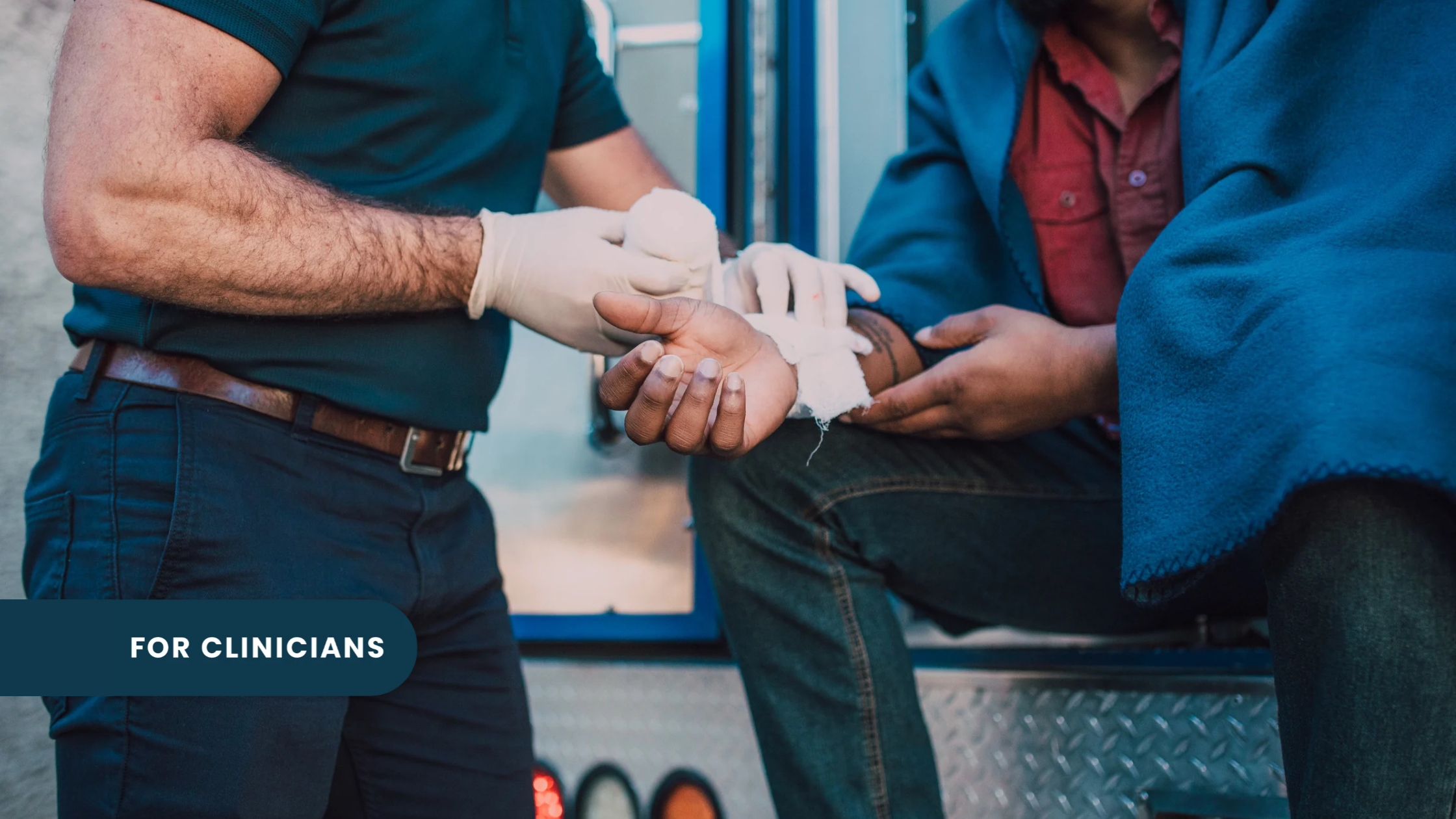
- Apply direct pressure over the bleeding site and press hard; you can use something to stuff into the wound; cotton gauze is best, but a t-shirt can work also. Press hard and wrap the extremity tight with a compression bandage, improvised bandage, or even an ACE wrap³.
- If the wound is still bleeding or you know it is bleeding too much to compress, apply a tourniquet. It should be 2–3 inches above the bleeding site if you can see the wound or as high on the arm or leg as it will go if you can’t⁴. Tighten until the bleeding stops. Yes, it will hurt. Note the time of application and write it on the tourniquet. Putting the tourniquet over clothing is fine, but make sure you empty all pockets under the tourniquet that could trap something between the strap and the arm or leg, or it won’t tighten enough to stop bleeding.
- If no tourniquet is available, use a belt or scarf and tighten it as much as possible around the extremity. Next, place a stick, pen, a metal fork or spoon, or something similar under a loop and twist it like a windlass to make the improvised tourniquet as tight as possible and secure it so it doesn’t unwind. Note what time you placed it. Improvised tourniquets are not ideal and often fail, so always recheck frequently.
- For wounds in the neck, groin, or armpit, pack the wound tightly with gauze or clean cloth and hold pressure, hard, until help arrives, and for at least 3 minutes if you’re using hemostatic gauze⁴. Do not place a tourniquet around the neck.
- If you feel that a threat is still present, you may consider applying a tourniquet before applying a compression bandage to move away from danger faster.
Prevent Shock and Reassure
Staying calm and avoiding panic in this situation is essential. Lay the person flat if there’s no head or chest injury, and give them something to lie on, if possible, to isolate them from the ground. Even on a warm day, a trauma victim can lose a lot of heat to the ground. Cover them with a jacket or emergency blanket. If you have the supplies, wrap them in warm clothing like a burrito, regardless of the outside temperature. Trauma victims commonly suffer from hypothermia, which causes other physiologic changes inside their body, making survival less likely. Keeping them warm slows that process down⁴,⁵.
Speak calmly. Your voice, presence, and reassurance may be the only things keeping them from giving up. Check on them often, especially if there are numerous patients and you are caring for more than one.
What to Carry: Build Your Personal Trauma Kit
You can build a small, powerful trauma kit that fits in a backpack, car trunk, or office drawer. You can also purchase a complete kit from a reliable quality manufacturer. Just remember, if it is so big you don’t want to carry it everywhere, you won’t have it when you need it.
Here’s what I recommend:
- 1-2x Commercial Tourniquets: Owning tourniquets presupposes you know how to use them. Get one extra, just like your real ones, to train with occasionally. I recommend getting the ones that fit your kit, work for your skill level, and are high quality.
- 1x 4-6in Compression bandage
- 2x 4-inch Gauze Cotton Rolls
- 1x Hemostatic Gauze
- Trauma Shears (useful for exposing wounds by cutting clothing)
- Nitrile Gloves: Carry a few sets; you will rip them.
- Emergency Blanket: I carry an extra-large one.
- Permanent marker (for marking tourniquet time and other notes)
If you work in a school, public venue, or around crowds, carrying a trauma kit and taking a Stop the Bleed course should be mandatory⁶. It’s a couple of hours that could save a life.
Final Thoughts
Threats can come suddenly, without warning, and from unexpected places. But we can’t live our lives in fear. It’s exhausting and, over time, just leads to complacency. By being attentive, thoughtful, and proactively approaching preparedness as a lifestyle choice, we can be ready for the unexpected. Many people freeze in emergencies. But with a little training, a minimal kit, and a proper mindset, you don’t have to. You can be the calm voice, the steady hands, and the difference between someone dying in the street or going home. Be ready.
Adapted from an article Aaron first published on his Substack, The HoboMed Field Journal, in March 2025.
Sources
- Davis JS, Satahoo SS, Butler FK, et al. An analysis of prehospital deaths: who can we save? J Trauma Acute Care Surg. 2014;77(2):213-218. https://pubmed.ncbi.nlm.nih.gov/25058244/
- Eastridge BJ, Mabry RL, Seguin P, et al. Death on the battlefield (2001-2011): implications for the future of combat casualty care. J Trauma Acute Care Surg. 2012;73(6 Suppl 5):S431-S437. https://pubmed.ncbi.nlm.nih.gov/23192066/
- Hewett Brumberg EK, Douma MJ, Alibertis K, et al. 2024 American Heart Association and American Red Cross guidelines for first aid. Circulation. 2024;150(24):e519-e579. https://doi.org/10.1161/CIR.0000000000001281
- Committee on Tactical Combat Casualty Care, Joint Trauma System. Tactical Combat Casualty Care (TCCC) guidelines, 01 May 2026. Deployed Medicine. https://www.deployedmedicine.com/tccc
- Dow J, Giesbrecht GG, Danzl DF, et al. Wilderness Medical Society clinical practice guidelines for the out-of-hospital evaluation and treatment of accidental hypothermia: 2019 update. Wilderness Environ Med. 2019;30(4S):S47-S69. https://doi.org/10.1016/j.wem.2019.10.002
- American College of Surgeons. Stop the Bleed. https://www.stopthebleed.org/
Lifesaving Solutions
Recent Posts
Keeping you informed and safe.
What to Do If Someone Is Choking: The New 2025 First Aid Guidelines
What to Do If Someone Is Choking: The New 2025 First Aid Guidelines By the Jase Medical Team Choking first aid changed in 2025. If an adult or child is severely choking, the American Heart Association now recommends starting with five back blows, followed by five...
For Clinicians | “There’s Something Wrong With My Baby”: Would You Know What to Do?
For Clinicians | "There's Something Wrong With My Baby": Would You Know What to Do? Off Duty Series: Part 5 of 6 By Aaron Asay, PA-C, DMSc, FIBODM, FAWMMedically reviewed and edited by Dr. Jamie Wilkey, PharmD Off Duty is a six-part series on the emergencies...
Who Do You Help First in an Emergency? How to Prioritize Injuries When Every Second Counts
Who Do You Help First in an Emergency? How to Prioritize Injuries When Every Second Counts By the Jase Medical Team When two people are injured in an emergency, who should you help first? Start by checking the person who is quiet, unresponsive, or struggling to...
For Clinicians | Emergency Priorities: How First Responders Decide What Injuries to Manage First
For Clinicians | Emergency Priorities: How First Responders Decide What Injuries to Manage First Off Duty Series: Part 4 of 6 By Aaron Asay, PA-C, DMSc, FIBODM, FAWMMedically reviewed and edited by Dr. Jamie Wilkey, PharmD Off Duty is a six-part series on the...