
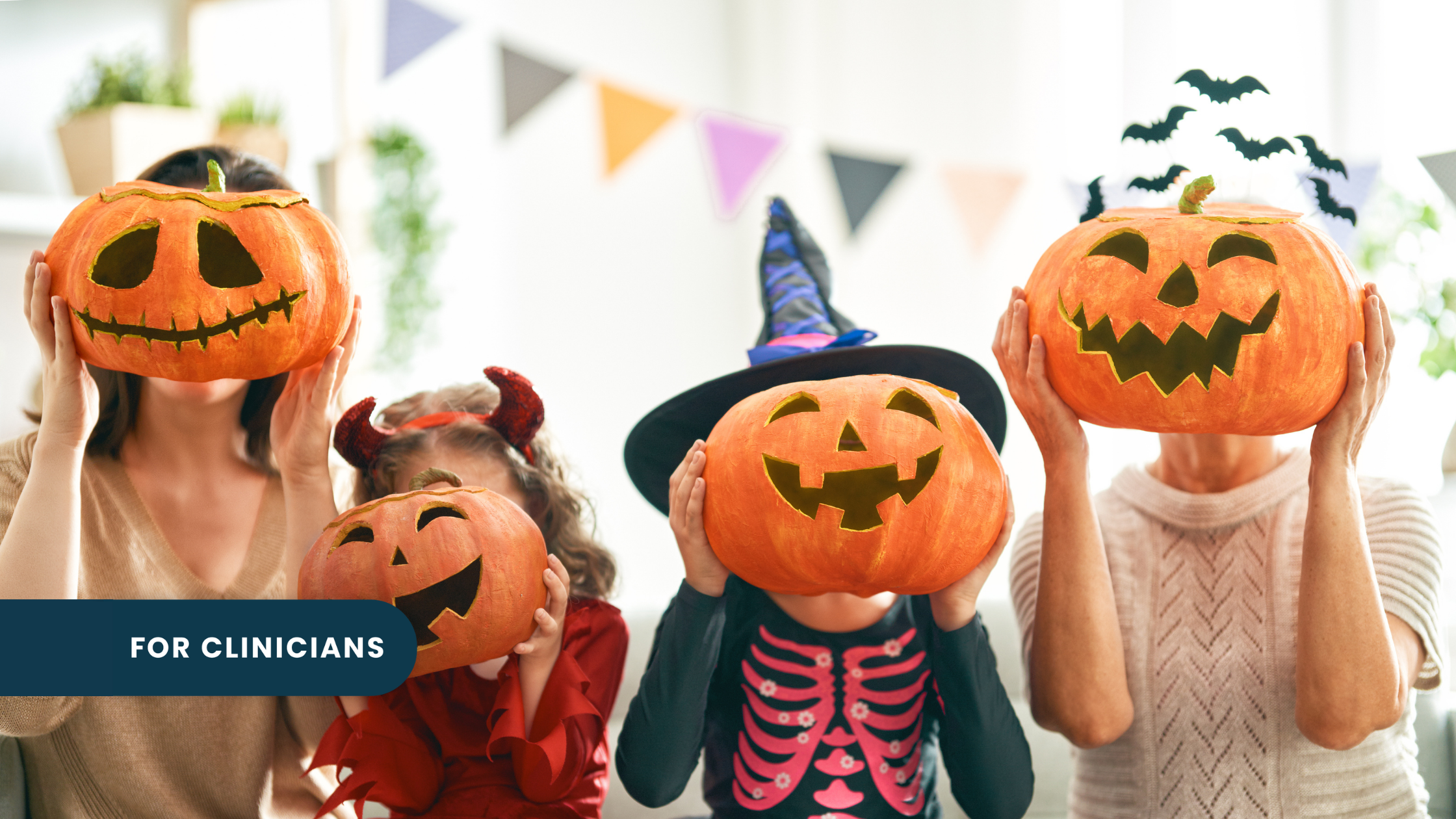
For Clinicians | Trick or Treatment? 5 Halloween Health Facts From a Pharmacist
By Dr. Jamie Wilkey, PharmD, Director of Clinical Education
Medically reviewed and edited by Kristen Carpenter, PA-C
Halloween is this week, so we’re taking a break from our in-depth appropriate medical preparation articles. I just love Halloween (cutesy Halloween, at least), and as a pharmacist I love tying medications into every part of our lives. This time of year they turn up in some strange places, because unusual candy is out and people are doing things they don’t normally do.
Here are the 5 we will cover today: black licorice, costume contacts, a nightly allergy pill, a mushroom from the yard, and a bat in the bedroom. Not all of them are medications….one is a bat. Each one will help you keep your patients safe this spooky season.
1-Is black licorice bad for you?
In big enough amounts, yes. Real licorice root contains glycyrrhizin (love that name!), which tricks the kidneys into acting like they’re swimming in aldosterone. They hang onto salt, dump potassium, and blood pressure climbs.¹
The New England Journal of Medicine published the cautionary tale in 2020. A 54-year-old construction worker switched from fruit-flavored soft candy to the licorice kind, and ate a large bag or two a day. Three weeks later he went into cardiac arrest in a fast-food restaurant. His team gave him 420 mmol of potassium in 12 hours (21 of those big 20 mEq tablets, for my pharmacist friends), and he didn’t survive.¹
For most people, a handful at a party is fine. A daily habit isn’t, and patients with high blood pressure or heart or kidney disease can get into trouble on even small amounts.² A diuretic, already flushing out potassium on its own, stacks dangerously on top.¹ (We covered the interactions that push potassium the other way in Drug Interactions in a Disaster.)
Not every bag counts, either. Many US “licorice” products are flavored with anise oil and contain no licorice at all, while licorice root itself shows up in supplements and herbal blends.² So when a potassium comes back low for no clear reason, ask about candy and supplements.
2-Are costume contacts dangerous?
They can be. A decorative contact lens is a medical device, even if it corrects nothing and just gives you those freaky alien eyes. Selling one without a prescription is illegal, and FDA lists Halloween stores, flea markets, beach shops, and video stores (if you can still find one) as places to never buy them.³
The problem is fit. Decorative lenses aren’t one size fits all, and a lens that doesn’t fit can scratch the cornea, which opens the door for bacteria. FDA warns these infections can cause blindness, sometimes within as little as 24 hours.³
Any red, painful eye after a costume party needs to get seen right away.³ At the pharmacy counter you’ll see a patient asking for redness drops, but the better answer is a same-day exam. (Our pink eye article covers why any lens wearer with a red eye skips the wait.)
3-Can medications cause nightmares?
They sure can, and two common ones put it right on the label. Montelukast, the nightly allergy and asthma pill, got an FDA boxed warning in 2020 for mental health side effects, and “bad or vivid dreams” made the list. FDA’s counseling is that a patient who notices these changes is to stop the medication and call a health care professional right away. FDA also asks prescribers to save montelukast for allergy patients who don’t respond to, or can’t tolerate, other allergy medicines.⁴
Beta-blockers are the other one: propranolol’s label lists vivid dreams, and metoprolol’s lists nightmares.⁵,⁶ It’s not clear why these cause bad dreams, though. One theory is melatonin. The brain makes it at night on a beta-receptor signal, and in one small study, a single dose of propranolol’s active form cut nighttime melatonin to about a fifth of normal.⁷
Beta-blockers get the opposite advice from montelukast, though. Both labels warn that stopping suddenly can worsen angina, so the patient is to keep taking it and call the prescriber for next steps.⁵,⁶
So when a patient mentions new nightmares….check the medication list before blaming the horror movie marathon.
4-Why are death cap mushrooms so sneaky?
Because they play dead, like any good horror movie villain. The mushrooms that only upset the stomach make people sick within an hour or two. Death caps wait, then hit with vomiting and diarrhea, often 6 or more hours after the meal.⁸,⁹ With fluids, the patient can even start to feel better while their liver tests still look normal, which is how some get sent home with a stomach bug diagnosis.⁸
Meanwhile, the toxin has shut down the liver cells’ ability to make new proteins. Liver injury shows up on labs within a day or so, and liver failure can follow over the next several days.⁸,⁹
Death caps grow along the West Coast, including in city parks, and peak season runs October through April (happy Halloween). Northern California just had the largest outbreak in its history: 39 suspected poisonings and 4 deaths. Many of those patients had picked a mushroom that looked like a safe one they’d foraged in another country.⁹
So when vomiting and diarrhea start hours after a meal, ask about wild mushrooms. If the answer is yes, call Poison Control at 1-800-222-1222 right away, even if the patient feels better. (A pharmacist might answer. We really are everywhere.)¹⁰
5-Does a bat in the house mean rabies shots?
Sometimes. Bats caused 35 of the 42 rabies cases caught in the US since 2000.¹¹ A bat bite can be so small nobody notices it, so people don’t seek shots before symptoms start, and by then it’s too late.¹¹
That’s why any direct contact with a bat gets a rabies risk assessment. If the bat can’t be tested, waking up with one in the room calls for shots when the sleeper could have missed a bite: a deep sleeper, a young child, someone who’d been drinking, or someone on a sedating medication (pharmacists, that one’s ours).¹¹,¹²
One of the two Americans who died of bat rabies in 2024 had found a bat in her Minnesota home. She saw clinicians several times after her symptoms started, and the bat never made it into her chart.¹¹ So ask! (Our bite and scratch article has the full rabies refresher.)
The bottom line
Halloween hazards like to hide in plain sight. Here are the 5 to keep in your clinical back pocket this week:
- Low potassium for no clear reason? Ask about licorice.
- Red, painful eye after a costume party? Same-day eye exam.
- New nightmares? Check the medication list.
- Vomiting hours after a meal? Ask about wild mushrooms, and call Poison Control at 1-800-222-1222.
- A bat in the house? Rabies risk assessment, especially for anyone who was asleep.
We’re here for the times primary care isn’t there, and in no way a replacement for it. This list is a good example: every one of these ends with a call to a clinician, an eye doctor, or Poison Control. Happy Halloween from all of us at Jase! 🎃
Sources
- Edelman ER, Butala NM, Avery LL, Lundquist AL, Dighe AS. Case 30-2020: a 54-year-old man with sudden cardiac arrest. N Engl J Med. 2020;383(13):1263-1275. https://pmc.ncbi.nlm.nih.gov/articles/PMC8568064/
- National Center for Complementary and Integrative Health. Licorice Root. Updated April 2025. https://www.nccih.nih.gov/health/licorice-root
- U.S. Food and Drug Administration. Colored and Decorative Contact Lenses: A Prescription Is a Must. Content current as of October 24, 2022. https://www.fda.gov/consumers/consumer-updates/colored-and-decorative-contact-lenses-prescription-must
- U.S. Food and Drug Administration. FDA requires Boxed Warning about serious mental health side effects for asthma and allergy drug montelukast (Singulair); advises restricting use for allergic rhinitis. Drug Safety Communication. March 4, 2020. https://www.fda.gov/drugs/drug-safety-communications/fda-requires-boxed-warning-about-serious-mental-health-side-effects-asthma-and-allergy-drug
- Inderal LA (propranolol hydrochloride) extended-release capsules. Prescribing information. ANI Pharmaceuticals; 2026. DailyMed. https://dailymed.nlm.nih.gov/dailymed/drugInfo.cfm?setid=35d28979-36b1-4630-b85e-a44e0a443734
- Metoprolol tartrate tablets. Prescribing information. Mylan Pharmaceuticals; 2024. DailyMed. https://dailymed.nlm.nih.gov/dailymed/drugInfo.cfm?setid=809c6386-0039-42ff-a03e-e42733e229b8
- Stoschitzky K, Sakotnik A, Lercher P, et al. Influence of beta-blockers on melatonin release. Eur J Clin Pharmacol. 1999;55(2):111-115. https://pubmed.ncbi.nlm.nih.gov/10335905/
- Santi L, Maggioli C, Mastroroberto M, Tufoni M, Napoli L, Caraceni P. Acute liver failure caused by Amanita phalloides poisoning. Int J Hepatol. 2012;2012:487480. https://pmc.ncbi.nlm.nih.gov/articles/PMC3395149/
- Brandecker KJ, Hayman C, LeSaint KT, et al. Amanita species mushroom poisonings, Northern California, November 2025-March 2026. MMWR Morb Mortal Wkly Rep. 2026;75(20):258-263. https://www.cdc.gov/mmwr/volumes/75/wr/mm7520a2.htm
- America’s Poison Centers. Get Poison Help. https://poisoncenters.org/page-1075452
- Ireland M, Fritz CL, Holzbauer S, et al. Human rabies deaths, Minnesota and California, 2024. MMWR Morb Mortal Wkly Rep. 2026;75(2):28-31. https://www.cdc.gov/mmwr/volumes/75/wr/mm7502a4.htm
- Manning SE, Rupprecht CE, Fishbein D, et al. Human rabies prevention, United States, 2008: recommendations of the Advisory Committee on Immunization Practices. MMWR Recomm Rep. 2008;57(RR-3):1-28. https://www.cdc.gov/mmwr/preview/mmwrhtml/rr57e507a1.htm
Lifesaving Solutions
Recent Posts
Keeping you informed and safe.

After a Tick Bite: Why the Lyme Disease Rash Doesn’t Always Look Like a Bull’s-Eye
After a Tick Bite: Why the Lyme Disease Rash Doesn't Always Look Like a Bull's-Eye By the Jase Medical Team You found a tick attached to your skin. You removed it. Now what? Most people know to watch for signs of Lyme disease after a tick bite. But there's a problem...

For Clinicians | After the Tick Bite: The Tick Decides the Risk
For Clinicians | After the Tick Bite: The Tick Decides the Risk By Dr. Jamie Wilkey, PharmD, Director of Clinical EducationMedically reviewed and edited by Aaron Asay, PA-C, DMSc, FIBODM, FAWM Ticks have been on my radar my whole life. I grew up in Wyoming, where...
Diabetes Sick-Day Rules in a Disaster
Diabetes Sick-Day Rules in a Disaster By the Jase Medical Team Diabetes sick-day rules are usually written for an ordinary week. You get the flu. Your stomach is upset. You check your blood sugar more often, keep drinking fluids, follow your medication plan, and call...
For Clinicians | Diabetes Sick-Day Rules in a Disaster
For Clinicians | Diabetes Sick-Day Rules in a Disaster By Dr. Jamie Wilkey, PharmD, Director of Clinical EducationMedically reviewed and edited by Kristen Carpenter, PA-C Diabetes is already hard to manage. Sick days just make everything worse. And a sick day in a...