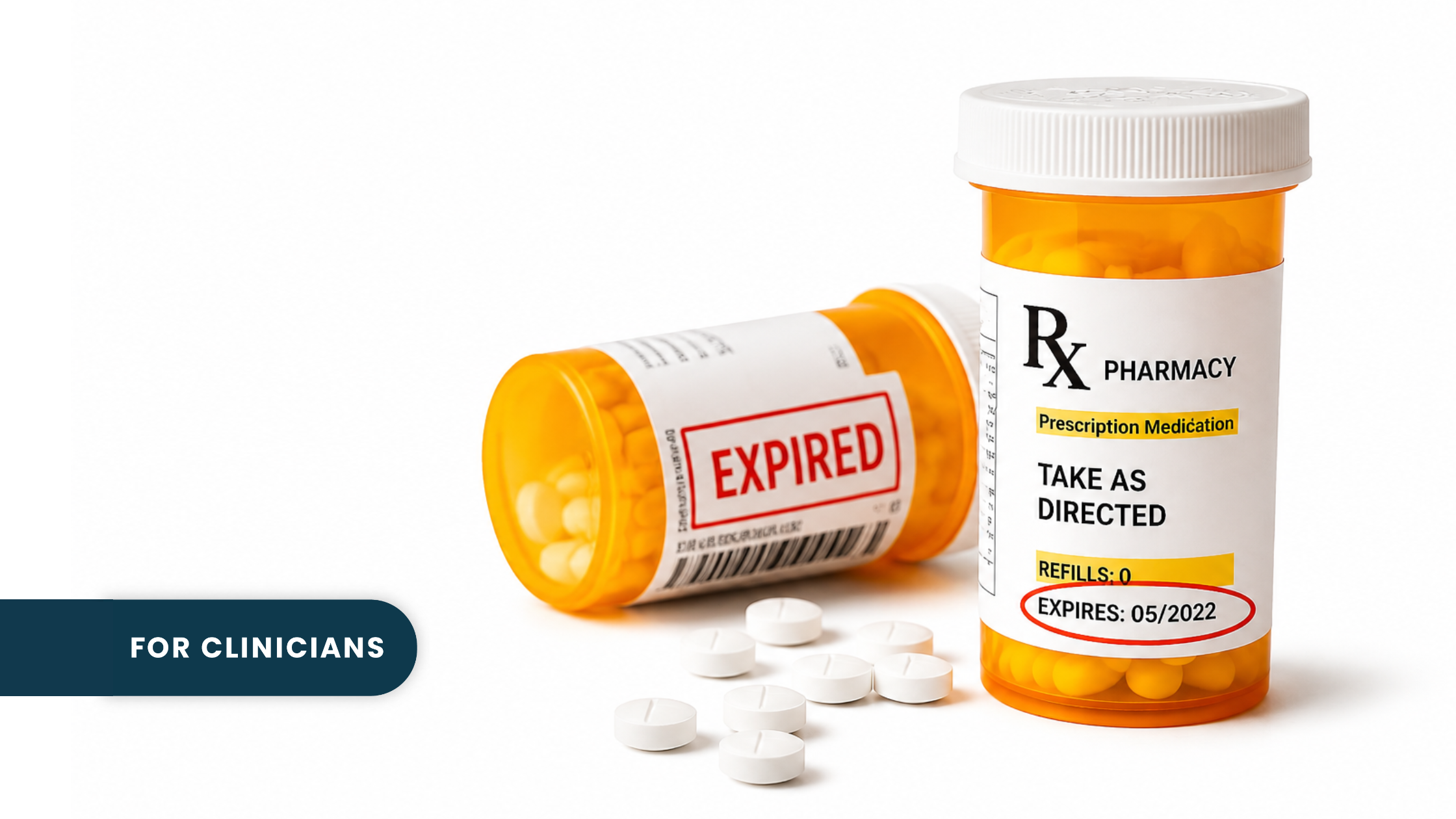
For Clinicians | Do Expired Medications Still Work?
Guide to What to Keep, Replace, and Never Trust in an Emergency
By Dr. Jamie Wilkey, PharmD — Director of Clinical Strategy, Jase
Medically reviewed by Kristen Carpenter, PA-C — Clinical Advisory Board Member
“Is this still good?” A patient holds up a bottle a year or two past the dispense date.
Most of us answer with some version of a shrug: probably fine, maybe just toss it.
Neither “you’re fine” nor “throw it all out” is the 100% right answer for every medication. Here is the three-tier map of what actually happens to a drug after its date, plus the one famous “toxic expired drug” story that hasn’t been true in sixty years.
Do expired medications still work?
Mostly yes, with important exceptions. The expiration date is a manufacturer’s guarantee, not a cliff. It certifies the drug holds at least 90% of its labeled potency under specified storage conditions up to that date.¹ It says nothing about a sudden drop the day after, and the decline past it is gradual and drug-dependent.
The best data we have on how long that decline really takes comes from the FDA and Department of Defense Shelf Life Extension Program, which stability-tests federally stockpiled medications and extends their dating when they still pass. Across the published readout, 2,650 of 3,005 lots, about 88 percent, spanning 122 products stayed stable for an average of 66 months, roughly five and a half years, past their labeled date, and none failed within the first year.² That is the number that gets quoted everywhere, and it is where almost every article stops. The part they leave out is the part that matters most for the patient standing in their bathroom: that stock sat in climate-controlled federal warehouses, not a cabinet above a hot shower.³ Heat and humidity accelerate degradation, so the bottle in a steamy bathroom does not get five and a half years. The SLEP data tells us the date is conservative. It does not tell us your patient’s ibuprofen is guaranteed effective until 2031.
Which expired medications are actually risky?
This is where the single exception list every other article publishes falls apart. “Expired” hides three very different situations, and lumping them together is what leaves patients either careless about the dangerous ones or panicked about the harmless ones.
Here is how we sort them:
Tier 1, loses potency slowly, low harm. Most solid oral tablets and capsules: ibuprofen, acetaminophen, most antibiotics in tablet form. The SLEP data lands hardest here. Ciprofloxacin tablets held 100 percent potency across 242 lots; ceftriaxone powder held 100 percent.⁴ Stored dry and cool, these degrade slowly and predictably, and the failure mode is a weaker drug, not a toxic one. A two-years-past ibuprofen from a kitchen drawer is very probably still doing something. Tell the patient it may be a little weaker, not that it will hurt them.
Tier 2, fails silently when you need it most. Nitroglycerin, epinephrine and EpiPens, insulin, rescue inhalers, naloxone. This is the tier that actually earns fear, and it is the one patients most often get wrong by keeping an expired one “just in case.” The risk here is not poisoning. It is a critical drug quietly underperforming in the exact moment that demands full potency, the chest pain, the anaphylaxis, the overdose. Nitroglycerin degrades fast and unpredictably once the bottle is opened; epinephrine and insulin lose potency with heat and time without changing how they look. One thing worth telling patients over and over again: for this tier, an expired dose is not a backup. Replace these on schedule, and do not let an out-of-date one stand in for the real thing in an emergency.
Tier 3, genuinely degrades or destabilizes. Liquid antibiotic suspensions, biologics, vaccines, and some eye drops. Here the problem is the formulation itself coming apart: reconstituted suspensions separate and lose dosing accuracy, biologics and vaccines are sensitive to time and temperature, and eye drops carry a sterility clock that has nothing to do with potency. These are replace-on-expiry, and for ophthalmics the open-bottle date often matters more than the printed one.
For Tier 1 the real cost of expiry is lost potency, not toxicity.
The drugs that deserve genuine caution are the ones in Tier 2 and Tier 3, and almost none of that caution is about poison.
Doesn’t expired tetracycline cause Fanconi syndrome?
This is the one every clinician half-remembers, and it is worth getting right because it is the only “expired drugs are toxic” claim with any clinical history behind it. The story is real but old. In 1963, Frimpter and colleagues reported three patients who developed Fanconi syndrome, a form of proximal renal tubule damage, after taking degraded tetracycline, with one further report following in 1981.⁵ The culprits were specific degradation products, anhydrotetracycline and epi-anhydrotetracycline, formed in old formulations of the drug.
What gets lost is everything since. The 2024 review of expired-antibiotic efficacy states it plainly: no recent cases of toxicity from expired oral tetracycline or its derivatives, including doxycycline, have been reported.⁶ A handful of cases from the early 1960s, tied to formulations that are not what sits on the shelf today, became a permanent line in patient-facing articles that name doxycycline as dangerous-when-expired with no historical context at all. The accurate version is both more interesting and more reassuring: there is no documented modern case of expired doxycycline causing Fanconi syndrome. When a patient raises it, you can correct it cleanly instead of repeating it.
What this means for medical preparation
The takeaway is not “expired drugs are fine” or “throw everything out on the date.” It is that the date means different things for different drugs, and a household that keeps medications on hand should know which tier each one sits in. That is the whole point of appropriate medical preparation: not stockpiling for its own sake, but holding the right things, stored the right way, and knowing what each one is actually good for when the moment comes. A drawer of expired ibuprofen is a minor footnote. An expired EpiPen someone is counting on is a real problem.
This is the kind of grey area we think clinicians should be charting out loud, instead of leaving patients to sort it from a search result. Working through a medicine cabinet tier by tier is genuinely time-consuming, so here is the rule of thumb worth handing a patient: if it is a solid pill or capsule kept somewhere cool and dry, the printed date is a guideline, and it is very likely still working a year or two past it. If it is something you would reach for in an emergency, nitroglycerin, an EpiPen, insulin, an inhaler, naloxone, or anything liquid, reconstituted, or refrigerated, treat the date as a deadline and replace it on schedule. Storage beats the calendar either way: a drug kept out of the bathroom and away from heat outlasts the same one stored over a hot shower. And when a specific drug really matters, the dispensing pharmacist is the best free reference there is. A quick call to the office or the pharmacy settles most of these.
None of this replaces primary care. The chronic conditions, the complex diagnoses, the ongoing relationship belong in the exam room. But preparation is something we care about deeply at Jase, and the medicine cabinet is exactly where it tends to go sideways. People hold onto medications and either assume they are good forever or churn through them far more often than they need to, when the truth sits in between and depends entirely on the drug. We love helping people keep what they need on hand in a way that will actually work the moment they reach for it.
TL;DR
The expiration date is a conservative guarantee, not a cliff, and for most solid pills stored well it is genuinely cautious. But “expired” is not one thing. A weaker ibuprofen and a quietly dead EpiPen read the same on the label and could not be more different in the moment that counts. Sort by tier, not by date: don’t panic over the tablets, replace the rescue drugs and the refrigerated and liquid ones on schedule, and retire the sixty-year-old fear that expired doxycycline will poison anyone. The date tells you when the manufacturer’s promise ends. It does not tell you what the drug can still do, and knowing the difference is the part worth being good at.
Sources
- Expiration date = ≥90% labeled potency guarantee, not a cliff
Pharmacy Times, Help Patients Understand Drug Expiration Dates
https://www.pharmacytimes.com/view/help-patients-understand-drug-expiration-dates - SLEP headline: 2,650 of 3,005 lots (~88%), 122 products, avg 66 months past label, none failed in year one
Lyon et al. 2006, Stability Profiles of Drug Products Extended beyond Labeled Expiration Dates, J Pharm Sci 95(7), as compiled in the 2024 PMC review
https://pmc.ncbi.nlm.nih.gov/articles/PMC11117793/ - SLEP stock sat in climate-controlled federal warehouses, not a home cabinet
FDA, Expiration Dating Extension
https://www.fda.gov/emergency-preparedness-and-response/mcm-legal-regulatory-and-policy-framework/expiration-dating-extension - Ciprofloxacin tablets 100% across 242 lots; ceftriaxone powder 100%
2024 PMC review citing the SLEP drug-class breakdown
https://pmc.ncbi.nlm.nih.gov/articles/PMC11117793/ - 1963 Frimpter et al., three Fanconi cases (plus a 1981 report); culprits anhydrotetracycline and epi-anhydrotetracycline
Frimpter GW et al., Reversible “Fanconi Syndrome” Caused by Degraded Tetracycline, JAMA. 1963;184:111-113; Montoliu et al. 1981
https://jamanetwork.com/journals/jamainternalmedicine/fullarticle/570490 - “No recent cases of toxicity… doxycycline” from expired tetracyclines
2024 PMC review, Efficacy of Expired Antibiotics: A Real Debate in the Context of Repeated Drug Shortages
https://pmc.ncbi.nlm.nih.gov/articles/PMC11117793/
Lifesaving Solutions
Everyone should be empowered to care for themselves and their loved ones during the unexpected. Check out our recent lifesaving products today.
Recent Posts
Keeping you informed and safe.

For Clinicians | Traveling With Medical Supplies
For Clinicians | Traveling With Medical Supplies Getting Weeks of Supplies Where Your Patient Is Going By Dr. Jamie Wilkey, PharmD — Director of Clinical Strategy, JaseMedically reviewed by Kristen Carpenter, PA-C — Clinical Advisory Board Member "My mother-in-law has...
The Search Bar Isn’t a Doctor
The Search Bar Isn't a Doctor: Why Medically Reviewed Medication Cards Matter By Cayla McGrath It's 2 a.m. Urgent care closed an hour ago, your doctor's office won't reopen until morning, and whatever is going on feels miserable enough that sleep isn't...
For Clinicians | Standby Antibiotics and Self-Start Therapy
For Clinicians | Standby Antibiotics and Self-Start Therapy Guideline Case for Guided Self-Treatment By Dr. Jamie Wilkey, PharmD — Director of Clinical Strategy, JaseMedically reviewed by Kristen Carpenter, PA-C — Clinical Advisory Board Member Patients stopped asking...
What Actually Happens When Medications Expire — And When It Matters
What Actually Happens When Medications Expire And When It Matters By Cayla McGrath If you've ever stood in front of your medicine cabinet holding a bottle a year past the printed date, wondering whether to toss it or keep it, you already know there are exactly two...