For Clinicians | Standby Antibiotics and Self-Start Therapy

For Clinicians | Standby Antibiotics and Self-Start Therapy


Guideline Case for Guided Self-Treatment

By Dr. Jamie Wilkey, PharmD — Director of Clinical Strategy, Jase
Medically reviewed by Kristen Carpenter, PA-C — Clinical Advisory Board Member

Patients stopped asking me whether they should keep leftover antibiotics years ago. They just tell me they did, usually after the fact, usually at the counter, usually with a little defiance in it: their old azithromycin from last winter went toward what felt like a UTI, aaaand they’re only bringing it up now because the symptoms didn’t budge.

Wrong drug for the likely bug. Wrong duration even if it were the right one. And the standard answer we’re all trained to give: “never self-treat, see a provider!” was never really in the running. It assumes a provider was reachable, and at 2am with no cell service, or three days out from the nearest clinic, nobody is. Patients in those moments will act on something. The only question is whether that something was written by clinicians, by a search bar, or just what is at the back of the medicine cupboard.

So today we’re going to flesh this out: what the guidelines already permit, where patient self-diagnosis is reliable (and where it really isn’t), what patients actually do when they can’t reach us, and what the guidance in their hands should look like.


Can patients accurately self-diagnose?

It depends on the condition, and the spread is wider than most of us would guess.Let’s just start at the encouraging side. In women with prior culture-confirmed UTIs, patient suspicion of a new UTI is more than 85% accurate in predicting culture-positive infection, more accurate than a urine dipstick.¹ This holds for women with an established recurrent pattern whose symptoms match prior confirmed episodes, and accuracy drops when vaginal discharge, pelvic pain, or STI exposure complicates the picture. But within those bounds, these patients know their bodies, and the data backs them.Now the other end. When women self-diagnosed a yeast infection and bought an over-the-counter antifungal, only about one in three actually had vulvovaginal candidiasis. The rest had bacterial vaginosis, mixed vaginitis, trichomoniasis, or normal findings. A prior clinician-confirmed yeast infection did not make them any more accurate the second time.²Hold both results at once. Patient intuition is real, and it is not uniform. It is condition-dependent, and patients have no way of knowing which conditions their intuition is good for. That specificity gap is exactly what a written tool has to close.


The permission already exists

The reflex is to file guided self-treatment under fringe medicine. The guidelines disagree.

  • Recurrent UTIs. The AUA’s guideline lets clinicians offer select patients self-start therapy: the antibiotic waits at home, and the patient starts it when symptoms hit.³
  • Travelers’ diarrhea. The CDC Yellow Book tells travelers to carry an antibiotic and start it themselves when moderate-to-severe symptoms hit. No call required.⁴
  • Expedition medicine. Kits are scaled to how far the group is from care, and every drug is labeled with what it treats and how to take it.
  • Your own exam room. We already prescribe ahead of the emergency: EpiPens, rescue inhalers, nitroglycerin. The patient carries the drug and uses their own judgment on the day.

Every one of these kicks in when care is out of reach. And every one of them assumes a clinician is nearby doing the guiding.

That’s the gap. We trained inside a closed system: one patient, one prescriber, one chart, one pharmacy. Nobody trained us for the patient at 2am, because she was supposed to be somebody else’s problem. There is no somebody else at 2am except maybe an ultra expensive ER with a wait a mile long. The permission for guided self-treatment exists. The plain-language tool it assumes was never built.


What medically-reviewed guidance actually looks like

This is where the med card earns its place, and the card makes the argument better than any abstraction does. Take the doxycycline card that ships in a JaseCase. The front opens with the counseling we give at the counter (take it with a full glass of water and stay upright for 30 minutes, your esophagus will thank you), then a conditions-treated table with adult dosing for each indication. The doses are not interchangeable: a single two-pill dose for Lyme prophylaxis, twice daily for 10 days for tetanus, once daily starting before travel for malaria prevention, up to 60 days for anthrax. They differ by condition, which is precisely what patients guess wrong. And the Lyme line won’t even grant that single dose unless every criterion is met: tick attached 36 hours or more, a region where blacklegged ticks are common, started within 72 hours of tick removal, no contraindications. That’s the IDSA’s own prophylaxis standard, printed where the patient can read it.⁷
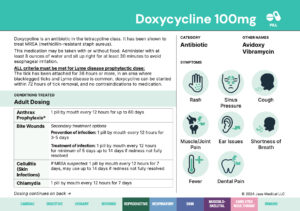
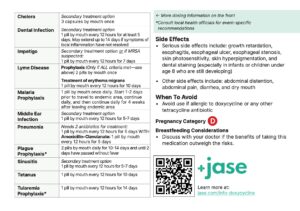
The back carries the side effects worth watching for, when to avoid the drug entirely, and a red Pregnancy Category D where nobody can miss it. Scattered through the dosing table is a phrase doing quiet stewardship work: secondary treatment option. The card tells the patient when this drug is not the right first choice. For pneumonia it goes further and requires a second antibiotic alongside it, partner drug and dose spelled out: the same combination the ATS/IDSA pneumonia guideline recommends for outpatients with comorbidities.⁸ That is the part the skeptics skip: the card spends as much ink on limits as on permissions.


The stewardship objection deserves a direct answer

The strongest pushback on at-home antibiotic kits, and infectious disease colleagues have made it in print, is antimicrobial resistance: patients shooting from the hip with broad-spectrum drugs. The concern is legitimate, and it deserves engagement rather than a dodge.

But look at what the objection assumes: that the alternative to the kit is a clinic visit. For the no-access moments these kits exist for, it isn’t. The real alternatives are going without, taking whatever antibiotics turn up around the house or from a friend’s leftover stash, or buying whatever they think they need from an online pharmacy. None of those comes with the right spectrum, a full course, or any counseling behind it. Against that baseline, a condition-specific, full-course, clinician-reviewed regimen with explicit do-not-use guidance is better stewardship, not worse.

And sometimes the right answer on the card is no drug at all. The clinical review behind each card draws the fence deliberately: well-understood, self-limiting conditions with predictable treatment paths, screened ahead of time by a clinician who reviewed the patient’s history. That fence is what keeps guided self-treatment from sliding into the free-for-all the skeptics fear.


Charting the grey area in public

Step back and look at how antibiotic access actually works in this country. It is all or none. Either the patient reaches a prescriber and gets the right drug, or they are completely on their own resources: the leftover stash, the search bar, the no-questions-asked website. There is no sanctioned middle step. We built a light switch and then act surprised when patients in the dark go looking for matches.

The guidelines covered above have already sketched what the middle step looks like: a defined, conditional, clinician-controlled layer between “call your doctor” and “you’re on your own.” Self-start therapy is that layer for recurrent UTIs. Standby treatment is that layer for travelers. What we’re building at Jase is the same layer for a short list of common, well-understood infections: the clinical work happens up front, a clinician reviews the patient’s history and prescribes for defined conditions, and the card carries the guidance into the moment it’s needed. That is what appropriate medical preparation means in practice: the basics, decided ahead of time, for the moments care isn’t there.

The boundary holds on both sides. This is in no way a replacement for primary care: anything complex, chronic, or unfamiliar still belongs in the exam room, and the cards say so. And if a patient asks you what they should have on hand just in case and you would rather not chart that middle layer yourself, you can refer them to us at Jase.com. We’re a family team of physicians, PAs, and pharmacists drawing these lines carefully, and we’ll keep publishing where we draw them.


The bottom line

Organized medicine already endorses guided self-treatment when access is the constraint; the existing frameworks just assume a clinician is standing there to do the guiding. At 2am, nobody is. What we can control is whether the information in the patient’s hand that night came from clinicians or from a search bar.

Most people never think about any of this until the night it happens to them.

We are here for them then.


Sources

  1. American Family Physician (AAFP), April 2016. Patient suspicion of UTI is more than 85% accurate in predicting culture-positive infection, more accurate than urine dipstick. https://www.aafp.org/pubs/afp/issues/2016/0401/p560.html
  2. Ferris DG, et al. Obstetrics & Gynecology, 2002. Among women who self-diagnosed vulvovaginal candidiasis and purchased an over-the-counter antifungal, 33.7% had the condition. https://pubmed.ncbi.nlm.nih.gov/11864668/
  3. AUA/CUA/SUFU, Recurrent Uncomplicated Urinary Tract Infections in Women, 2025 guideline amendment. Patient-initiated (self-start) treatment for select patients, conditional recommendation (Moderate, Grade C). https://www.auanet.org/guidelines-and-quality/guidelines/recurrent-uti
  4. CDC Yellow Book, Travelers’ Diarrhea. Standby self-treatment for travelers; antibiotics reduce illness duration by approximately 1 to 2 days for susceptible bacterial pathogens. https://www.cdc.gov/yellow-book/hcp/preparing-international-travelers/travelers-diarrhea.html
  5. IDSA/AAN/ACR, Prevention, Diagnosis and Treatment of Lyme Disease guideline, 2020. Single-dose doxycycline prophylaxis within 72 hours of a high-risk bite: identified Ixodes vector, highly endemic area, attached 36 hours or more. https://www.idsociety.org/practice-guideline/lyme-disease/
  6. ATS/IDSA, Community-Acquired Pneumonia guideline, 2019, summarized in American Family Physician, 2020. Outpatients with comorbidities: amoxicillin/clavulanate plus a macrolide or doxycycline. https://www.aafp.org/pubs/afp/issues/2020/0715/p121.html


Lifesaving Solutions

Everyone should be empowered to care for themselves and their loved ones during the unexpected. Check out our recent lifesaving products today.

Recent Posts

Keeping you informed and safe.

When a Tooth Infection Can’t Wait

When a Tooth Infection Can’t Wait

Antibiotics Won't Cure Your Tooth Infection. Here's What They Actually Do By Cayla McGrath A molar starts throbbing on day two of a ten-day cruise. A crown cracks Friday night and your dentist can't see you until Wednesday. A tooth flares in a rural area where the...

read more
For Clinicians | The Tooth Infection at Your Counter

For Clinicians | The Tooth Infection at Your Counter

For Clinicians | The Tooth Infection at Your Counter: What to Do When the Dentist Is Days Away By Dr. Jamie Wilkey, PharmD — Director of Clinical Strategy, JaseMedically reviewed by Kristen Carpenter, PA-C — Clinical Advisory Board Member Almost none of us trained to...
read more
You Don’t Have to Be an Expert to Be Prepared

You Don’t Have to Be an Expert to Be Prepared

You Don't Have to Be an Expert to Be Prepared By Cayla McGrath Medical preparation has a branding problem. On one end of the conversation, you have disaster medicine — the world of field manuals, off-grid clinical decision trees, and preparation for scenarios where...
read more

Join Our Newsletter

Our mission is to help you be more medically prepared. Join our newsletter and follow us on social media for health and safety tips each week!

What Actually Happens When Medications Expire — And When It Matters

What Actually Happens When Medications Expire

And When It Matters

By Cayla McGrath

Consumer notice: A note on expiration dates. This article discusses published research on drug stability, including the FDA and Department of Defense Shelf Life Extension Program (SLEP). SLEP applies to federal stockpiles held under controlled, monitored storage and tested lot by lot. It does not apply to medications stored at home, and its findings do not extend the expiration date of any medication you own. FDA’s guidance to consumers is that expired medications should not be used. Jase Medical follows the manufacturer’s printed expiration date on every medication we dispense. Replace medications when they expire, and dispose of the expired supply following FDA’s disposal guidance.

Clinician notice: Same text through “should not be used,” then: This article is written for licensed healthcare professionals to support patient counseling. Jase Medical follows the manufacturer’s printed expiration date on every medication we dispense, and we recommend counseling patients to replace medications at the labeled date and dispose of expired supply following FDA guidance.

If you’ve ever stood in front of your medicine cabinet holding a bottle a year past the printed date, wondering whether to toss it or keep it, you already know there are exactly two kinds of advice available: “probably fine, just use it” and “throw it out immediately, it might be toxic.” Neither one is fully right, and neither one is actually useful.

The honest answer is more specific — and more practical — than either extreme. Medications differ in how sensitive they are to heat, light, and moisture. Knowing which category a medication falls into tells you how to store it and which to replace first as expiration dates come due. Any opener in the “Is this still good? Mostly yes” pattern becomes: A bottle a year past its date raises a fair question: is it still good? The answer is to replace it. Here’s why the date matters and how to keep your supply from reaching it.


What the expiration date means

The date on a medication bottle is a manufacturer’s commitment: the drug holds at least 90% of its labeled potency under the specified storage conditions up to that date. It doesn’t say anything about a sudden drop the day after. The decline past it is gradual and varies significantly by drug.

The best evidence on how long that decline really takes comes from the FDA and Department of Defense Shelf Life Extension Program (SLEP), which stability-tests federal stockpiles and extends dating when products still pass. Across 2,650 of 3,005 lots tested, spanning 122 products, about 88% remained stable for an average of 66 months past their labeled date. None failed within the first year past dating.

The figures above come from institutional stockpile testing and do not describe medications stored in a home. FDA’s consumer guidance remains: do not use expired medication.

Here’s the piece that almost every article leaves out: that stockpile sat in climate-controlled federal warehouses. Not in a bathroom cabinet above a hot shower. Heat and humidity are the real drivers of pharmaceutical degradation, and the SLEP data tells us the label is conservative — it doesn’t tell us your specific bottle, in your specific storage environment, is still at full potency five years out.

Three categories that tell you what you actually need to know

Not all medications degrade the same way, and lumping them together is what produces both the careless responses and the unnecessary panic.

Oral tablets and capsules — ibuprofen, acetaminophen, most antibiotics in pill form — are the most stable. The SLEP data is clearest here: ciprofloxacin tablets held 100% potency across 242 lots tested; ceftriaxone powder held 100%. Stored in a cool, dry location away from the bathroom, well-formulated tablets degrade slowly and predictably. When these medications degrade, the primary risk is reduced potency, which is why FDA advises against relying on them past their expiration date.

The figures above come from institutional stockpile testing and do not describe medications stored in a home. FDA’s consumer guidance remains: do not use expired medication.

Liquids, suspensions, and reconstituted medications are less stable. An amoxicillin suspension mixed with water starts degrading immediately and is typically reliable for 10 to 14 days refrigerated. Liquid antibiotics, eye drops, and oral suspensions should generally not be treated as long-term stockpile items.

Medications with narrow therapeutic windows warrant more caution simply because even modest potency reduction becomes clinically relevant. This category also includes refrigeration-dependent medications: insulin stored improperly becomes unreliable, which is a different kind of problem when you’re managing a condition that depends on it.

What this means for preparedness

If you’re building any kind of medication supply, storage conditions are the variable that matters most. The bathroom medicine cabinet is one of the worst environments in your home: high humidity, temperature fluctuations from showers. A cool, dry closet shelf is significantly better. An airtight container is better still.

What to replace first: liquid suspensions (especially if mixed), medications stored in heat or humidity, refrigeration-dependent items that may have been temperature-excursioned, and anything with visible physical changes — discoloration, odor, clumping.

At Jase, we send every kit with guidance on storage conditions because this is the variable most people overlook. A JaseCase stored properly and replaced at its labeled expiration dates gives you what you need when you need it. Jase offers refills for expired kit medications.

Learn more at jase.com/

Closing note: When a medication reaches its expiration date, replace it. Dispose of the expired supply following FDA’s guidance on expired medicines.


Cayla McGrath is a content strategist with Jase Medical. This post is for informational purposes only and does not constitute medical advice. Always consult a licensed healthcare provider before using any prescription medication.


Lifesaving Solutions

Everyone should be empowered to care for themselves and their loved ones during the unexpected. Check out our recent lifesaving products today.

Recent Posts

Keeping you informed and safe.

When a Tooth Infection Can’t Wait

When a Tooth Infection Can’t Wait

Antibiotics Won't Cure Your Tooth Infection. Here's What They Actually Do By Cayla McGrath A molar starts throbbing on day two of a ten-day cruise. A crown cracks Friday night and your dentist can't see you until Wednesday. A tooth flares in a rural area where the...

read more
For Clinicians | The Tooth Infection at Your Counter

For Clinicians | The Tooth Infection at Your Counter

For Clinicians | The Tooth Infection at Your Counter: What to Do When the Dentist Is Days Away By Dr. Jamie Wilkey, PharmD — Director of Clinical Strategy, JaseMedically reviewed by Kristen Carpenter, PA-C — Clinical Advisory Board Member Almost none of us trained to...

read more
You Don’t Have to Be an Expert to Be Prepared

You Don’t Have to Be an Expert to Be Prepared

You Don't Have to Be an Expert to Be Prepared By Cayla McGrath Medical preparation has a branding problem. On one end of the conversation, you have disaster medicine — the world of field manuals, off-grid clinical decision trees, and preparation for scenarios where...

read more

Join Our Newsletter

Our mission is to help you be more medically prepared. Join our newsletter and follow us on social media for health and safety tips each week!

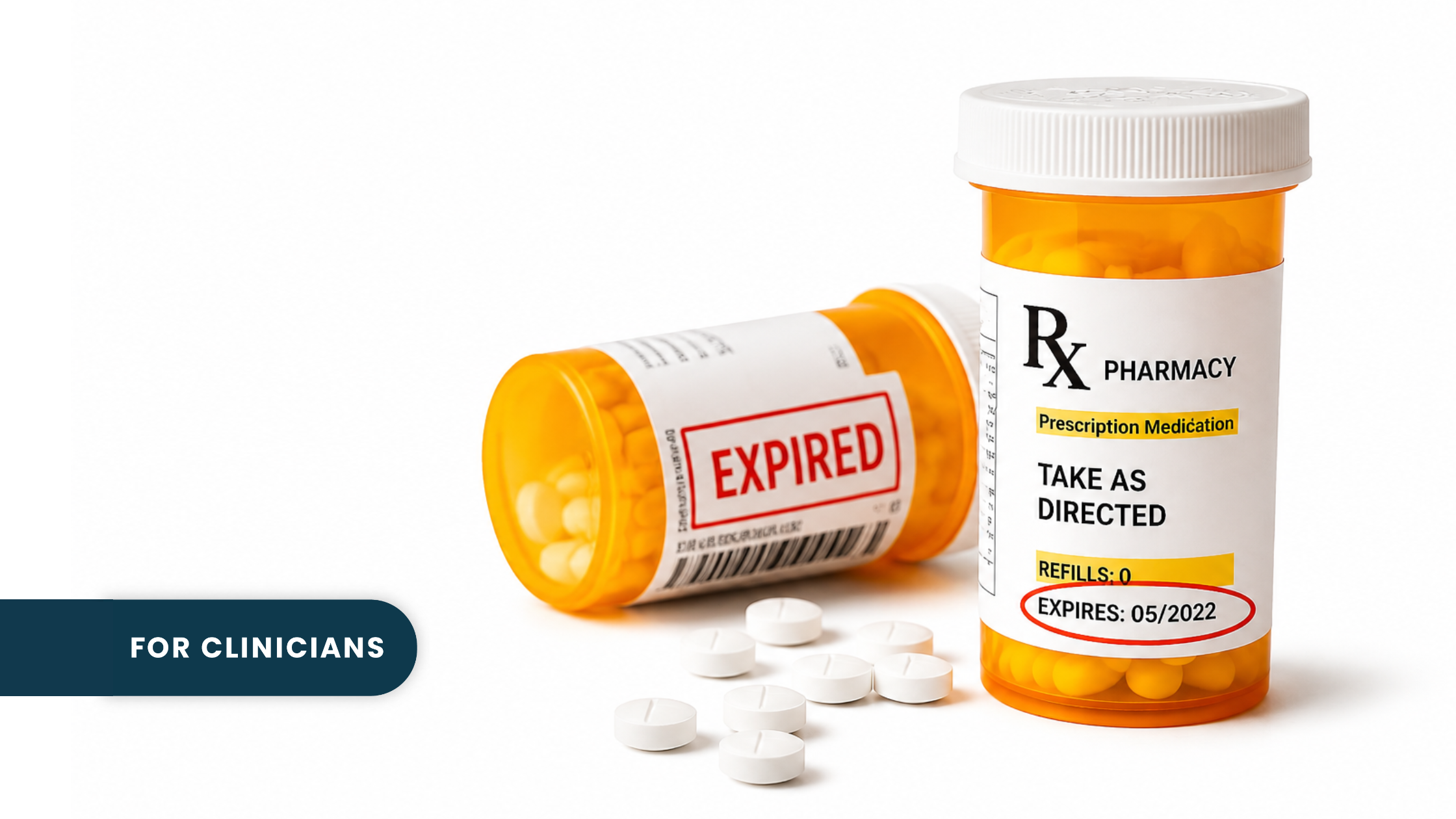
For Clinicians | Do Expired Medications Still Work?

For Clinicians | Do Expired Medications Still Work?

By Dr. Jamie Wilkey, PharmD — Director of Clinical Strategy, Jase
Medically reviewed by Kristen Carpenter, PA-C — Clinical Advisory Board Member

Consumer notice: A note on expiration dates. This article discusses published research on drug stability, including the FDA and Department of Defense Shelf Life Extension Program (SLEP). SLEP applies to federal stockpiles held under controlled, monitored storage and tested lot by lot. It does not apply to medications stored at home, and its findings do not extend the expiration date of any medication you own. FDA’s guidance to consumers is that expired medications should not be used. Jase Medical follows the manufacturer’s printed expiration date on every medication we dispense. Replace medications when they expire, and dispose of the expired supply following FDA’s disposal guidance.

Clinician notice: Same text through “should not be used,” then: This article is written for licensed healthcare professionals to support patient counseling. Jase Medical follows the manufacturer’s printed expiration date on every medication we dispense, and we recommend counseling patients to replace medications at the labeled date and dispose of expired supply following FDA guidance.

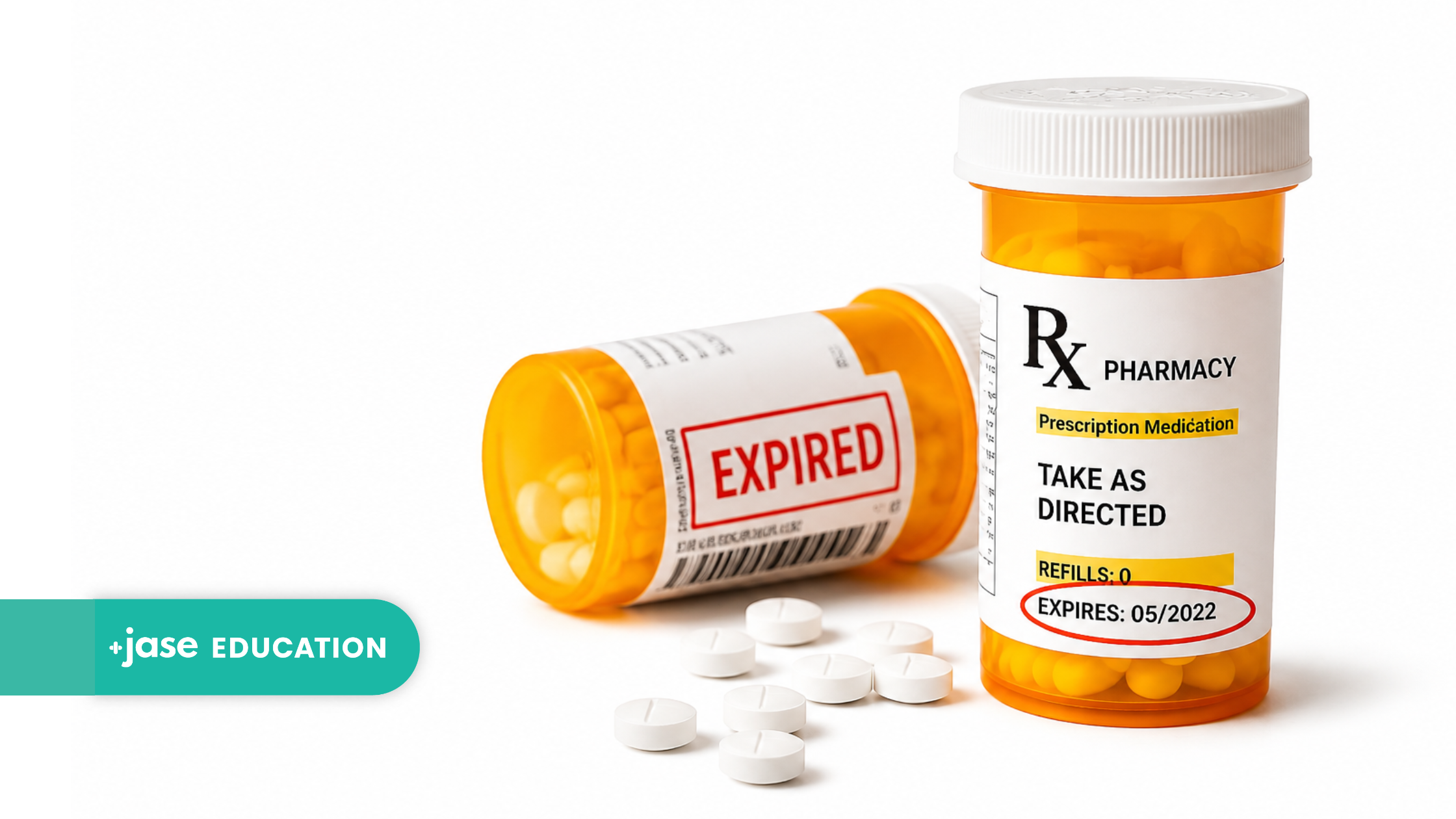
A patient holds up a bottle a year or two past the dispense date and asks, “Is this still good?” The counseling answer is the same for every product: replace it. The labeled date is the replacement date.

Stability differs by drug, formulation, and storage history. Solid oral forms hold up better than liquids, and a small set of products degrade quickly or carry specific risks once degraded. That variation is exactly why a patient cannot judge an expired product at home, and why counseling always lands on replacement at the labeled date. Use the tiers below to decide which products to replace first and which need the closest storage attention.

Closing notice: When a medication reaches its expiration date, replace it. Dispose of the expired supply following FDA’s guidance on expired medicines.


Sources

  1. Expiration date = ≥90% labeled potency guarantee, not a cliff
    Pharmacy Times, Help Patients Understand Drug Expiration Dates
    https://www.pharmacytimes.com/view/help-patients-understand-drug-expiration-dates
  2. SLEP headline: 2,650 of 3,005 lots (~88%), 122 products, avg 66 months past label, none failed in year one
    Lyon et al. 2006, Stability Profiles of Drug Products Extended beyond Labeled Expiration Dates, J Pharm Sci 95(7), as compiled in the 2024 PMC review
    https://pmc.ncbi.nlm.nih.gov/articles/PMC11117793/
  3. SLEP stock sat in climate-controlled federal warehouses, not a home cabinet
    FDA, Expiration Dating Extension
    https://www.fda.gov/emergency-preparedness-and-response/mcm-legal-regulatory-and-policy-framework/expiration-dating-extension
  4. Ciprofloxacin tablets 100% across 242 lots; ceftriaxone powder 100%
    2024 PMC review citing the SLEP drug-class breakdown
    https://pmc.ncbi.nlm.nih.gov/articles/PMC11117793/
  5. 1963 Frimpter et al., three Fanconi cases (plus a 1981 report); culprits anhydrotetracycline and epi-anhydrotetracycline
    Frimpter GW et al., Reversible “Fanconi Syndrome” Caused by Degraded Tetracycline, JAMA. 1963;184:111-113; Montoliu et al. 1981
    https://jamanetwork.com/journals/jamainternalmedicine/fullarticle/570490
  6. “No recent cases of toxicity… doxycycline” from expired tetracyclines
    2024 PMC review, Efficacy of Expired Antibiotics: A Real Debate in the Context of Repeated Drug Shortages
    https://pmc.ncbi.nlm.nih.gov/articles/PMC11117793/


Lifesaving Solutions

Everyone should be empowered to care for themselves and their loved ones during the unexpected. Check out our recent lifesaving products today.

Recent Posts

Keeping you informed and safe.

When a Tooth Infection Can’t Wait

When a Tooth Infection Can’t Wait

Antibiotics Won't Cure Your Tooth Infection. Here's What They Actually Do By Cayla McGrath A molar starts throbbing on day two of a ten-day cruise. A crown cracks Friday night and your dentist can't see you until Wednesday. A tooth flares in a rural area where the...

read more
For Clinicians | The Tooth Infection at Your Counter

For Clinicians | The Tooth Infection at Your Counter

For Clinicians | The Tooth Infection at Your Counter: What to Do When the Dentist Is Days Away By Dr. Jamie Wilkey, PharmD — Director of Clinical Strategy, JaseMedically reviewed by Kristen Carpenter, PA-C — Clinical Advisory Board Member Almost none of us trained to...

read more
You Don’t Have to Be an Expert to Be Prepared

You Don’t Have to Be an Expert to Be Prepared

You Don't Have to Be an Expert to Be Prepared By Cayla McGrath Medical preparation has a branding problem. On one end of the conversation, you have disaster medicine — the world of field manuals, off-grid clinical decision trees, and preparation for scenarios where...

read more

Join Our Newsletter

Our mission is to help you be more medically prepared. Join our newsletter and follow us on social media for health and safety tips each week!

Power Outages are Getting Longer. Your Medication Plan Hasn’t Caught Up.

Power Outages Are Getting Longer.

Your Medication Plan Hasn’t Caught Up.

By Cayla McGrath

Most households’ mental model for a power outage goes something like this: the lights go out, the fridge holds for a few hours, the power comes back before anything important happens.

That mental model was built for a different era of outages.

Across the West, utilities have been quietly changing how they handle faults on the grid. In wildfire-prone areas, automatic reclosers that used to snap a line back on within seconds have been disabled. The logic is sound: re-energizing a line into dry brush is exactly how a small fault becomes a fire. So when a line goes down, a crew has to physically drive out, inspect the circuit, and clear it before power is restored. What used to be a three-second blip becomes a half-day outage. A real fault becomes days. Xcel’s shutoffs on the Colorado Front Range in December 2025 lasted days, not hours. Storms and grid strain are producing the same result in places that have never heard the term Red Flag.

For most households, a longer outage is an inconvenience. For a household where someone is managing temperature-sensitive medications, home oxygen, or a CPAP machine, the gap between “a few hours” and “a few days” is the gap between fine and a real problem. And that gap is quietly widening.

Here’s what every household should have in place before the next one.


Ask your pharmacist one specific question — and write down the answer

The most common piece of advice about medications and power outages is “keep them refrigerated.” That’s not actually useful guidance when the power is out.

The useful question is: how long is my specific medication safe at room temperature? Ask your pharmacist and write down the answer — it’s product-specific. The FDA guidance for insulin is that open vials and cartridges can be kept at room temperature — defined as 59–86°F — for up to 28 days for most products. But that assumes room temperature, not a house that’s warming up in July. And a pump reservoir, because insulin is exposed to body heat, has a much shorter window — typically around 48 hours. These numbers are product-specific and won’t show up in a general preparedness article. Your pharmacist has them.

The other thing to know: never freeze insulin. Freezing degrades insulin permanently and a vial that’s been frozen looks completely normal — there’s no visible change.

If someone in your household depends on a powered medical device, this conversation cannot wait

Home oxygen concentrators, ventilators, CPAP and BiPAP machines all run on electricity, and “the power is out” is not an acceptable answer if the device is life-sustaining.

If someone in your household depends on any of these devices, contact your equipment supplier before the next outage — not during it. Most home medical equipment suppliers have emergency backup plans that customers can set up in advance: backup battery systems, non-electric alternatives for oxygen, documentation for priority utility restoration. These plans require paperwork and sometimes lead time. A Sunday night outage is not when to find out they exist.

Enroll in your utility’s medical-baseline program

Your utility company almost certainly has a medical-baseline program that qualifies households with electricity-dependent medical needs for lower rates, priority notification during planned outages, and in some cases priority restoration. Enrollment requires a clinician to sign a form certifying the medical need. It takes a few minutes to request, and once it’s done, it’s in place for every outage that follows.

The HHS emPOWER program maintains a public database of electricity-dependent Medicare beneficiaries — over 4.6 million households across the US — and uses it to coordinate emergency response when outages happen at scale. Your local utility program is the household-level equivalent.

Keep a buffer supply and a written medication list

A 7-to-30-day supply of critical medications means that a several-day outage doesn’t immediately become a medication crisis. A written list — drug name, dose, prescriber, pharmacy — means that if you need emergency dispensing, you have the documentation to make it work. During a declared emergency, pharmacists in most states can dispense Schedule III through V medications without a new prescription, typically up to 30 days. That authority exists and pharmacists use it — but it requires documentation. For up to a 12-month supply of your chronic daily medication, check out JaseDaily. 

Where the JaseCase fits

The JaseCase is not a refrigerator substitute. What it covers is the second problem that can develop during a prolonged disruption: the acute infection that starts when healthcare access is interrupted. A UTI on day three of an outage. An ear infection when the pediatrician’s office isn’t taking same-day calls. A skin infection that needs treatment before it spreads.

The JaseCase is the contingency layer for those moments — a physician-prescribed, guidebook-supported supply of antibiotics for defined, common conditions, with Jase telehealth as the backstop when your regular provider isn’t reachable.

Learn more at jase.com/


Cayla McGrath is a content strategist with Jase Medical. This post is for informational purposes only and does not constitute medical advice. Always consult a licensed healthcare provider before using any prescription medication.


Lifesaving Solutions

Everyone should be empowered to care for themselves and their loved ones during the unexpected. Check out our recent lifesaving products today.

Recent Posts

Keeping you informed and safe.

When a Tooth Infection Can’t Wait

When a Tooth Infection Can’t Wait

Antibiotics Won't Cure Your Tooth Infection. Here's What They Actually Do By Cayla McGrath A molar starts throbbing on day two of a ten-day cruise. A crown cracks Friday night and your dentist can't see you until Wednesday. A tooth flares in a rural area where the...

read more
For Clinicians | The Tooth Infection at Your Counter

For Clinicians | The Tooth Infection at Your Counter

For Clinicians | The Tooth Infection at Your Counter: What to Do When the Dentist Is Days Away By Dr. Jamie Wilkey, PharmD — Director of Clinical Strategy, JaseMedically reviewed by Kristen Carpenter, PA-C — Clinical Advisory Board Member Almost none of us trained to...

read more
You Don’t Have to Be an Expert to Be Prepared

You Don’t Have to Be an Expert to Be Prepared

You Don't Have to Be an Expert to Be Prepared By Cayla McGrath Medical preparation has a branding problem. On one end of the conversation, you have disaster medicine — the world of field manuals, off-grid clinical decision trees, and preparation for scenarios where...

read more

Join Our Newsletter

Our mission is to help you be more medically prepared. Join our newsletter and follow us on social media for health and safety tips each week!

For Clinicians | Power Outage Medical Readiness

For Clinicians | Power Outage Medical Readiness 


Insulin Storage, Oxygen Backup, and Planning for Days Without Power

By Dr. Jamie Wilkey, PharmD — Director of Clinical Strategy, Jase
Medically reviewed by Kristen Carpenter, PA-C — Clinical Advisory Board Member

Why are power outages lasting so much longer now?

I lost power three times in two weeks this month out here in Utah. Two different accommodations, hours-long each time. And neither was some rural place where electricity could kinda expect to be spotty. Just normal neighborhoods in my wild-fire infested Utah. The kind of thing that used to be a flicker, the microwave clock blinking, back on before you’d even found the flashlight. Not anymore.

Here’s what changed, and it changed on purpose. Across the West, when Red Flag fire conditions hit, utilities now switch off the automatic reclosers that used to snap a line back on within seconds of a fault. The logic is sound: a recloser that re-energizes a downed wire into dry brush is exactly how you start a wildfire. So the line stays dead until a crew physically patrols and inspects the circuit before restoring it. That turns a few-second blip into hours, and a genuine fault into days. Xcel’s December shutoffs on the Colorado Front Range came back over days, not hours. And storms and grid strain are doing the same thing in plenty of places that have never heard the term Red Flag.

For most households, that’s an inconvenience. A spoiled fridge, a tense night, some swearing at the breaker box. For a patient on insulin, home oxygen, or a ventilator, the gap between “a few hours” and “a few days” is the gap between fine and a real crisis. And the mental model most of us still counsel from, the fridge holds a couple hours so you’ll be okay, was built for the short outage that’s on its way out.

That’s the shift I want to talk about today. Outages are getting longer, in some places by design, and the patients who can least afford a long one are the same ones we send home with the most temperature-sensitive medications and the most power-hungry devices.The medical side is missing a space. Our medical side has three parts: the medications, the devices, and the systems most patients have never heard of. We’ll take them by acuity, because that’s how you’d triage it anyway.


How long is insulin safe out of the fridge?

Of course we have to start with the big kahuna: insulin, because it’s the one patients panic over and the one where a wrong answer in either direction does harm. The FDA numbers are more forgiving than most patients expect, and stricter than most realize in one specific spot. Vials and cartridges, opened or unopened, hold up unrefrigerated at 59 to 86F for up to 28 days and keep working.¹ The exception that catches people: insulin already in a pump reservoir or tubing is good for only 48 hours, and insulin that’s been diluted or drawn out of the manufacturer’s vial should go within two weeks.¹ All of it assumes the product is still within its expiration date, and is product-specific. Read the label that’s actually in the patient’s hand, not a general number in your head.

Then widen out, because insulin isn’t the only thing in the door of that fridge. Most refrigerated meds want 36 to 46F. A closed refrigerator holds a safe temperature for only about two to four hours once the power’s out, and a full freezer that remains shut buys you roughly 48 hours. After that, the move is a cooler with ice packs as long as the medication is kept off direct contact with the ice. Which brings us to the one instruction nobody should ever get wrong: do not freeze these medications to be safe. Freezing destroys insulin and a long list of biologics outright. The patient who buries a vial in the freezer to be extra careful has just ruined it. Dang it!

And here’s the caveat that should change how we counsel, straight out of a 2025 review of room-temperature stability across 150 refrigerated drugs: stability is drug- and brand-specific, and the same active ingredient can behave differently from one manufacturer to the next.² Worse, a degraded medication can look and smell completely normal. No cloudiness, no off color, nothing to catch by eye. So the cold chain can’t be judged by appearance, and “it looked fine” is not clearance. The real counseling line is: tell me your exact product, how warm it got, and for how long, and we’ll check it against the manufacturer’s data instead of your eyes.

Plenty else in that fridge is temperature-sensitive too: biologics like adalimumab and etanercept, many vaccines, some liquid antibiotics, certain eye drops. The pattern holds for all of them. Know the specific product’s window, keep it cold without freezing it, and when there’s any doubt, the pharmacist has the manufacturer’s stability data so the patient isn’t guessing.


Oxygen, ventilators, and CPAP: build the backup plan before the lights go

Now to the devices, where the stakes spread across a wide range, so we triage by acuity.

At the top are ventilators and home oxygen. For these patients, a long outage isn’t an inconvenience, it’s an emergency, because the equipment has to keep running. The most useful thing we can do is make sure they have a written backup plan, worked out with their equipment supplier before the power ever goes out. A good plan answers three questions: how long the backup battery lasts, whether there’s a backup oxygen supply that doesn’t need electricity, and where this patient goes if the power stays out. The supplier builds the plan. We’re usually the one who has to tell the patient to ask for it, because most never have.

One thing worth flagging to them: not every generator or battery can safely run a medical device. Some will damage the equipment, some just won’t power it.³ So the plan shouldn’t assume the generator in the garage will do the job. Have the patient confirm the right backup equipment with their supplier, and test it once before they’re counting on it in the dark.

Then there’s CPAP and BiPAP, and here I get to lower the temperature a little. These run 30 to 90 watts, they run at night, and a missed night or two, while nobody’s idea of a good time, is not a life-threatening event for the large majority of users. So the counseling here is mostly reassurance plus one practical option: a CPAP battery pack, the kind that covers a night or two, is cheap insurance and easy to keep charged. The CPAP population is huge, and a lot of them are carrying more worry about an outage than the clinical risk actually warrants. Telling them that, plainly, is its own kind of care.


What is the medical baseline program, and the other systems you can put in motion?

Here’s the part most patients have never heard of, and the part where you, specifically, can do something today. There’s a whole support layer behind all of this that most people never see, and the clinician (hey, you!) is often the one who unlocks it.

The medical baseline program (some utilities call it a life-support registry) is the big one. It’s a utility program the patient enrolls in, and it usually takes a licensed clinician’s signature to certify they depend on electricity for medical equipment: oxygen, a ventilator, CPAP, dialysis, a feeding pump, a powered wheelchair. Once they’re enrolled, depending on the utility, they get an extra energy allowance, advance notice of planned shutoffs, and sometimes priority for restoration.⁴ Benefits vary by utility and state, but the form is short and you’re the one who signs it. It may be the highest-leverage five minutes you can spend for an electricity-dependent patient.

A few more worth keeping in your back pocket:

  • Emergency refills. During a declared emergency, pharmacists in many states can dispense an emergency supply, often up to 30 days, without a fresh prescription. And HHS’s EPAP program provides a free 30-day supply to uninsured people in federally-declared disaster areas.⁵ Patients rarely know either one exists.
  • A buffer supply. Push for at least a 7-day cushion of essential medications, 30 days if their plan allows it. The patient living refill-to-refill is the one a long outage hurts first.
  • A current medication list + the pharmacy where the medications are filled. Written down, on paper, kept with them. When someone gets displaced to a shelter or a relative’s house, that list is what lets the next clinician or pharmacist help fast.

And for scale, so none of this feels like an edge case: the federal emPOWER program counts more than 4.6 million electricity-dependent Medicare beneficiaries living independently.⁶ That’s a large, mapped, known-to-be-at-risk population, and some of them are sitting in your case load right now.


Appropriate medical preparation, applied to the grid

Step back from the parts of power outages here and look at the shape of the thing. Everything above is the same move: get the plan in place before access breaks, not during. The buffer supply and the written med list from a minute ago, the backup plan with the DME supplier, the registry form, all of it is preparation done while the lights are still on, so a long outage is something the patient is ready for instead of something happening to them.

That’s the whole idea behind how we think about the JaseCase, and it works in two layers. Layer one is the patient’s own medications: a real buffer of what they take every day, plus that current, written list. Layer two is contingency medications for the acute things that don’t wait for the power company, the infection or the injury that shows up at hour thirty of a blackout when nothing’s open and nobody’s reachable.

Let’s be clear about what the kit is and isn’t, because the temptation in an article like this is to overclaim. The JaseCase does not refrigerate insulin and is not a fix for the cold chain. If your patient’s question is “how do I keep my insulin cold for three days,” the answer is the cooler, the pharmacist, and the registry, not a kit. What the kit is, is the contingency layer: a prescribed, clinician-built set of medications for the predictable acute problems, ready before access is the thing standing in the way.

That’s appropriate medical preparation applied to the grid. We’re a family team of physicians, PAs, and pharmacists, and the standard is the same one running through this whole article: clinically grounded, calm, planned in advance, and a complement to the patient’s own clinicians, never a replacement for them. A longer-outage world doesn’t change that standard. It just makes the case for it harder to argue with.


Last Points

Outages aren’t what they used to be. In a lot of places they run longer now, sometimes on purpose, and the patients who feel it first are the ones depending on a cold medication or a powered device. The good news: almost none of this takes heroics. It takes a plan made early.

So the next time you’ve got a patient on insulin, oxygen, a ventilator, or CPAP in front of you, take the two minutes. Tell them their specific medication’s storage window and where to confirm it. Make sure the device-dependent ones have a real backup plan with their supplier. Sign the medical-baseline form. Nudge the buffer supply and the written med list. None of it is hard, and all of it has to happen while the power is still on.

That’s the whole point. The work of being ready for a long outage gets finished before the lights go out, or it doesn’t get done at all.


Sources

  1. FDA. Information Regarding Insulin Storage and Switching Between Products in an Emergency. Vials and cartridges (opened or unopened) may be left unrefrigerated at 59-86F for up to 28 days and keep working; insulin in a pump reservoir or tubing should be discarded after 48 hours; insulin diluted or removed from the manufacturer’s vial within 2 weeks. (Pairs with CDC, Managing Insulin in an Emergency.) https://www.fda.gov/drugs/emergency-preparedness-drugs/information-regarding-insulin-storage-and-switching-between-products-emergency
  2. Stability of Refrigerated Medications at Room Temperature: Implications for Transport, Delivery, and Patient Safety. Cureus. 2025;17(9):e93213. Of 150 refrigerated medications with room-temperature stability data, 22.8% remained stable for at least 24 hours; stability varied by brand even among products with the same active ingredient, so brand-specific data must be prioritized; degradation is not visually detectable. https://pmc.ncbi.nlm.nih.gov/articles/PMC12465357/
  3. American Lung Association. Preparing for a Power Outage as a Medical Device User. Ventilator users need a manual resuscitation bag plus external batteries and a plan to relocate; oxygen suppliers should provide non-electric backup tanks; CPAP/BiPAP users need a battery or car adapter; notify the utility of life-sustaining equipment and confirm any generator can safely run the device. https://www.lung.org/blog/power-outage-preparation
  4. PG&E / California Public Utilities Commission. Medical Baseline Program. Clinician-certified enrollment for households dependent on electricity for medical equipment; provides an additional energy allowance at the lowest rate and, depending on the utility, outage notification and restoration priority. Benefits and eligibility vary by utility and state. https://www.cpuc.ca.gov/consumer-support/financial-assistance-savings-and-discounts/medical-baseline
  5. HHS ASPR. Emergency Prescription Assistance Program (EPAP): a free 30-day supply of medications, supplies, and limited DME for uninsured people in a federally-declared disaster area, renewable while the program is active. NABP Model Rules and many state boards also permit pharmacists to dispense an emergency supply (commonly up to 30 days) during declared emergencies. https://aspr.hhs.gov/EPAP/Pages/epap-for-patients.aspx
  6. HHS emPOWER Program (ASPR and CMS). More than 4.6 million Medicare beneficiaries live independently and rely on electricity-dependent durable medical or assistive equipment, or essential health services; the data and maps are used by public-health authorities in all 50 states. https://empowerprogram.hhs.gov/


Lifesaving Solutions

Everyone should be empowered to care for themselves and their loved ones during the unexpected. Check out our recent lifesaving products today.

Recent Posts

Keeping you informed and safe.

When a Tooth Infection Can’t Wait

When a Tooth Infection Can’t Wait

Antibiotics Won't Cure Your Tooth Infection. Here's What They Actually Do By Cayla McGrath A molar starts throbbing on day two of a ten-day cruise. A crown cracks Friday night and your dentist can't see you until Wednesday. A tooth flares in a rural area where the...

read more
For Clinicians | The Tooth Infection at Your Counter

For Clinicians | The Tooth Infection at Your Counter

For Clinicians | The Tooth Infection at Your Counter: What to Do When the Dentist Is Days Away By Dr. Jamie Wilkey, PharmD — Director of Clinical Strategy, JaseMedically reviewed by Kristen Carpenter, PA-C — Clinical Advisory Board Member Almost none of us trained to...

read more
You Don’t Have to Be an Expert to Be Prepared

You Don’t Have to Be an Expert to Be Prepared

You Don't Have to Be an Expert to Be Prepared By Cayla McGrath Medical preparation has a branding problem. On one end of the conversation, you have disaster medicine — the world of field manuals, off-grid clinical decision trees, and preparation for scenarios where...

read more

Join Our Newsletter

Our mission is to help you be more medically prepared. Join our newsletter and follow us on social media for health and safety tips each week!