
For Clinicians | What Is Plague? One Bacterium, Three Diseases
By Dr. Jamie Wilkey, PharmD, Director of Clinical Education
Medically reviewed and edited by Aaron Asay, PA-C, DMSc, FIBODM, FAWM
Well, the plague is back in the news. Reports out of Russia in early October said a worker at an anti-plague institute died of pneumonic plague after a purported lab accident.¹ Russian officials deny it, and the regional governor calls it pneumonia of unknown cause.²
As a pharmacist, I may not be your breaking news source. But, I remember the stories from history class of millions dying from the plague back in the Middle Ages. It’s a great reminder of how little most of us know about plague since it has dropped out of everyday conversation for the last 200 years. That’s what this clinical refresher is about: one bacterium, that causes three types of illness
Why does one bacterium cause three diseases?
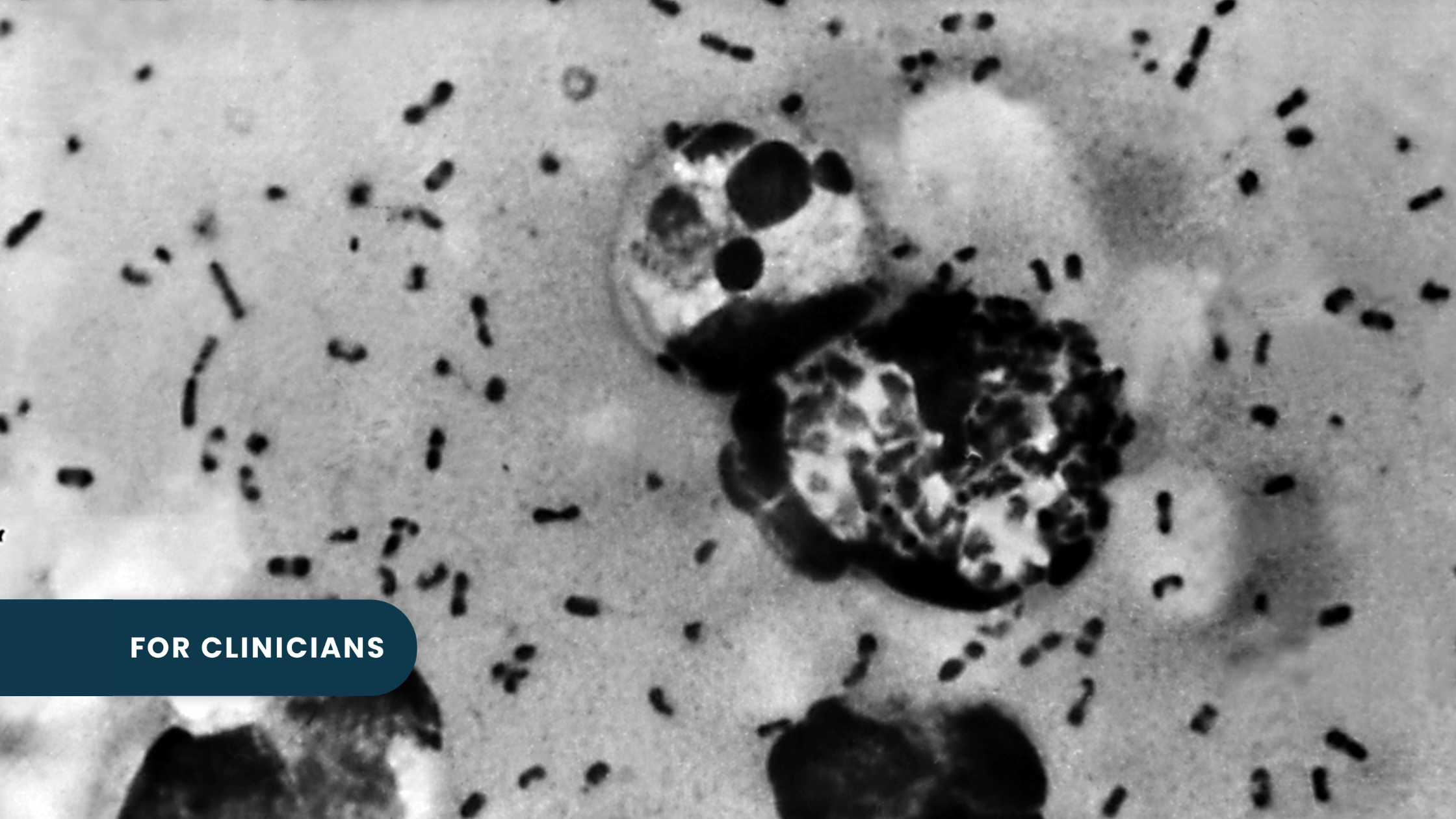
Yersinia pestis is the one bacterium, and where it takes hold in the body (skin, blood or lungs) decides which of three main clinical patterns you’re looking at.³
A flea bite drops it into the skin. It travels to the nearest lymph node and multiplies there, usually in the groin, armpit, or neck, and that node swells into a bubo.⁴ That’s bubonic plague, and it’s more than 8 in 10 US cases.⁵
When it takes hold in the bloodstream, it causes septicemic plague: fever, chills, extreme weakness, and shock characterize this variant.⁶ It can follow an untreated bubo, or it can come first, without the telltale node and with prominent nausea, vomiting, diarrhea, and abdominal pain.⁴ Yep, it can look like a stomach bug with a fever.
When it takes hold in the lungs, it’s called pneumonic plague, a pneumonia that gets bad fast, with cough, chest pain, and sometimes bloody sputum. Patients can become infected by breathingin droplets or particles from a person or animal with plague pneumonia, orby an untreated bubonic or septicemic infection which spreads there.⁶,⁷
Left untreated, plague can move from node to blood to lungs. The lung form is the only type that can spread from person to person.⁶
When a patient has a sudden fever and a painful, swollen lymph node within about a week of flea or animal exposure, and lives in or recently visited the rural West, that’s the time to start thinking plague.⁴,⁶ Ask where they’ve been and what animals they’ve touched, including the family cat and anything they hunted or skinned.³,⁷ It is prime hunting season out here in Utah/Wyoming right now so this is particularly on my mind as I walk around neighborhoods and see every third house processing their successful hunts in their driveway.
Why doesn’t the lung form spread like the flu?
Pneumonic plague does spread from person to person. Like flu, it travels in respiratory droplets and exposure within about 6 feet can be catching.⁸,⁹ The difference is timing.
Flu is most contagious in the first few days of illness.⁸ Plague, like aging cheese, gets stronger with time. Transmission risk is minimal early, before the cough fully develops, and highest in the mid-to-late stages, when the patient is coughing up sputum loaded with bacteria.⁹,¹⁰ By then, the patient is usually too sick to be out and about, so the people at risk are the ones close enough to care for them.
Colorado saw this in 2014. A dog with pneumonic plague infected its owner and two veterinary staff. A fourth person, who handled the dog’s body and later spent extended close time with the owner while he coughed up bloody sputum, may have caught it from him. That was the first possible human-to-human spread in the US since Los Angeles nearly 100 years before in 1924.¹¹
Masks and distance stopped pneumonic plague outbreaks even before antibiotics were available,¹⁰ and they still protect you and your staff today. CDC doesn’t consider prophylaxis necessary for clinicians caring for these patients as long as standard and droplet precautions are upheld.¹² Prophylaxis is for people with close, sustained contact with a patient or animal with pneumonic plague who weren’t wearing adequate protective equipment, or with direct contact with infected fluids or tissue. The regimens are in CDC’s 2021 plague recommendations in MMWR.⁹,¹²
Why does timing decide survival?
Since plague is bacterial, antibiotics can be effective when treatment starts early. Before antibiotics, about 2 of every 3 US cases were fatal. Since then, it’s about 1 in 6.³
Untreated, plague keeps moving, from node to blood to lungs, and the odds get worse at each stop in the body. Even in the antibiotic era, septicemic and pneumonic plague kill more often than bubonic.³
At the pharmacy counter, if a patient presents with fever plus a painful node and describes that exposure history, refer them to a prescriber immediately. Don’t give them acetaminophen for the fever and tell them to wait-and-see. In the office, call your local or state health department as soon as you suspect plague, and start treatment without waiting on test results.⁴,¹² Tell the lab you suspect plague because automated systems can misidentify Y. pestis, and in Colorado one called it a different bacterium for a week.⁴,¹¹
Who actually gets plague in the US?
Plague lives in wild rodents and their fleas across parts of the West, including prairie dogs, ground squirrels, chipmunks, and wood rats.⁷ People get it when they cross into that cycle: an infected flea bites a rodent, a cat that ate the infected rodent passes it to its owner, or someone handles or skins an infected animal.³,⁷ Wyoming’s 2021 pneumonic plague case likely traced to contact with sick pet cats.¹³ The US sees about 7 cases a year, mostly in rural New Mexico, Arizona, Colorado, and California.³,⁵
Even the worst case here, a traveler arriving with pneumonic plague, has a known response. Health officials trace close contacts, those contacts get prophylaxis or fever monitoring, and the care team uses droplet precautions.⁹,¹² That’s what happened in Colorado in 2014: officials traced 114 close contacts, recommended prophylaxis for 88, and no further cases turned up.¹¹
When a patient asks about the Russia story, in the office or at the pharmacy, here’s a short reply you can use: plague is a bacterial infection, it’s curable when treated early, and it’s rare here.
Then the prevention list:¹⁴
- Keep fleas off pets, get a sick pet to the vet quickly, and don’t let pets that roam outside sleep in the bed.
- Use insect repellent with DEET while outdoors.
- Wear gloves to handle or skin animals.
- Clear brush, rock piles, and woodpiles near the house, where rodents like to live.
If a sudden fever and a painful, swollen node show up, get seen fast and report where you’ve been.
The bottom line
Plague is very unlikely to touch your patients. It’s still a good reminder that illness doesn’t wait for a convenient time, and that a plan made ahead of time beats a scramble. That’s the work we do at Jase: helping people prepare for the times primary care isn’t available, in no way as a replacement for it. A licensed provider reviews every request before anything is prescribed, and our emergency kit medications are for use only in an emergency, after first seeking help from a qualified healthcare provider.
Sources
- Meduza. Hospital in Russia’s Irkutsk region quarantined amid reports that a patient died of pneumonic plague. October 2, 2026. https://meduza.io/en/news/2026/10/02/hospital-in-russia-s-irkutsk-region-quarantined-amid-reports-that-a-patient-died-of-pneumonic-plague
- Doubine S, Euronews Russian. Russia denies lab worker died of plague as quarantine in Siberia stays in place. Euronews. October 5, 2026. https://www.euronews.com/2026/10/05/situation-under-control-russian-authorities-reassure-public-after-plague-reports-in-siberi
- Kugeler KJ, Staples JE, Hinckley AF, Gage KL, Mead PS. Epidemiology of human plague in the United States, 1900-2012. Emerg Infect Dis. 2015;21(1):16-22. https://wwwnc.cdc.gov/eid/article/21/1/14-0564_article
- Centers for Disease Control and Prevention. Clinical Testing and Diagnosis for Plague. https://www.cdc.gov/plague/hcp/diagnosis-testing/index.html
- Centers for Disease Control and Prevention. Plague: Maps and Statistics. https://www.cdc.gov/plague/maps-statistics/index.html
- Centers for Disease Control and Prevention. Signs and Symptoms of Plague. https://www.cdc.gov/plague/signs-symptoms/index.html
- Centers for Disease Control and Prevention. How Plague Spreads. https://www.cdc.gov/plague/causes/index.html
- Centers for Disease Control and Prevention. How Flu Spreads. https://www.cdc.gov/flu/spread/index.html
- Nelson CA, Meaney-Delman D, Fleck-Derderian S, Cooley KM, Yu PA, Mead PS. Antimicrobial treatment and prophylaxis of plague: recommendations for naturally acquired infections and bioterrorism response. MMWR Recomm Rep. 2021;70(3):1-27. https://www.cdc.gov/mmwr/volumes/70/rr/rr7003a1.htm
- Kool JL. Risk of person-to-person transmission of pneumonic plague. Clin Infect Dis. 2005;40(8):1166-1172. https://pubmed.ncbi.nlm.nih.gov/15791518/
- Runfola JK, House J, Miller L, et al. Outbreak of human pneumonic plague with dog-to-human and possible human-to-human transmission, Colorado, June-July 2014. MMWR Morb Mortal Wkly Rep. 2015;64(16):429-434. https://www.cdc.gov/mmwr/preview/mmwrhtml/mm6416a1.htm
- Centers for Disease Control and Prevention. Clinical Care of Plague. https://www.cdc.gov/plague/hcp/clinical-care/index.html
- Wyoming Department of Health. Wyoming Detects Rare Human Case of Pneumonic Plague. September 15, 2021. https://health.wyo.gov/wyoming-detects-rare-human-case-of-pneumonic-plague/
- Centers for Disease Control and Prevention. Preventing Plague. https://www.cdc.gov/plague/prevention/index.html
Lifesaving Solutions
Recent Posts
Keeping you informed and safe.

For Clinicians | Medication List Accuracy
For Clinicians | Medication List Accuracy: Nobody Has the Whole Picture Anymore By Dr. Jamie Wilkey, PharmD, Director of Clinical EducationMedically reviewed and edited by Kristen Carpenter, PA-C We're closing out National Preparedness Month with the one step that...
Carbon Monoxide After the Storm
Carbon Monoxide After the Storm: The Symptoms Mistaken for the Flu By the Jase Medical Team The storm has passed, but the power is still out. It's raining, so the generator gets moved a little closer to the house—maybe under the porch or near an open garage. You're...

Why Patients Run Out of Meds
Why Patients Run Out of Meds: Ordinary Disruptions By the Jase Medical Team Most people who unexpectedly lose access to a prescription didn't lose it in a hurricane. A bottle gets left in a hotel room. A suitcase doesn't make the flight. Medication disappears during a...

For Clinicians | Why Patients Run Out of Medication
For Clinicians | Why Patients Run Out of Medication: The Ordinary Disruptions, Not the Disaster By Dr. Jamie Wilkey, PharmD, Director of Clinical EducationMedically reviewed and edited by Kristen Carpenter, PA-C As a pharmacist, I've helped patients keep access to...