
For Clinicians | What Diseases Spread After a Hurricane, Flood or Fire
Ranked by the Surveillance Data
By Dr. Jamie Wilkey, PharmD — Director of Clinical Strategy, Jase
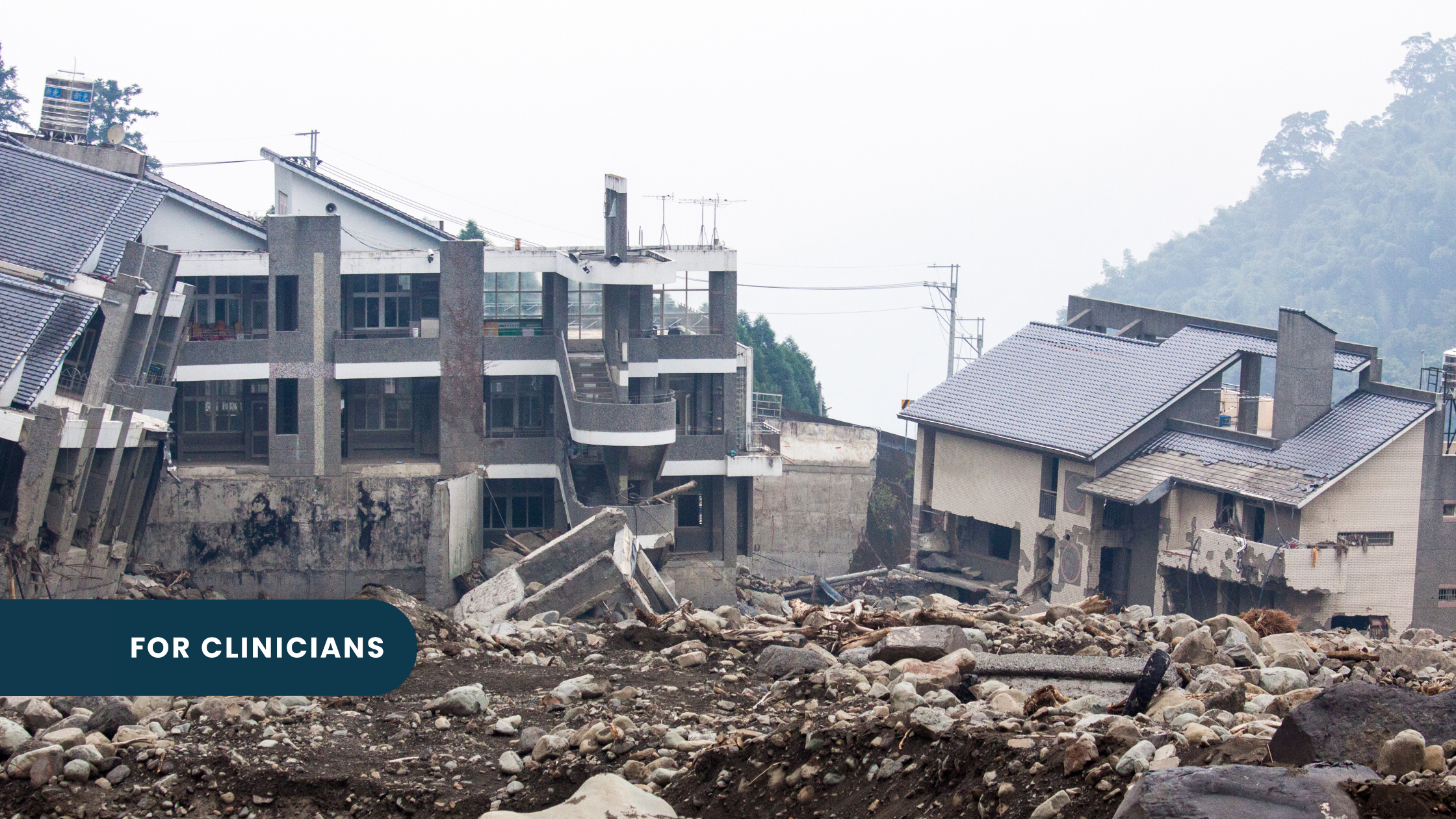
Natural disasters that displace a lot of people (hurricane, flood or wildfire) can lead to sickness. I don’t know about you, but I always pictured something specific to the natural disaster; for example in a hurricane it would be something waterborne and making those in contact with the floodwater itself sick.
What truly makes people sick after a storm has less to do with the disaster itself than with what happens next: a few hundred people evacuated into one building, sharing air and bathrooms for a week. The disaster displaces people. The crowding is what spreads the post-disaster disease. Crowding is something we as clinicians can help our patients be ready for ahead of time.
Today we’re busting some myths: what really spreads after a natural disaster, and in what order.
Can you get sick at a hurricane or wildfire evacuation shelter?
Yes, and it’s the most likely way you get sick after a disaster.
The two best data sets we have on this are both wildfire shelters. In January 2025, the Pasadena Convention Center opened as an evacuation shelter for the Eaton fire and held about 1,700 people by the second night. Over six weeks of operations, enhanced surveillance counted 104 cases of norovirus, 56 of COVID-19, 29 of influenza, and 30 of nonspecified respiratory illness.¹ Every category on that list is viral. Nine of the norovirus patients and six of the COVID-19 patients were hospitalized.¹
In November 2018, norovirus moved through eight of the nine Camp Fire evacuation shelters in Butte and Glenn counties: 292 cases among roughly 1,100 evacuees, an estimated 27% attack rate, median patient age 63.² Twenty-one of them, 7%, needed evaluation at a hospital or urgent care.²
Not a drop of floodwater in either one. What those two events shared was several hundred people in one building sharing bathrooms and air for weeks, which is exactly what a hurricane evacuation also produces.
Pasadena had written its shelter infection control protocols partly off the 2018 Camp Fire outbreak, and a site visit on day six still found no adequate isolation area, inadequate hand hygiene and PPE use, and cleaning products that don’t kill norovirus.¹
What the two responses came down to:
- Screening arriving evacuees for GI symptoms at registration, which is where Camp Fire caught cases²
- A real isolation area for people who were sick, with their own toileting and handwashing
- Handwashing with soap and water rather than hand sanitizer, because alcohol does little to norovirus²
- Around-the-clock cleaning with a disinfectant that works on norovirus, meaning an EPA List G product¹
There is no medication anywhere in either response. At Eaton, COVID-19 and influenza antivirals weren’t even available on site.¹ Both reports are observational, so infection control is temporally associated with cases falling rather than proven to have caused it.¹
Reports fell sharply nine days after the first site visit.
What infections actually go up after a flood?
The waterborne part of the story isn’t wrong, it’s just smaller than it looks, and it’s a different list than most people picture. This tier belongs to water. Wildfire evacuation carries the shelter risk above, not this one.
Lynch and Shaman ran 23 years of national surveillance data against tropical cyclone exposure in the United States, 1996 through 2018, and tested six waterborne diseases. Three went up:
- Cryptosporidiosis, up 52% during storm weeks³
- Shiga toxin-producing E. coli, up 48% the week after a storm³
- Legionnaires’ disease, up 42% two weeks after a storm³
The other three didn’t. Salmonellosis and giardiasis weren’t greatly associated with storm exposure, and shigellosis rates dipped slightly.³
The two GI infections on that list are managed with fluids and rest, not antibiotics. With STEC that isn’t a preference: the IDSA guideline says to avoid antibiotics when Shiga toxin is involved, because of the risk of hemolytic uremic syndrome.⁴ Legionnaires’ does need an antibiotic, but it’s pneumonia, so it needs a diagnosis and usually a hospital first. It also isn’t coming from the floodwater. It comes from the building’s own plumbing after the power goes out and the water sits warm and still.
Quick reference: what actually spreads, and what stops it
WHO laid out the pattern in 2007: outbreak risk after a disaster tracks population displacement, water and sanitation, crowding, the baseline health of the population, and access to care, rather than the disaster itself.⁵ The tiers below run roughly in the order the surveillance data supports, though no single source ranks them head to head.
Tier 1: viral illness in shelters. Norovirus, COVID-19, influenza, and the respiratory illness that never gets a name. It moves person to person in crowded congregate housing, and what holds it down is the infection control above.
Where a prescription fits: no antiviral touches norovirus, and for influenza and COVID-19 the gate is the clock and the prescriber, not the test.⁹ That gap is what preparation closes. Oseltamivir and nirmatrelvir-ritonavir are both JaseCase add-ons, and ondansetron is in the base kit for the vomiting norovirus causes. All of it is reviewed and prescribed by a licensed provider ahead of time, for emergency use only after trying to reach care.
Tier 2: skin and soft tissue infection. Cuts and punctures during cleanup, contaminated by debris and standing water. Gloves and boots prevent most of it, irrigating early with clean water prevents more, and tetanus vaccination should already be current before anyone starts hauling drywall.⁶
Where a prescription fits: here, and only here. A wound that has become infected with spreading cellulitis, in a patient who can’t reach care, for emergency use only after trying. Not an abscess, which needs drainage rather than a pill.
Tier 3: the water-ecology infections. Leptospirosis comes from skin or wound contact with fresh water carrying animal urine. Vibrio vulnificus comes from an open wound meeting warm brackish or coastal water.
Where a prescription fits: not at home. Vibrio needs IV antibiotics and usually an operating room.⁸ Leptospirosis does have an oral answer in doxycycline, but the symptoms are indistinguishable from flu and dengue without testing, and 10% of the post-Fiona cases were dengue-positive too.⁷
Tier 4: the rare ones.Mucormycosis is a fungal wound infection, melioidosis a soil bacterium. Both are real, both are documented after disasters, and both are hospital-level care every time.
Where a prescription fits: it doesn’t. Both need hospital care.
One myth to put the kabosh on once and for all while we’re here. CDC states that floodwater exposure by itself does not create tetanus risk, and post-flood tetanus vaccination campaigns aren’t indicated.⁶ The risk rides on the puncture wound, not the water, which is why the people who need current vaccination are the ones going in to clean up.
Where preparation really helps
Three of the four bacterial infections above need something no cupboard holds. Vibrio is surgical before it’s medical: pain out of proportion to the wound, erythema spreading while you watch it, bullae, or crepitus means an emergency department now, not a call in the morning, because early debridement is what changes the outcome.⁸ Legionnaires’ is pneumonia and needs the workup. Severe leptospirosis is Weil’s disease: jaundice, renal failure, hemorrhage.
What’s left is pretty narrow.
The influenza antiviral is the strongest case. Oseltamivir is approved for treatment within two days of symptom onset, and CDC is explicit that treatment shouldn’t wait for laboratory confirmation, because testing delays it and a negative rapid test doesn’t rule flu out.⁹ The barrier was never the test. It’s the clock and the prescriber, and after a hurricane those are the same problem.
The antiemetic matches the volume. Tier 1 is mostly norovirus, and norovirus sends people looking for care because of what they can’t keep down. Ondansetron doesn’t touch the virus and doesn’t need to.
The antibiotic is the narrowest. A wound that has become infected with spreading cellulitis, in a person who can’t reach care, with roads out and clinics closed. Not the abscess, which needs drainage rather than a pill.
All three are for emergency use only, after trying to reach a provider, and a patient has them at home because a licensed provider reviewed the request and wrote the prescription.
What appropriate medical preparation actually covers
Look at what worked in this article and it sorts into two piles. One is free and behavioral: gloves and boots, soap and water over sanitizer, a separate room for the person who’s vomiting, current tetanus before anyone hauls drywall. The other is out of reach: an IV, an operating room, a prescriber who can see you today.
Almost nothing sits between them. Three things do, and all three only work if they were in the house before the storm, which means someone prescribed them before the storm.
That band is the category, and it has a name: appropriate medical preparation. The clinical work happens ahead of time, by a licensed provider who reviews the request and writes the prescription, for bounded indications, for emergency use only after the patient has tried to reach care. It is in no way a replacement for primary care or an emergency department. It exists for the stretch when neither one is reachable, which after a hurricane runs days.
We’re a family company of medical doctors, physician assistants, and pharmacists, and we’d rather publish where the line falls than sell past it. If a patient asks what they should have at home before a storm and you’d rather not work through it in a visit that’s already full, you can send them to us at jase.com, where a licensed provider reviews every request and writes every prescription. We’ll keep publishing the criteria as we work them out.
The bottom line
The infections that actually follow a hurricane, flood, or wildfire come out ranked almost backward from the way preparedness content lists them. The top of the list is viral, it spreads because people are packed into one building, and it’s stopped by gloves, soap, separation, and cleaning with the right product. Three of the four bacterial infections in this article need a clinician, an IV, or an operating room.
The next time a patient asks what to have on hand before a storm, the first half of the answer is prevention, and it’s free. The second half is three prescriptions for three situations, and that’s a conversation to have before the season rather than during it.
Sources
- Patrick R, Lee K, Kuan M, et al. Norovirus, COVID-19, and Influenza Outbreaks Among Residents and Staff Members at the Eaton Wildfire Evacuation Shelter, Pasadena, California, January-February 2025. MMWR Morb Mortal Wkly Rep 2026;75(26):337-342. https://www.cdc.gov/mmwr/volumes/75/wr/mm7526a2.htm
- Outbreak of Norovirus Illness Among Wildfire Evacuation Shelter Populations, Butte and Glenn Counties, California, November 2018. MMWR Morb Mortal Wkly Rep 2020;69(20). https://www.cdc.gov/mmwr/volumes/69/wr/mm6920a1.htm
- Lynch VD, Shaman J. Waterborne Infectious Diseases Associated with Exposure to Tropical Cyclonic Storms, United States, 1996-2018. Emerg Infect Dis 2023;29(8):1548-1558. Cryptosporidiosis 52% increase during storm weeks (95% CI 42%-62%); STEC 48% increase at lag week 1 (95% CI 27%-69%); Legionnaires’ disease 42% increase at lag week 2 (95% CI 22%-62%). https://wwwnc.cdc.gov/eid/article/29/8/22-1906_article
- Shane AL, Mody RK, Crump JA, et al. 2017 Infectious Diseases Society of America Clinical Practice Guidelines for the Diagnosis and Management of Infectious Diarrhea. Clin Infect Dis 2017;65(12):e45-e80. https://academic.oup.com/cid/article/65/12/e45/4557073
- Watson JT, Gayer M, Connolly MA. Epidemics after Natural Disasters. Emerg Infect Dis 2007;13(1):1-5. https://wwwnc.cdc.gov/eid/article/13/1/06-0779_article
- CDC. Safety Guidelines: Floodwater. https://www.cdc.gov/floods/safety/floodwater-after-a-disaster-or-emergency-safety.html
- Leptospirosis Outbreak in Aftermath of Hurricane Fiona, Puerto Rico, 2022. MMWR Morb Mortal Wkly Rep 2024;73(35). Mean weekly cases 10.4 during the 15 weeks after the storm versus 2.9 during the prior 37 weeks. https://pmc.ncbi.nlm.nih.gov/articles/PMC11376507/
- Vibrio vulnificus in Taiwan. Emerg Infect Dis 2004;10(8). Overall case fatality approximately 30%; 86% of patients with cutaneous lesions received surgical treatment. https://wwwnc.cdc.gov/eid/article/10/8/04-0047_article
- CDC. Influenza Antiviral Medications: Summary for Clinicians. https://www.cdc.gov/flu/hcp/antivirals/summary-clinicians.html
Lifesaving Solutions
Recent Posts
Keeping you informed and safe.
For Clinicians | What Is Plague? One Bacterium, Three Diseases
For Clinicians | What Is Plague? One Bacterium, Three Diseases By Dr. Jamie Wilkey, PharmD, Director of Clinical EducationMedically reviewed and edited by Aaron Asay, PA-C, DMSc, FIBODM, FAWM Well, the plague is back in the news. Reports out of Russia in early October...

Nobody Has Your Medication List, Including Your Doctor and Your Pharmacy
Nobody Has Your Medication List, Including Your Doctor and Your Pharmacy By the Jase Medical Team Most of us assume that somewhere in the healthcare system, there is one correct list of every medication we take. Your primary care doctor has a list. Your pharmacy has a...

For Clinicians | Medication List Accuracy
For Clinicians | Medication List Accuracy: Nobody Has the Whole Picture Anymore By Dr. Jamie Wilkey, PharmD, Director of Clinical EducationMedically reviewed and edited by Kristen Carpenter, PA-C We're closing out National Preparedness Month with the one step that...
Carbon Monoxide After the Storm
Carbon Monoxide After the Storm: The Symptoms Mistaken for the Flu By the Jase Medical Team The storm has passed, but the power is still out. It's raining, so the generator gets moved a little closer to the house—maybe under the porch or near an open garage. You're...