
For Clinicians | “There’s Something Wrong With My Baby”: Would You Know What to Do?
Off Duty Series: Part 5 of 6
By Aaron Asay, PA-C, DMSc, FIBODM, FAWM
Medically reviewed and edited by Dr. Jamie Wilkey, PharmD
Off Duty is a six-part series on the emergencies clinicians end up handling outside of work: a call from family overseas, a car crash, a choking baby, a bad bleed. Aaron Asay has spent his career in emergency, disaster, and austere medicine. Part 5 is choking: what the American Heart Association changed in 2025, and what severe choking looks like when the patient is nine months old.
“There’s something wrong with my baby!“
That is the kind of phrase that turns a first responder’s blood cold.
I was working from home that day. It was a quiet morning, and I was busying myself with chores around the house. I recognized the fear in her voice from across the small field between our properties, even before I processed what she was yelling. My neighbor is a young mom, and the baby was her nine-month-old son. I know the family well, and I also know this mother is not one to scream for help unless something is truly wrong.
I dropped what I was doing and ran to their front door. The baby’s uncle was coming down the steps, cradling the child in his arms. He had the deer-in-the-headlights stare of someone who recognized an emergency but had no idea what to do next.
The child was breathing, but I heard a high-pitched whistling sound, known as stridor, each time he inhaled. He was drooling copiously, and there was a faint blue color around his lips. His eyes were wide open, as if pleading with me to fix what was wrong, but no cry came out when he tried to voice his discomfort.
I quickly looked inside his mouth and saw nothing obviously blocking the airway. Recognizing the signs of severe choking, I gave him five back blows followed by five chest thrusts. I looked in his mouth again for a dislodged object I could clearly see and remove. There was nothing, so as I repositioned him to repeat the sequence, I told the family to call 911.
Choking Can Be Difficult to Recognize
Choking is particularly common in young children. Babies explore the world with their mouths, and their small airways can be obstructed by food, toys, coins, and other objects they curiously grab. Older children and adults choke as well, especially while eating.
Fortunately, the body has protective reflexes. Gagging helps prevent an object from entering the airway, while coughing forcefully expels air from the lungs and may clear an obstruction. A person who can cough forcefully, speak, or make sounds is still moving air. Encourage that person to keep coughing and watch closely.
Severe choking is different. A person with a completely or nearly completely blocked airway may be unable to speak, breathe, or cough effectively. They may make only faint sounds, or no sound at all.
Rapidly recognizing this change is the most important first step. The sooner you recognize that the airway is blocked, the sooner you can begin treatment and summon help.
Choking First Aid Has Changed
In 2025, the American Heart Association updated its guidelines for treating severe choking in conscious adults and children¹,²,³. The new approach more closely matches guidelines already used by organizations such as the American Red Cross and European Resuscitation Council⁴,⁵,⁶.
The recommended sequence is:
- Give five firm back blows.
- Give five abdominal thrusts.
- Repeat until the object is expelled or the person becomes unresponsive.
If you see a headline declaring that “the Heimlich maneuver is dead,” that is sensational but misleading. Abdominal thrusts, the technique made famous by Dr. Henry Heimlich, remain an important part of choking first aid. They are now used in combination with back blows.
The universal sign for choking is a person clutching their neck. In an adult or older child, this is usually a plea for help. Babies and small children, however, may not respond that way. They may reach toward a caregiver, move their mouths without making a sound, drool excessively, or remain strangely still as their color begins to change.
A choking person may also try desperately to clear the obstruction. I once watched a restaurant patron throw their own body over the back of a large chair to dislodge a piece of meat. The offending morsel ejected onto a neighboring table, landing with a wet splash in someone’s soup. It was unpleasant, but effective.
Remember Five and Five
For a conscious adult or child with severe choking, lean the person forward and support the chest. Using the heel of your hand, deliver five firm blows between the shoulder blades.
If that does not clear the obstruction, stand behind the person and wrap your arms around the waist. Place a clenched fist just above the navel and well below the breastbone. Cover the fist with your other hand and give five quick thrusts inward and upward.
Continue alternating five back blows and five abdominal thrusts until the object comes out or the person becomes unresponsive. If you cannot encircle the abdomen, or if the person is pregnant, chest thrusts are used instead⁴.
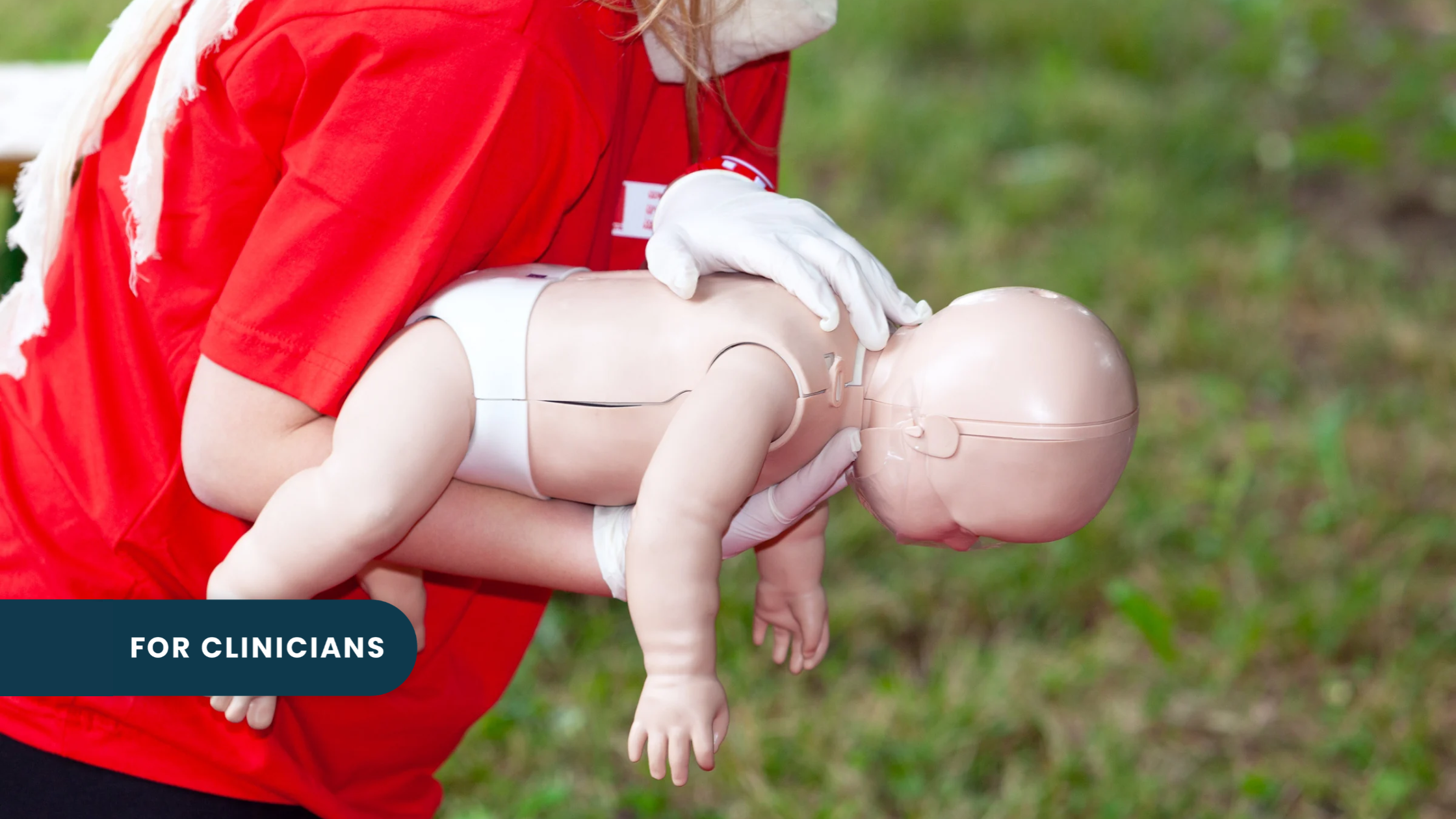
Infants younger than one year require a different technique. Give five back blows while supporting the infant face down, with the head lower than the chest. Then turn the infant face up and give five chest thrusts using the heel of one hand, following the current AHA technique. Never perform abdominal thrusts on an infant¹,³.
Do not blindly sweep a finger inside anyone’s mouth. You may push the obstruction deeper. Attempt to remove an object only when you can clearly see it and can grasp it without forcing it farther into the airway⁴.
If the person becomes unresponsive, lower them carefully to a firm surface, call 911 if that has not already been done, and begin CPR starting with chest compressions. Before attempting breaths, look inside the mouth for a visible object⁴. Continue CPR and follow the emergency dispatcher’s instructions until help arrives.
A quick note on suction devices. Anti-choking suction devices are increasingly found in homes, schools, and care facilities. In March 2026, the FDA authorized LifeVac for use in adults and children at least one year old, but only as a second-line treatment after established choking techniques have failed⁷. Other marketed devices may not have FDA authorization, and retrieving or assembling any device should never delay back blows, thrusts, or a call to 911.
Back to the Baby
We continued back blows and chest thrusts until the baby became unresponsive. I began resuscitative care while we waited for the ambulance. It took about twenty minutes to arrive because we lived in a very rural community.
We intubated him at the scene, and he was flown to the nearest children’s hospital. He made a full recovery within a few days.
We later learned that his toddler-age brother had been feeding him cheese puffs, unknown to the parents. One had lodged deep in his airway, beyond anything that could be seen or safely removed from his mouth. The obstruction eventually moved into his right main bronchus* while we were treating him, allowing his other lung to be ventilated until surgeons could remove it.
Without immediate intervention, this little boy would likely have died that day.
No one knows when they will be called upon to help someone in need. Choking first aid, CPR, and AED use are simple, practical skills that nearly anyone can learn. Courses are available online, through blended programs, and in traditional hands-on classes, although practicing these techniques with a qualified instructor provides an experience that a video cannot completely replace.
In an emergency, you will not have time to begin learning. The time to prepare is now.
*Bronchus: The trachea divides into two main airways, called bronchi, with one entering each lung. The right main bronchus is generally wider, shorter, and more vertical than the left, so objects that travel this far are more likely to lodge there⁸. In this case, the object’s movement into the right bronchus allowed air to reach the left lung.
Sources
- American Heart Association. Updated CPR guidelines tackle choking response, opioid-related emergencies and a revised chain of survival. AHA Newsroom. October 22, 2025. https://newsroom.heart.org/news/updated-cpr-guidelines-tackle-choking-response-opioid-related-emergencies-and-a-revised-chain-of-survival
- Kleinman ME, Buick JE, Huber N, et al. Part 7: Adult basic life support: 2025 American Heart Association Guidelines for Cardiopulmonary Resuscitation and Emergency Cardiovascular Care. Circulation. 2025;152(16 Suppl 2):S448-S478. https://doi.org/10.1161/CIR.0000000000001369
- Joyner BL, Dewan M, Bavare A, et al. Part 6: Pediatric basic life support: 2025 American Heart Association and American Academy of Pediatrics Guidelines for Cardiopulmonary Resuscitation and Emergency Cardiovascular Care. Circulation. 2025;152(16 Suppl 2):S424-S447. https://doi.org/10.1161/CIR.0000000000001370
- American Red Cross. Adult and child choking: symptoms and first aid. https://www.redcross.org/take-a-class/resources/learn-first-aid/adult-child-choking
- Djärv T, Rogers J, Semeraro F, et al. European Resuscitation Council Guidelines 2025 First Aid. Resuscitation. 2025;215 Suppl 1:110752. https://doi.org/10.1016/j.resuscitation.2025.110752
- Djakow J, Turner NM, Skellett S, et al. European Resuscitation Council Guidelines 2025 Paediatric Life Support. Resuscitation. 2025;215 Suppl 1:110767. https://doi.org/10.1016/j.resuscitation.2025.110767
- US Food and Drug Administration. De Novo classification request for LifeVac (DEN250012): decision summary. https://www.accessdata.fda.gov/cdrh_docs/reviews/DEN250012.pdf
- Tahir N, Ramsden WH, Stringer MD. Tracheobronchial anatomy and the distribution of inhaled foreign bodies in children. Eur J Pediatr. 2009;168(3):289-295. https://doi.org/10.1007/s00431-008-0751-9
Lifesaving Solutions
Recent Posts
Keeping you informed and safe.

Who Do You Help First in an Emergency? How to Prioritize Injuries When Every Second Counts
Who Do You Help First in an Emergency? How to Prioritize Injuries When Every Second Counts By the Jase Medical Team When two people are injured in an emergency, who should you help first? Start by checking the person who is quiet, unresponsive, or struggling to...

For Clinicians | Emergency Priorities: How First Responders Decide What Injuries to Manage First
For Clinicians | Emergency Priorities: How First Responders Decide What Injuries to Manage First Off Duty Series: Part 4 of 6 By Aaron Asay, PA-C, DMSc, FIBODM, FAWMMedically reviewed and edited by Dr. Jamie Wilkey, PharmD Off Duty is a six-part series on the...

Is It Safe to Help? What to Check First in an Emergency
Is It Safe to Help? What to Check First in an Emergency By the Jase Medical Team You see someone fall from a ladder. Or you're the first person to stop at a roadside accident. Maybe a family member suddenly collapses during a holiday gathering. Your first instinct is...

For Clinicians | Seeing the Emergency: Scene Safety and Triage
For Clinicians | Seeing the Emergency: Scene Safety and Triage Off Duty Series: Part 3 of 6 By Aaron Asay, PA-C, DMSc, FIBODM, FAWMMedically reviewed and edited by Dr. Jamie Wilkey, PharmD Off Duty is a six-part series on the emergencies clinicians end up handling...