
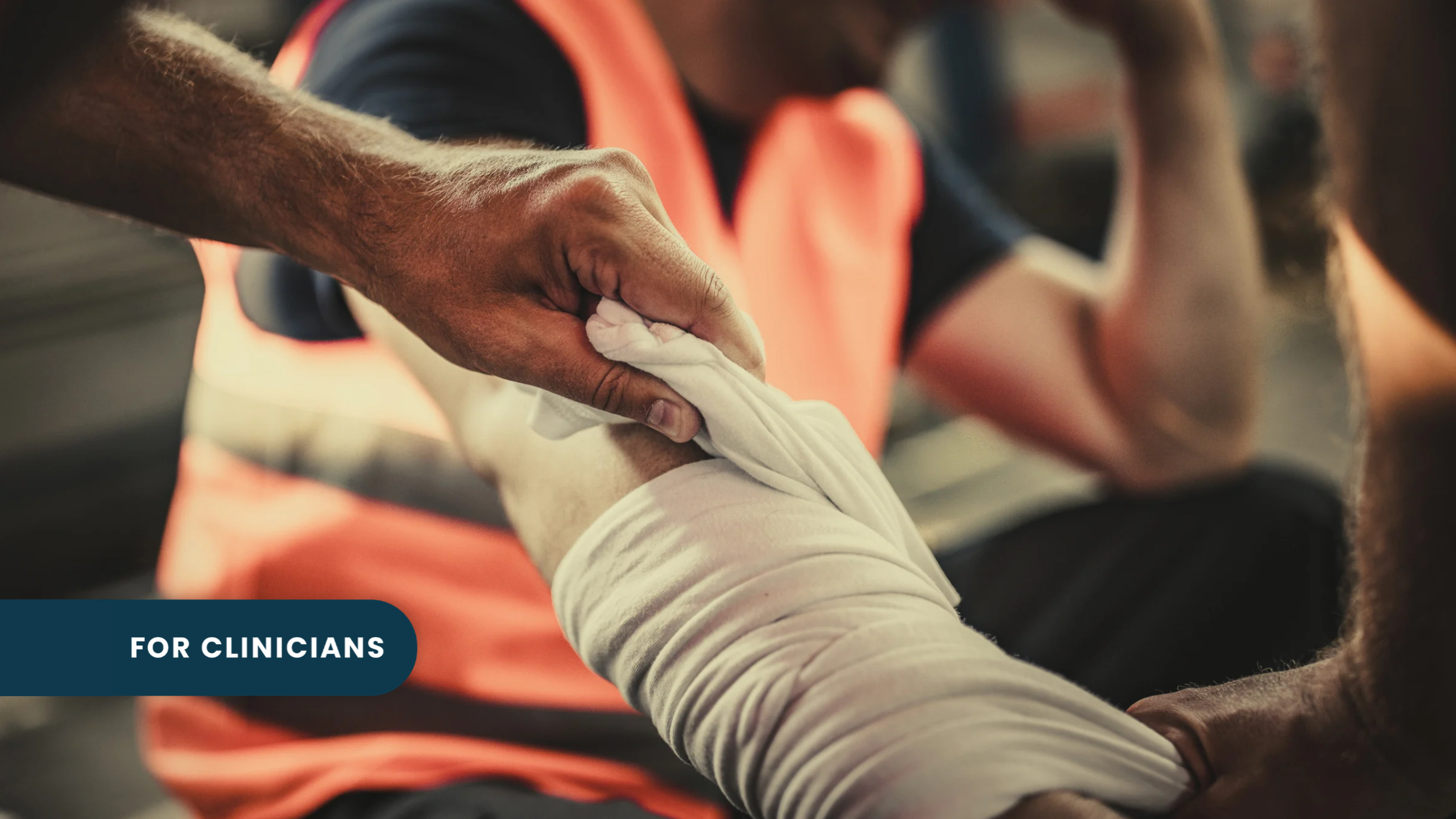
For Clinicians | Emergency Priorities: How First Responders Decide What Injuries to Manage First
Off Duty Series: Part 4 of 6
By Aaron Asay, PA-C, DMSc, FIBODM, FAWM
Medically reviewed and edited by Dr. Jamie Wilkey, PharmD
Off Duty is a six-part series on the emergencies clinicians end up handling outside of work: a call from family overseas, a car crash, a choking baby, a bad bleed. Aaron Asay has spent his career in emergency, disaster, and austere medicine. Part 4 is the car crash: two patients, one bystander, and the order that decides who gets help first.
Imagine you are driving home when traffic suddenly comes to a stop. Just ahead, two vehicles have collided.
One victim is outside of the car, screaming in pain. Blood covers one arm, which is obviously injured. They are pacing in circles, crying for help, and demanding someone do something. Another victim remains slumped over the steering wheel. They have not moved since you arrived and you cannot tell if they are breathing.
You can only help one of them first.
Who do you choose?
Most people instinctively move toward the person who is screaming. They are the most visible and the most emotional, and their injuries appear dramatic.
I am leading you to the answer that many veteran responders would recognize in this situation. A patient who is walking, talking, and alert can probably tolerate a brief delay to first evaluate a patient who is unresponsive or appears to not be breathing¹. The screaming patient may indeed have a life-threatening injury and require immediate intervention. But experienced responders may first determine that another patient has a more immediate threat in spite of the drama surrounding them.
In addition to the actual hands-on skills, good first aid requires awareness and an ability to differentiate lethal versus non-lethal injuries and whether interventions will change an outcome. It is how emergencies are prioritized to save as many victims as possible, and one of the most important lessons in emergency response. The patient making the most noise may not be the patient closest to dying.
In Part 2 of this series, we introduced the four conditions responsible for many preventable deaths before a patient reaches the highest level of medical care. In Part 3, we learned to see the emergency by recognizing hazards, assessing the scene, and identifying immediate dangers before rushing to help.
Before we begin discussing the management of severe bleeding, the most common cause of preventable prehospital death²,³, we need to answer an important question.
How do experienced responders know what to do first?
The answer is not that they know more medicine. It is that they have learned to organize their attention. Every emergency presents distractions: emotions, competing injuries, and well-meaning bystanders pulling their focus in different directions. Responders learn to recognize the few conditions that threaten life immediately and address those first.
Stress has a predictable effect on our minds. It narrows our attention. We become focused on the first thing we notice, the loudest voice, the most dramatic injury, or the task directly in front of us. Psychologists call this attentional narrowing⁴. Emergency responders recognize it as tunnel vision, a normal human reaction under stress.
Before we learn how to control life-threatening bleeding, open an airway, or perform CPR, we must first understand how to recognize and prioritize the major life threats that can turn a survivable injury into a fatal one within minutes.
That is why experienced responders rely on structured assessment algorithms. They are not designed to replace critical thinking. They exist to support it. An algorithm provides a consistent mental framework that helps responders recognize life-threatening problems in a logical order, reducing the chance that a treatable life threat will be overlooked. It also provides a stepwise approach that allows responders to pause, reassess, and begin again if conditions change or they get interrupted during treatment.
Military medicine uses the MARCH algorithm to prioritize care for casualties injured in combat⁵. Similar to the ABCs (airway, breathing, circulation) used in trauma care, it is an outstanding framework for battlefield trauma assessment.The principles behind MARCH are also valuable in civilian emergencies. With some minor adjustments, because community responders encounter a broader range of emergencies than battlefield trauma alone, the MARCH algorithm can help provide a simple framework for anyone interested in improving their first aid skills.
A civilian responder may be called to help in a motor vehicle collision, a farm accident, a drowning, a choking child, a cardiac arrest, or a victim of violence. While the circumstances differ, the underlying question remains the same:
What injury is most likely to kill this person first?
MARCH begins with M for Massive Hemorrhage, or bleeding. In a tactical setting the most likely injury that will kill a patient is uncontrolled, rapid bleeding from an artery. While the military and tactical medicine is most concerned with penetrating injuries, civilians rarely deal with those kinds of wounds. I teach the initial M step as Major Life Threats, because bleeding and penetrating injury are only two of a variety of possible problems in a public or civilian setting that can be lethal. Imagine a victim of a shark attack or someone struck by a boat propeller who is bleeding in the water. While stopping the bleed is technically the first intervention, logically, removing them from the water prior to drowning or a second attack would be more appropriate to focus on.
The rest of the sequence, as the TCCC guidelines lay it out⁵:
- A: Airway. Is it open, and will it stay open?
- R: Respiration. Is the patient breathing effectively, or is a chest injury getting in the way?
- C: Circulation. Are there signs of shock, or bleeding that hasn’t been found yet?
- H: Hypothermia and head injury. Keep the patient warm, and watch for changes in alertness.
This step-by-step assessment is a simple way of organizing priorities before treatments begin. Rather than reacting to the loudest patient or the most dramatic injury, responders learn to recognize the few conditions that cannot wait and manage them in the order that gives the patient the greatest chance of survival.
Experienced first responders memorize these steps, not so they can work without thinking, but rather so that they can give their minds a scaffolding to hang their critical thinking on, and avoid missing critical clues and interventions. In the articles that follow, we will put these steps to work, starting with a blocked airway and then massive bleeding.
Adapted from an article Aaron first published on his Substack, The HoboMed Field Journal, in July 2026.
Sources
- Chemical Hazards Emergency Medical Management (CHEMM). START Adult Triage Algorithm. US Department of Health and Human Services, Administration for Strategic Preparedness and Response. https://chemm.hhs.gov/incident-primer/triage/start-triage
- Davis JS, Satahoo SS, Butler FK, et al. An analysis of prehospital deaths: who can we save? J Trauma Acute Care Surg. 2014;77(2):213-218. https://pubmed.ncbi.nlm.nih.gov/25058244/
- Eastridge BJ, Mabry RL, Seguin P, et al. Death on the battlefield (2001-2011): implications for the future of combat casualty care. J Trauma Acute Care Surg. 2012;73(6 Suppl 5):S431-S437. https://pubmed.ncbi.nlm.nih.gov/23192066/
- Easterbrook JA. The effect of emotion on cue utilization and the organization of behavior. Psychol Rev. 1959;66(3):183-201. https://doi.org/10.1037/h0047707
- Committee on Tactical Combat Casualty Care, Joint Trauma System. Tactical Combat Casualty Care (TCCC) guidelines and education materials. Deployed Medicine. https://www.deployedmedicine.com/tccc
Lifesaving Solutions
Recent Posts
Keeping you informed and safe.
Is It Safe to Help? What to Check First in an Emergency
Is It Safe to Help? What to Check First in an Emergency By the Jase Medical Team You see someone fall from a ladder. Or you're the first person to stop at a roadside accident. Maybe a family member suddenly collapses during a holiday gathering. Your first instinct is...
For Clinicians | Seeing the Emergency: Scene Safety and Triage
For Clinicians | Seeing the Emergency: Scene Safety and Triage Off Duty Series: Part 3 of 6 By Aaron Asay, PA-C, DMSc, FIBODM, FAWMMedically reviewed and edited by Dr. Jamie Wilkey, PharmD Off Duty is a six-part series on the emergencies clinicians end up handling...
What to Do Before the Ambulance Arrives: Four First Aid Skills That Could Save a Life
What to Do Before the Ambulance Arrives: Four First Aid Skills That Could Save a Life By the Jase Medical Team The first few minutes of a medical emergency can change everything. And the person who makes the biggest difference before an ambulance arrives might not be...
For Clinicians | The First Hour: An Introduction to Community Crisis First Aid
For Clinicians | The First Hour: An Introduction to Community Crisis First Aid Off Duty Series: Part 2 of 6 By Aaron Asay, PA-C, DMSc, FIBODM, FAWMMedically reviewed and edited by Dr. Jamie Wilkey, PharmD Off Duty is a six-part series on the emergencies clinicians end...