
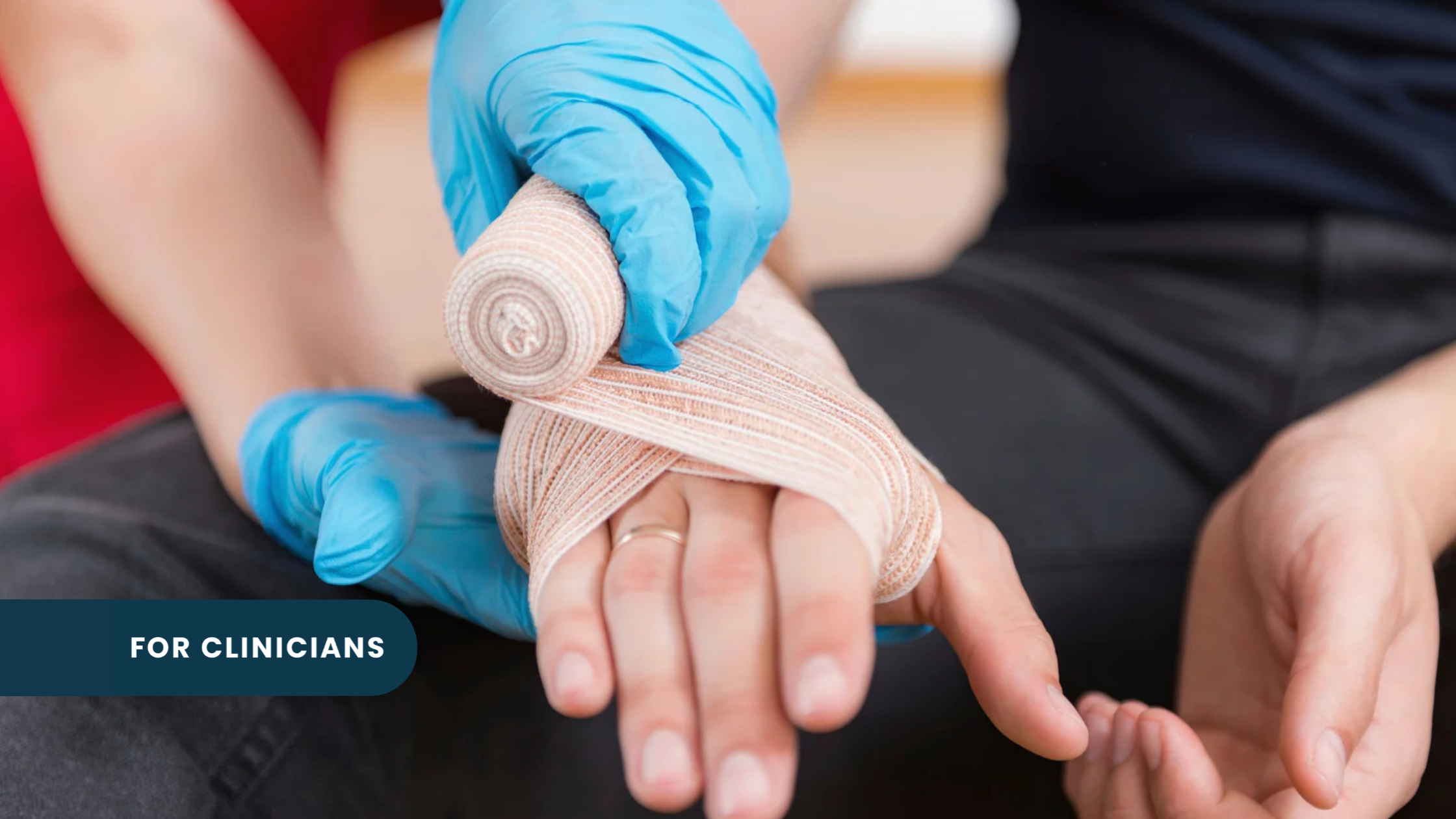
For Clinicians | The First Hour: An Introduction to Community Crisis First Aid
Off Duty Series: Part 2 of 6
By Aaron Asay, PA-C, DMSc, FIBODM, FAWM
Medically reviewed and edited by Dr. Jamie Wilkey, PharmD
Off Duty is a six-part series on the emergencies clinicians end up handling outside of work: a call from family overseas, a car crash, a choking baby, a bad bleed. Aaron Asay has spent his career in emergency, disaster, and austere medicine. Part 2 starts his teaching on bystander care: what happens in the first hour, before anyone with equipment arrives.
The most important emergency medical provider during a disaster may not be a healthcare professional.
When disaster strikes, the first person on scene is often forced into the role of first responder, providing immediate aid, and possibly, life-saving interventions. It would be reassuring if that person were always an experienced emergency medical technician, paramedic, nurse, or physician. In reality, it is usually a family member, friend, coworker, neighbor, or even a stranger. It could be you.
Many people think of disasters as destructive hurricanes, earthquakes, wildfires, or other large-scale events. While those certainly qualify, a disaster is better defined as any situation where needs exceed available resources¹. A natural catastrophe, motor vehicle collision, industrial accident, violent attack, or mass casualty incident all share the same characteristic: there are more problems than can be immediately managed with the resources at hand.
This is an important distinction because most people will never respond to a major hurricane or earthquake. Nearly everyone, however, will eventually encounter a medical emergency. A chainsaw accident in a rural area, a rollover crash on a remote highway, a cardiac arrest at a sporting event, or a serious injury while hiking can quickly create a situation where professional help is delayed and immediate action is required.
In emergency medicine, we often focus on what happens during the first hour. This is the period between the emergency and definitive care. During this window, ordinary people have an extraordinary opportunity to influence outcomes. While we would prefer to get an injured patient to a facility quickly, that is not always possible. When evacuation or transport is delayed, what happens in the first few minutes can sometimes mean the difference between life and death.
The good news is that many preventable deaths before arrival at a hospital result from a surprisingly small number of problems²,³.
- Massive bleeding
- Airway obstruction
- Cardiac arrest
- Exposure and hypothermia
These conditions can kill quickly, but they are also situations where bystanders can make a meaningful difference. Applying direct pressure to a bleeding arterial wound, placing an unconscious person in a position that protects their airway, beginning CPR, using an AED, or simply preventing an injured person from becoming cold can buy valuable time until higher levels of care can take over³,⁴,⁵.
None of these interventions requires advanced medical training. But they do require awareness, preparation, and the willingness to act.
Modern society has conditioned us to believe that emergencies are someone else’s responsibility. We expect trained professionals to arrive quickly, with specialized equipment to solve the problem. Often they do. The challenge is that some emergencies don’t happen when community resources are readily available.
When these events occur, the factor that makes survival possible might be our own level of preparedness and skills. Preparedness is often associated with food storage, generators, or emergency kits. While those tools have value, skills are frequently more important than equipment. Knowledge weighs nothing. Training takes up no storage space. Confidence costs little to acquire but can prove invaluable when a life depends on it.
The reality is simple. If an emergency happens in front of you, you are the first responder, whether you planned for that responsibility or not. The question is not whether you will ever be called upon to help. The question is whether you will be ready when the first hour belongs to you.
Adapted from an article Aaron first published on his Substack, The HoboMed Field Journal, in June 2026.
Sources
- Centre for Research on the Epidemiology of Disasters (CRED), UCLouvain. EM-DAT documentation: general definitions and concepts. https://doc.emdat.be/docs/data-structure-and-content/general-definitions-and-concepts/
- Davis JS, Satahoo SS, Butler FK, et al. An analysis of prehospital deaths: who can we save? J Trauma Acute Care Surg. 2014;77(2):213-218. https://pubmed.ncbi.nlm.nih.gov/25058244/
- Dainty KN, Colquitt B, Bhanji F, et al. Understanding the importance of the lay responder experience in out-of-hospital cardiac arrest: a scientific statement from the American Heart Association. Circulation. 2022;145(17):e852-e867. https://doi.org/10.1161/CIR.0000000000001054
- Hewett Brumberg EK, Douma MJ, Alibertis K, et al. 2024 American Heart Association and American Red Cross guidelines for first aid. Circulation. 2024;150(24):e519-e579. https://doi.org/10.1161/CIR.0000000000001281
- Dow J, Giesbrecht GG, Danzl DF, et al. Wilderness Medical Society clinical practice guidelines for the out-of-hospital evaluation and treatment of accidental hypothermia: 2019 update. Wilderness Environ Med. 2019;30(4S):S47-S69. https://doi.org/10.1016/j.wem.2019.10.002
Lifesaving Solutions
Recent Posts
Keeping you informed and safe.
Can You Get Rabies From a Dog Lick? What Travelers Need to Know
Can You Get Rabies From a Dog Lick? What Travelers Need to Know By the Jase Medical Team Can you get rabies from a dog licking you? Yes, if the animal's saliva comes into contact with broken skin or the moist membranes of your eyes, nose, or mouth. Most people...
For Clinicians | It Was Only a Lick: A Rabies Exposure Case Study Part 1
For Clinicians | It Was Only a Lick: A Rabies Exposure Case Study Off Duty Series: Part 1 of 6 By Aaron Asay, PA-C, DMSc, FIBODM, FAWMMedically reviewed and edited by Dr. Jamie Wilkey, PharmD, Director of Clinical Education Off Duty is a six-part series on the...
Flu and COVID Prevention for the Holidays: Why Timing Matters
Flu and COVID Prevention for the Holidays: Why Timing Matters By the Jase Medical Team The holidays are a time for gathering around the table, catching up with family, and making memories with the people we love. They're also a time when respiratory viruses can spread...
For Clinicians | How Long Does the Flu Shot Take to Work? Holiday Flu Prevention
For Clinicians | How Long Does the Flu Shot Take to Work? Holiday Flu Prevention By Dr. Jamie Wilkey, PharmD, Director of Clinical EducationMedically reviewed and edited by Kristen Carpenter, PA-C Hi again, everyone. Last week I had a lot of fun writing about flu...