
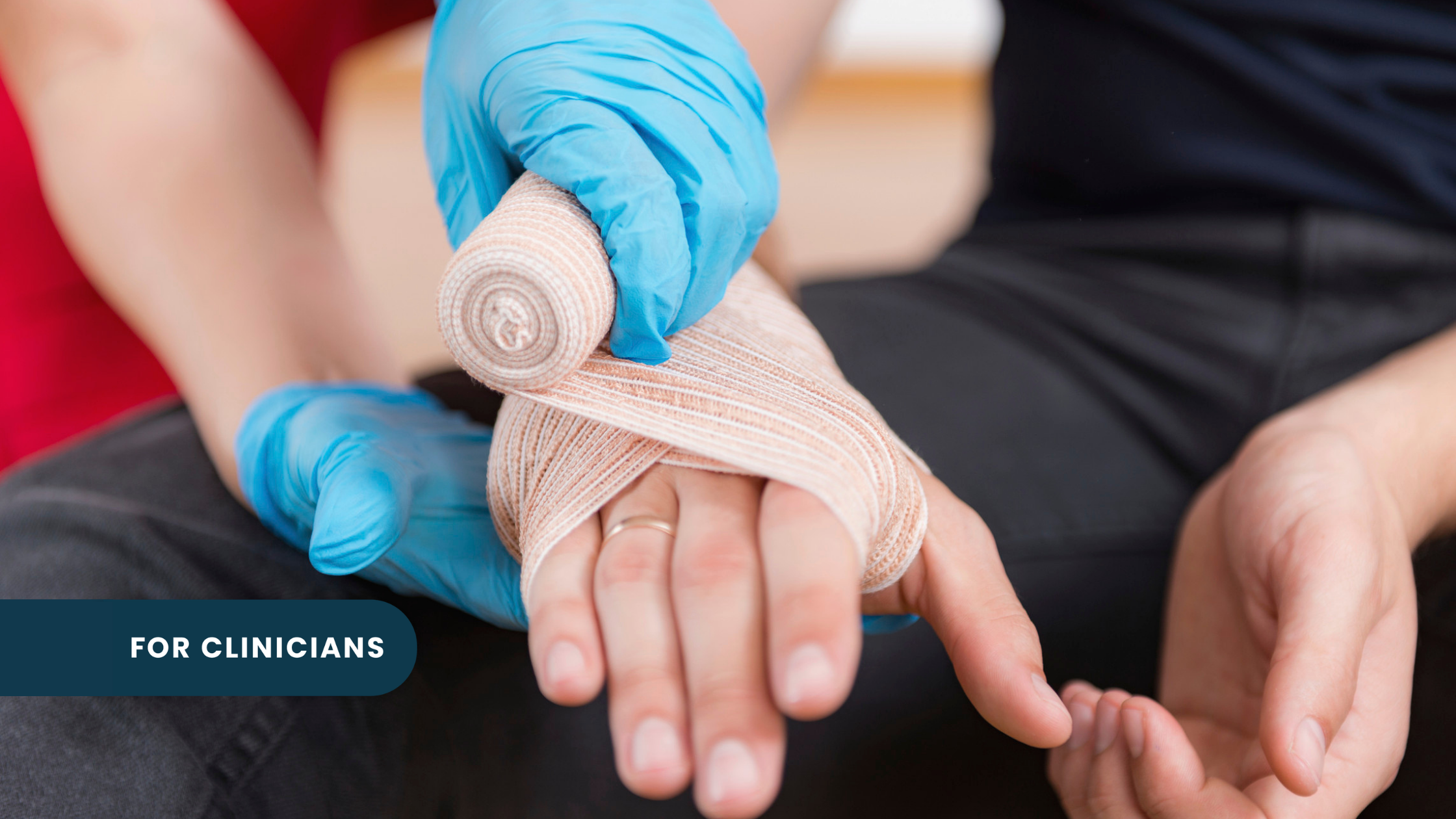
For Clinicians | Burn First Aid Without Running Water
By Dr. Jamie Wilkey, PharmD, Director of Clinical Education
Medically reviewed and edited by Aaron Asay, PA-C, DMSc, FIBODM, FAWM
Every burn first-aid guide starts the same way: cool it under running water. That’s the one thing you can’t count on in a power outage, when homes on a well lose the pump, or at a campsite miles from the nearest faucet. Burns are already the most common injury in my house full of boys, and they’re hard enough to manage with running water. Without it, they feel so much harder. Today we’re covering where these burns come from, how long to cool one, how to do it without a tap, and which burns must be escalated to a provider no matter what.
Where do these burns come from?
Mostly from the heat sources we bring in when the usual ones aren’t there. In a power outage, that’s a candle lit for light, a space heater pulled too close to the couch, a pot of water on a camp stove, or fuel spilled on a generator that’s still hot. (That same generator is behind our carbon monoxide article, same outage, different injury.) After Hurricane Ida, generator and cooking accidents caused 56% of the storm-related burns treated at two New Orleans hospitals, and 78% of all those burn patients were admitted¹. Those high admission rates tell you these burns are serious stuff.
Outdoors the campfire is the big culprit. Interestingly, the most dangerous stage of the fire is the one that looks like it is put out. In a review of children burned by recreational fires, 40% fell into and another 30% crawled or walked onto the remnants of a fire that hadn’t been fully put out. The same study found a small charcoal fire stayed hot enough to burn at least 16 hours after it was lit². Hands and feet were the most common places those burns were incurred.
How do you cool a burn without a tap?
Cooling really matters here. In a human model, burns kept getting deeper after the heat was gone, and 20 minutes of cooling at 16°C (about 60°F) saved about a quarter of the skin’s deeper layer³. If that doesn’t make sense, picture a pan you just pulled off the stove. The flame is off, but the pan keeps cooking whatever it’s touching. Burned skin holds heat the same way.
How long? The Wilderness Medical Society’s 2025 burn guideline, written for remote and low-resource settings like a blackout or a campsite, recommends 20 minutes of cool running water for burns covering less than 10% of the body¹⁰. A 2022 systematic review backs the number: 20 minutes of cooling within the first 3 hours lowered the odds of needing a skin graft or surgery⁵. The American Burn Association’s patient page says at least 5 minutes⁴. That’s a minimum. The target is 20. Twenty minutes is roughly one good ‘ol sitcom episode.
All of that evidence comes from running water, which is exactly what a blackout or a campsite takes away. So, in our disaster scenario without a running tap the patient has to rebuild the water flow with what they have available:
- Pour clean, cool water slowly and steadily over the burn from a jug, a bottle, or a camp water bag.
- If there’s enough water but no way to keep it flowing, immerse the burn in a basin, pot, or cooler of cool water. WMS lists immersion as acceptable when running water isn’t available¹⁰.
- Keep it cool, not cold, around 53 to 64°F¹⁰. No ice, which can worsen the damage⁴.
- If water is scarce, a clean cloth soaked in cool water and swapped out often is the fallback. It’s less reliable than flow⁶, and it still cools and is better than nothing.
Watch the patient’s temperature along with the burn. Twenty minutes of cool water on a cold night, in a house with no heat, or at a campsite can drop a person’s core temperature, and WMS notes hypothermia is more common with larger burns and in older patients¹⁰. When hypothermia is a real risk, WMS suggests not cooling the burn in the field at all¹⁰. Short of that, cool only the burned area and keep the rest of the person covered and warm.
And don’t fret too much if that burn can’t be cooled right away. It can still be cooled late, so if the water shows up 30 minutes later, please use it.
What do you put on a burn?
First of all, nothing greasy on a fresh burn. The American Burn Association says to skip butter, oils, and ointments, because they trap heat⁴. Toothpaste is the other household remedy people sometimes use, and it doesn’t cool either. The British Red Cross notes that its menthol can feel cool on the surface without actually helping⁷.
Once the burn is cooled, cover it loosely with sterile gauze or a clean cloth⁴. If care is less than a day away, that’s all it needs. WMS says no antibiotic ointment or special dressing is required when definitive care is within 12 to 24 hours¹⁰.
Ointment earns its place after cooling, when care is delayed. For a deep partial-thickness burn (wet or waxy, with mottled color) that has to be managed in the field, or when getting to care will take a while, WMS recommends antibiotic ointment or honey¹⁰. Those deeper burns carry a much higher infection risk¹⁰, and they’re on the referral list below regardless. The ointment covers the gap until the patient gets there. Oral antibiotics aren’t part of this: WMS says not to use them prophylactically for burns, because they can raise the risk of a later resistant infection¹⁰.
For pain, start with over-the-counter analgesics, which WMS recommends as the first treatment¹⁰. Ibuprofen helps with both pain and swelling. Acetaminophen treats the pain. No aspirin for anyone under 19, obviously⁸.
And leave the blisters alone. MedlinePlus says to avoid breaking them⁸, and WMS agrees for most situations¹⁰. That fluid-filled roof is the body’s own dressing, and it matters even more when clean water and clean hands are in short supply. WMS makes one field exception: if a blister limits movement of a joint or sits where it would keep the person from hiking out, it suggests draining it through a small hole¹⁰.
Which burns can’t wait?
Some burns go to care no matter what the power grid or the camping trip is doing. The American Burn Association’s 2025 referral guidelines call for immediate burn center consultation, with transfer considered, for⁹:
- Full-thickness burns
- Partial-thickness burns covering 10% or more of the body
- Deep burns of the face, hands, feet, genitals, perineum, or over a joint
- Burns in patients with other medical conditions or other injuries
- Pain that isn’t controlled
- Any suspected inhalation injury, including facial burns, singed facial hair, or smoke exposure
- All chemical burns, high-voltage electrical injuries, and lightning
Every pediatric burn (14 and under, or under 30 kg) may benefit from referral, and any burn that might be deep, at any size, warrants a consult⁹. That toddler with a campfire burn on their hand checks two boxes at once.
The ABA’s patient guidance uses size to help parents know when to stop self-treating and get to care ASAP: don’t delay care for a burn larger than a hand⁴. If the burn is on the face, hands, feet, or a joint, comes from a chemical or electricity, involves smoke, or is on a child, it gets care now, power outage or not.
What to tell patients before storm season or a trip
Burn first aid assumes running tap water to cool that ouchy burn. Plenty of families find out it’s missing at the worst possible moment. The middle layer of healthcare between “run it under the faucet” and “drive to the ER” is a plan made ahead of time. For patients on a well, in rural areas, running a generator, or heading out camping, that plan comes down to two questions: where would the cooling water come from, and which burns go straight to care? That’s a two-minute conversation in your office or your pharmacy before storm season or the trip.
That’s appropriate medical preparation for burns: the first-aid steps worked out before anyone needs them, and a clear line where first aid stops. We’re here for the times primary care isn’t there, and in no way a replacement for it. If you’d rather hand the preparation conversation off, you can refer patients to us at Jase.com. A licensed provider reviews every request before anything is prescribed, and every medication we dispense is for emergency use only, after first seeking help from a qualified healthcare provider. We’ll keep publishing how we draw these lines, including where first aid self-care ends and care begins.
I’ve switched tenses in this article where it feels like I’m writing to the patient, but this is for you as healthcare professionals to communicate with patients before the disaster happens.
The bottom line
Burn first aid without a tap comes down to a few moves. Cool the burn for 20 minutes with whatever clean, cool water is on hand, poured slowly or in a basin, and keep the rest of the person warm while you do it. Also, remove any clothing or jewelry like rings that could exacerbate the problem like swelling or contribute to infection. Keep anything greasy off a fresh burn, cover it loosely, and leave blisters intact unless one keeps the person from moving. Save antibiotic ointment for a deep burn after it’s cooled, when care is delayed. And know which burns go to care no matter what.
Sources
- Kopari NM, Rivera M, Phelan HA III, Kearns RD, Carter JE. 570 Burn-related injuries treated at two Gulf Coast hospitals following a Category 4 hurricane. J Burn Care Res. 2022;43(Suppl 1):S121. https://academic.oup.com/jbcr/article/43/Supplement_1/S121/6552619
- Cahill TJ, Rode H, Millar AJ. Ashes to ashes: thermal contact burns in children caused by recreational fires. Burns. 2008;34(8):1153-1157. https://pubmed.ncbi.nlm.nih.gov/18789590/
- Wright EH, Tyler M, Vojnovic B, Pleat J, Harris A, Furniss D. Human model of burn injury that quantifies the benefit of cooling as a first aid measure. Br J Surg. 2019;106(11):1472-1479. https://pubmed.ncbi.nlm.nih.gov/31441049/
- American Burn Association. Burn First Aid. https://www.ameriburn.org/patients/burn-first-aid
- Griffin B, Cabilan CJ, Ayoub B, Xu HG, Palmieri T, Kimble R, Singer Y. The effect of 20 minutes of cool running water first aid within three hours of thermal burn injury on patient outcomes: a systematic review and meta-analysis. Australas Emerg Care. 2022;25(4):367-376. https://pubmed.ncbi.nlm.nih.gov/35688782/
- Yuan J, Wu C, Holland AJ, et al. Assessment of cooling on an acute scald burn injury in a porcine model. J Burn Care Res. 2007;28(3):514-520. https://pubmed.ncbi.nlm.nih.gov/17438497/
- British Red Cross. Learn first aid for burns. https://www.redcross.org.uk/first-aid/learn-first-aid/burns
- MedlinePlus Medical Encyclopedia. Burns. Reviewed April 9, 2026. https://medlineplus.gov/ency/article/000030.htm
- American Burn Association. Burn Center Referral Guidelines (2025). https://ameriburn.org/resources/burn-center-referral-guidelines/
- Bitter CC, Storkan M, Overmiller A, Respicio JA, McGowan T, Park A, Culhane JT. Wilderness Medical Society Clinical Practice Guideline on Care of Burns in the Wilderness. Wilderness Environ Med. 2025;36(4):549-558. https://journals.sagepub.com/doi/10.1177/10806032251345768. Recommendations cited, with grades: cool running water for 20 minutes for burns under 10% TBSA (strong recommendation, moderate-quality evidence); no field cooling when hypothermia is a risk (weak, low); blisters left intact in most situations (weak, low); drainage through a small window when a blister limits joint movement or self-evacuation (weak, low); antibiotic ointment or honey on deep partial-thickness burns when field management is attempted or evacuation is delayed (strong, moderate); over-the-counter analgesics as initial pain treatment (strong, moderate).
Lifesaving Solutions
Recent Posts
Keeping you informed and safe.

What to Do If You’re Bitten by a Snake?
What to Do If You're Bitten by a Snake: Forget What the Movies Taught You By the Jase Medical Team If you're bitten by a venomous snake, forget almost everything the movies taught you about snakebite first aid. Don't cut an X over the fang marks. Don't suck out the...
For Clinicians | Should You Suck Out Snake Venom?
For Clinicians | Should You Suck Out Snake Venom? The Snakebite Myths Your Patients Still Believe By Dr. Jamie Wilkey, PharmD, Director of Clinical EducationMedically reviewed and edited by Aaron Asay, PA-C, DMSc, FIBODM, FAWM I really love gathering my little boys...
How to Rehydrate Someone Properly When There Is No IV
How to Rehydrate Someone Properly When There Is No IV By the Jase Medical Team When someone is losing fluid from vomiting or diarrhea, rehydration isn't simply a matter of getting them to drink something. The type of fluid matters. The amount matters. And especially...
For Clinicians | Oral Rehydration When IV Fluids Aren’t Available
For Clinicians | Oral Rehydration When IV Fluids Aren't Available By Dr. Jamie Wilkey, PharmD, Director of Clinical EducationMedically reviewed and edited by Kristen Carpenter, PA-C Hi again, it's Jamie, your pharmacist who loves writing about appropriate medical...