
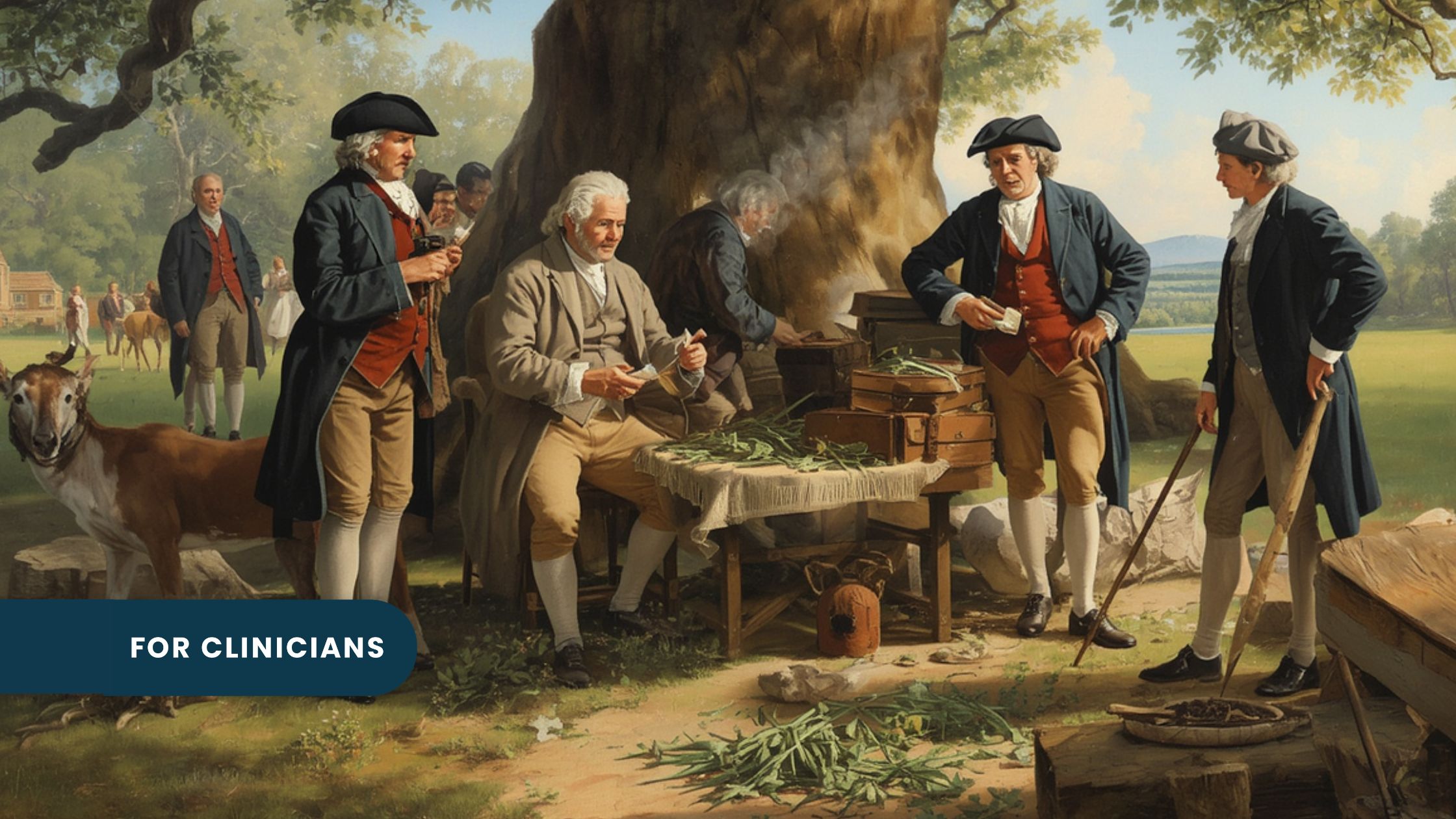
For Clinicians | What If the Founders Had a Medicine Cabinet?
7 Times It Would Have Changed American History
By Dr. Jamie Wilkey, PharmD — Director of Clinical Strategy, Jase
Medically reviewed by Kristen Carpenter, PA-C — Clinical Advisory Board Member
In 1799, George Washington’s doctors took 80 ounces of blood out of him in 12 hours, roughly 40% of his blood volume. They also pressed a strip of Spanish fly to his throat to raise a blister, made him gargle vinegar and sage tea, and gave him an enema before he died.
Forty-two years later, William Henry Harrison drank his White House water, which was sourced uphill from a marsh that doubled as the city’s sewage depository. He was dead in 31 days.
Forty years after that, 12 different physicians took turns sticking their dirty fingers in President Garfield’s bullet wound with unwashed hands for 79 straight days. Joseph Lister had published his antiseptic technique in 1867, and European surgeons had adopted it. American doctors? Unfortunately for Garfield, they weren’t onboard.
This week, America turns 250. And whatever else people are pessimistic about right now, here is something that is not up for debate: this is the best place in human history to be alive when something goes wrong with your body. The Friday-night UTI gets treated. The bullet wound gets debrided in a sterile OR. The cipro Rx is at the CVS down the street. We live in a wonderful time medically that was built brick by brick, mostly inside our great-grandparents’ lifetimes.
Jase usually writes about how to be ready for what your body throws at you next week. For our 250th issue, we wanted to do something different and look backward instead. Half of early American history reads like a record of important people dying from infections a household Jase kit would handle today, and we kept finding ourselves wishing we could ship a JaseCase back in time to save them.
Here are seven of the best ones.
#1. Valley Forge, Winter 1777-78
Saved by: JaseCase antibiotic panel + JaseMedic oral rehydration salts
The popular story of Valley Forge is the cold. The actual story is the lice and the latrines.
Between 1,700 and 2,500 of Washington’s 12,000 soldiers died at the 1777-78 winter encampment, roughly one in six.¹ More dead than at any single engagement of the Revolutionary War. And most didn’t go in the worst of winter; two-thirds died in March, April, and May, as the camp’s sanitation problems compounded. The killers were typhus (from body lice), typhoid and dysentery (from contaminated water), and influenza and pneumonia sweeping the barracks.
Period medicine: bleeding, calomel (a mercury-based purgative), and opium. That was the kit. No germ theory. No antibiotics. No oral rehydration concept. If you came down with dysentery, the standard of care was making it worse.
If they had a JaseCase: the antibiotic panel handles the typhus, typhoid, and dysentery, and JaseMedic ORS pulls the dehydrated cases back from the edge. Washington marches out of Valley Forge in spring 1778 with his army intact and combat-ready for the redcoats, instead of gutted by the latrines before the next engagement.
#2. George Washington’s Final Illness, December 1799
Saved by: JaseCase amoxicillin/clavulanate
Bloodletting gets the blame, but the bacterial infection in his throat got there first. The bleeding just finished the job.
Modern medical historians say what actually killed Washington was acute bacterial epiglottitis: a fast-moving throat infection (likely Haemophilus influenzae) that swelled his airway shut during a regional flu epidemic.² His doctors responded with bleeding, blistering, calomel, and an enema. Over twelve hours they took 80 ounces of blood from him in four sessions, about 40% of his total volume. The final draw came out slow and thick, the textbook look of Class IV hemorrhagic shock.
If he had a JaseCase: amoxicillin/clavulanate, taken in the first hours of the illness, treats the bacterial infection before the airway closes. Washington gets a few more years at Mount Vernon and a voice in the 1800 election, instead of dying of a treatable throat infection far too young at age 67.
#3. The Lewis & Clark Corps of Discovery, 1804–06
Saved by: JaseCase ciprofloxacin, doxycycline, metronidazole + JaseMedic ORS
The myth of Lewis and Clark is the tough frontiersmen. The reality is they were sick the entire expedition.
Jefferson sent Meriwether Lewis to Philadelphia for a crash-course in medicine with Dr. Benjamin Rush, who outfitted the corps with 50 dozen of his patented purgative pills (nicknamed “Thunderclappers” for the obvious reason), 15 pounds of Peruvian bark, mercury, and opium. Dysentery and skin abscesses plagued them for two years. Clark’s June 1804 journal entry, verbatim spelling: “The party is much afflicted by boils and several have the deassentary which I contribute to the water.”³ The mercury in those Thunderclappers still tracks the expedition today; archaeologists find the corps’ old latrine sites by testing soil for residue.
If they had a JaseCase: cipro and doxycycline handle the dysentery, metronidazole covers the anaerobes, JaseMedic ORS keeps the dehydrated cases alive, and doxycycline replaces the 15 pounds of Peruvian bark as malaria prophylaxis. Lewis and Clark reach the Pacific on schedule and bring the whole corps home, instead of leaving graves along the Missouri and stalling the mapping of the Louisiana Purchase for years.
#4. Sacagawea, May–June 1805
Saved by: JaseCase doxycycline + metronidazole
Sacagawea almost died in eastern Montana in June 1805. High fever, severe pelvic pain, delirium. The corps assumed she wouldn’t make it; Clark’s journal entries that month read like a death-watch.
Modern medical historians read it as pelvic inflammatory disease, caused by a sexually transmitted infection she’d almost certainly gotten from her husband, the French-Canadian fur trapper Toussaint Charbonneau.⁴ Clark treated her with bleeding, bark, salts, and opium. Lewis added “two doses of barks and opium” to that. The party gave her water from a sulfur spring along the trail. She eventually recovered in spite of these ‘treatments’.
If she had a JaseCase: doxycycline plus metronidazole is the modern outpatient regimen for PID. Days of pills resolve what nearly killed her over weeks. Sacagawea recovers fast, the corps reaches the Shoshone without losing the only person who can speak to her brother’s tribe, and the expedition gets home, instead of stranding in the Rockies with no interpreter and no diplomatic line.
#5. William Henry Harrison, April 1841
Saved by: JaseCase ciprofloxacin or azithromycin + JaseMedic ORS
The story everyone learned: Harrison gave a two-hour inauguration speech in the rain, caught pneumonia, and died a month later. The story we now know: he was killed by his own White House drinking water.
A 2014 paper in Clinical Infectious Diseases identified the killer as enteric fever (typhoid or paratyphoid) from the White House drinking water, which sat downstream of a marsh used as the city’s depository for night soil.⁵ Five days of constipation and abdominal distension. Then watery diarrhea. Then the cold blue extremities of dehydration shock. His doctors gave him opium, castor oil, calomel, ipecac, leeches, and snakeweed. Every treatment compounded the dehydration. He died on day 31 of his presidency.
If he had a JaseCase: ciprofloxacin or azithromycin handles the typhoid, and JaseMedic ORS addresses the proximate cause of death (volume depletion from days of watery diarrhea). Harrison serves out his term, Tyler never becomes president, and the 1840s play out under Whig leadership instead of the third-party lurch the country actually got.
#6. James Garfield, July–September 1881
Saved by: JaseTrauma hemostatic gauze + pressure bandage + JaseCase ciprofloxacin + metronidazole
Charles Guiteau shot James Garfield on July 2, 1881. Garfield died 79 days later. Guiteau did not kill him. His doctors did.
The bullet entered Garfield’s back, passed his first lumbar vertebra without touching the spinal cord, and came to rest behind his pancreas. By the standards of 1881 surgery (meaning, no surgery), this was a survivable wound.
Instead: 12 different physicians took turns probing the open wound with unwashed fingers and unsterilized instruments, starting at the train station on a manure-stained floor. Lead physician Dr. D. Willard Bliss kept it up for 79 days. One probe punctured Garfield’s liver, creating a false channel that filled with pus. The doctors followed the pus, assuming it was the bullet’s track, and widened the original 3-inch wound into a 20-inch incision from ribs to groin. Without sterile technique.
Joseph Lister had published his antiseptic protocol in 1867. European surgeons were already using it as standard practice. American medicine had stuck with miasma theory and considered the British surgeon’s hand-washing crusade overblown.⁶ Garfield wasted from 210 pounds to 130. His body was eating itself trying to fight the infection. He died on September 19, 1881.
If he had a JaseTrauma kit and a JaseCase: hemostatic gauze and a pressure bandage stop the bleeding at the train station; nobody sticks their fingers in the wound; ciprofloxacin and metronidazole cover the polymicrobial flora of deep abdominal trauma. Garfield finishes his civil rights work on his own terms instead of dying of his own doctors over 79 days, and Chester Arthur stays a footnote in New York machine politics.
#7. Theodore Roosevelt’s “Bull Moose” Speech, October 14, 1912
Helped by: JaseTrauma pressure bandage + hemostatic gauze
Garfield got 12 doctors. Theodore Roosevelt got a folded speech and a steel eyeglass case. On October 14, 1912, John Schrank shot Roosevelt in the chest at a Milwaukee campaign stop. The bullet was slowed by two items in his right jacket pocket: a steel eyeglass case and the folded 50-page manuscript of the speech he was about to give. It still pierced his fourth rib and lodged in his chest.
TR was an experienced hunter. He checked himself for coughing blood. None. Concluding his lung wasn’t pierced, he refused the hospital and went on to deliver his 90-minute speech with a bullet in his chest and blood seeping through his shirt. The speech included the line: “It takes more than that to kill a Bull Moose.”⁷ The bullet stayed in his chest for the remaining seven years of his life.
If he had a JaseTrauma kit: hemostatic gauze and a pressure bandage cut the blood loss during the 90-minute speech. But TR’s story isn’t a Jase save — it’s a Jase principle in action. The 1912 doctors did exactly what the 1881 doctors couldn’t, and TR’s bullet went on to outlive several of them.
Wrap Up
What the seven stories above have in common is how recent the things we take for granted actually are. Antibiotics, antisepsis, oral rehydration, hemostatic gauze, the discipline to leave a wound alone: none of it was available to the people in this article. Most of it isn’t even a century old.
That’s a big part of our country’s 250th worth celebrating: the country they built, and the medical floor that’s risen since then.
Jase exists to put that floor in your house. JaseCase puts physician-prescribed antibiotics on your shelf. JaseMedic puts the oral rehydration solution that would have saved Harrison in your travel bag. JaseTrauma puts the gauze and the pressure bandage that would have spared Garfield in your car. It’s the household-level standard of appropriate medical preparation. It complements your primary care doctor, your urgent care, and your ER. Never replaces them.
Happy 250th.
Sources
- Valley Forge mortality figures: https://en.wikipedia.org/wiki/Valley_Forge
- Modern diagnosis of Washington’s epiglottitis (Morens, NEJM 1999): https://pubmed.ncbi.nlm.nih.gov/16244717/
- Clark’s June 1804 journal and Corps medicine (NPS, “Medicine on the Lewis and Clark Expedition”): https://www.nps.gov/articles/000/medicine-on-the-lewis-and-clark-expedition.htm
- Sacagawea’s pelvic inflammatory disease (PubMed PMID 18622070): https://pubmed.ncbi.nlm.nih.gov/18622070/
- Harrison enteric-fever reread (McHugh & Mackowiak, Clinical Infectious Diseases, 2014): https://academic.oup.com/cid/article/59/7/990/2895539
- Lister’s antiseptic technique and American rejection of germ theory (American College of Surgeons): https://www.facs.org/about-acs/governance/board-of-governors/resources/giants-garfield/
- Theodore Roosevelt’s Bull Moose speech, October 14, 1912 (TR Presidential Library): https://www.trlibrary.com/bullet-speech
Lifesaving Solutions
Everyone should be empowered to care for themselves and their loved ones during the unexpected. Check out our recent lifesaving products today.
Recent Posts
Keeping you informed and safe.
For Clinicians | Burn First Aid Without Running Water
For Clinicians | Burn First Aid Without Running Water By Dr. Jamie Wilkey, PharmD, Director of Clinical EducationMedically reviewed and edited by Aaron Asay, PA-C, DMSc, FIBODM, FAWM Every burn first-aid guide starts the same way: cool it under running water. That's...

What to Do If You’re Bitten by a Snake?
What to Do If You're Bitten by a Snake: Forget What the Movies Taught You By the Jase Medical Team If you're bitten by a venomous snake, forget almost everything the movies taught you about snakebite first aid. Don't cut an X over the fang marks. Don't suck out the...
For Clinicians | Should You Suck Out Snake Venom?
For Clinicians | Should You Suck Out Snake Venom? The Snakebite Myths Your Patients Still Believe By Dr. Jamie Wilkey, PharmD, Director of Clinical EducationMedically reviewed and edited by Aaron Asay, PA-C, DMSc, FIBODM, FAWM I really love gathering my little boys...

How to Rehydrate Someone Properly When There Is No IV
How to Rehydrate Someone Properly When There Is No IV By the Jase Medical Team When someone is losing fluid from vomiting or diarrhea, rehydration isn't simply a matter of getting them to drink something. The type of fluid matters. The amount matters. And especially...