
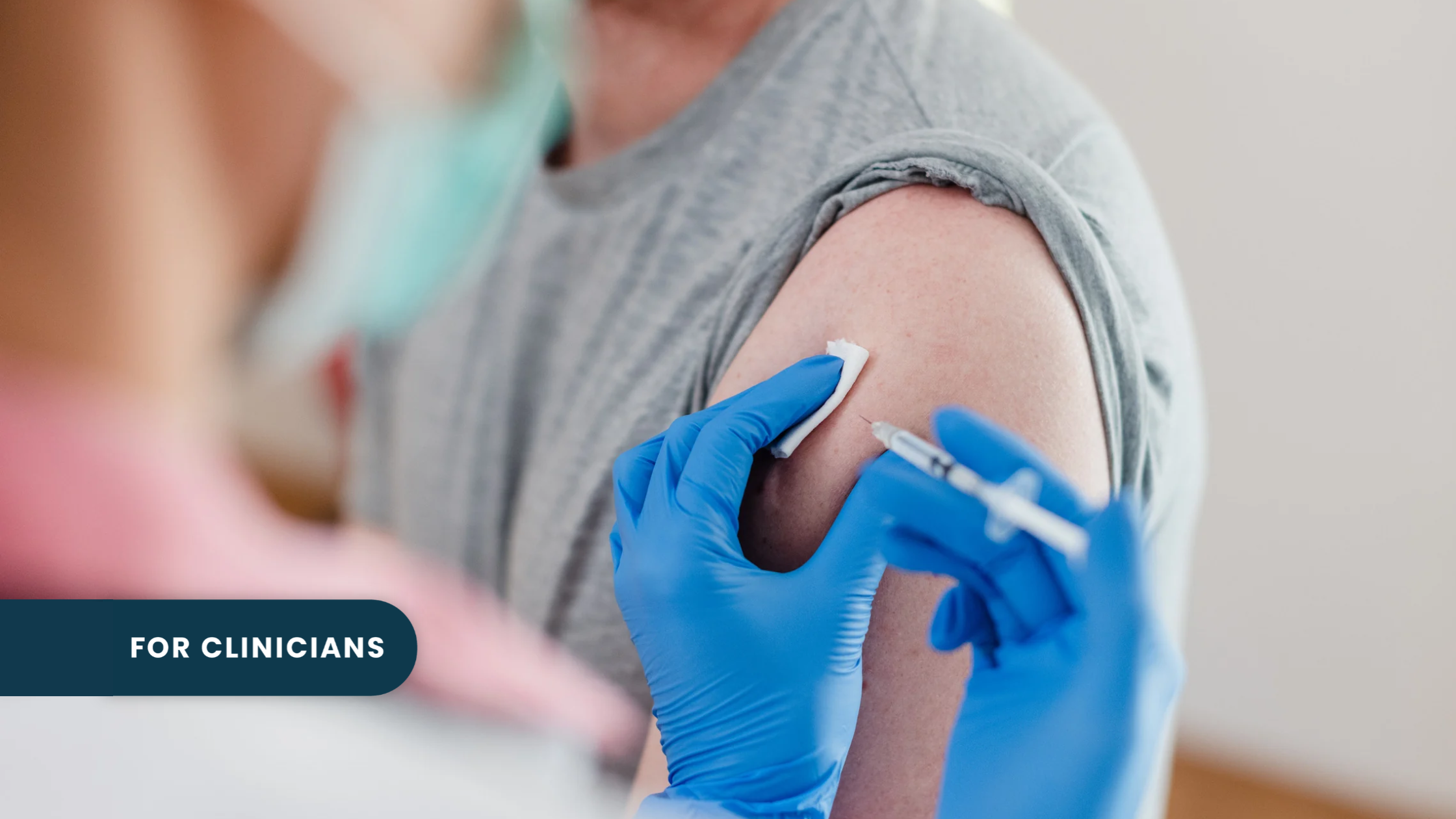
For Clinicians | How Long Does the Flu Shot Take to Work? Holiday Flu Prevention
By Dr. Jamie Wilkey, PharmD, Director of Clinical Education
Medically reviewed and edited by Kristen Carpenter, PA-C
Hi again, everyone. Last week I had a lot of fun writing about flu treatment, but the whole time I was writing it, I felt like half the story was missing. Treating the flu is one thing. Not getting it in the first place is even better. I’m a girl who loves preventative medicine and will do just about anything to keep sickness out of my house. So today we’re talking flu prevention, because everyone’s looking at the calendar and seeing Thanksgiving right around the corner. This is the season of getting together with family from all over the country, and we’ll cover when the shot needs to happen, what to do when someone at the table tests positive, and where COVID and RSV fit into the same season.
A couple of Sundays ago, I was sitting next to one of my good friends at church, and we got to talking about shots. We both agreed we hate getting vaccines. We’re also strict about getting them every single year, because we love preventing sickness, for ourselves and for the herd immunity of everyone around us. I already gave my family their flu and COVID shots, so we’re all ready to go for this season. This isn’t something I’m just preaching. It’s something I’m doing for my own family.
How long does the flu shot take to work?
About two weeks. Flu vaccines cause antibodies to develop about two weeks after vaccination¹, so protection at Thanksgiving dinner on November 26 means a shot by November 12. Yep, that’s this week!!
The end of October was CDC’s ideal¹, but it isn’t too late, and we keep offering the shot as long as flu is circulating². Bring it up at every visit and refill call this week, in the office or at the pharmacy counter.
For patients 65 and up, reach for an enhanced vaccine: high-dose, adjuvanted, recombinant, or mRNA². If none of those is on the shelf, give the standard shot rather than wait³.
And for the patient who says the flu shot never works for them anyway that’s a great time to remind them that even when it doesn’t stop the infection, vaccinated adults hospitalized with flu are far less likely to end up in the ICU⁴.
Does the flu shot protect the people around your patient?
It can, and that’s the herd immunity my friend and I were talking about. In a cluster-randomized trial in Hutterite colonies in Canada, vaccinating the kids cut confirmed flu by 61% among the community members who didn’t get the study vaccine⁵. Kids bring flu home, so protecting them protects the people they live with.
CDC is a little more careful, saying a shot “may also protect people around you”⁴. The protection doesn’t last forever: immunity wanes and the virus changes every season, which is why this is a yearly shot.
So when a patient tells you they never get the flu and don’t need it, that’s the moment to remind them the shot isn’t only for them. It’s for the grandparent flying in for Thanksgiving and the baby too young for a flu shot of their own¹.
What should happen after a flu exposure?
Tell your high-risk patients to call the same day someone at the gathering tests positive. They need to call that day, not when they start feeling a fever come on 2-3 days later. That day.
Prevention after an exposure is based on the exposure clock, not the symptom clock:
- Oseltamivir (Tamiflu): start within 48 hours of close contact⁶.
- Baloxavir (Xofluza): a single dose within 48 hours of contact, for ages 5 and up⁷.
Once symptoms start, it’s a treatment question.
But alas, that’s not so easy over the next couple of months because it is a holiday problem. If someone coughs through Thursday’s turkey, tests positive Friday morning, and the 48-hour window closes Saturday night…that’s all happening on a holiday weekend when most offices are closed.
Prevention after exposure works. In the Tamiflu household trial, confirmed flu dropped from 12% to 1% in the contacts who took it⁶. The patients who most need that same-day call are the ones flu hits hardest: adults 65 and up, pregnant patients, and anyone with a chronic condition like asthma, diabetes, or heart disease⁸.
And in case you were feeling like, well, it’s way easier to just take Tamiflu than get a shot…. it’s no substitute for the shot⁶. It’s not always easy to get, either. Generic oseltamivir is the cheap one, around $22 to $55 for a 10-capsule box, depending on the pharmacy and whether there’s a discount card⁹. Xofluza is brand-only, about $170 to $250 cash for a single dose¹⁰. Insurance usually puts quantity limits on oseltamivir, so a prevention course can eat into what the plan covers for treatment later in the season, and Xofluza often needs a prior authorization first¹¹,¹².
And pharmacies run out during the holiday rush (I know, because I worked in one for years and we almost always ran out). Last January, ASHP listed some oseltamivir capsules and powders in short supply from local stockouts driven by demand¹³. Check stock before you send the prescription.
COVID and RSV should be considered too!
Flu is the one on everyone’s mind, but COVID and RSV travel to the same gatherings.
For COVID, AAFP recommends an updated vaccine for every adult this season, with two doses six months apart at 65 and up². A shot in the past six months also cut spread to household members by about 43%, and the effect was no longer measurable by month seven¹⁴. After an exposure, there’s now a pill for COVID too: ensitrelvir (Xocova), approved in late May for ages 12 and up and started within 72 hours of contact¹⁵. It’s a strong CYP3A inhibitor, so check the full medication list and pregnancy status first. Paxlovid is still treatment only, started within 5 days of symptoms.
For RSV, AAFP recommends a single dose for those ages 75 and up, and at 50 to 74 for anyone at increased risk². There’s no pill after an RSV exposure, and treatment is mostly supportive¹⁶, so the shot is the prevention. Babies get theirs through the maternal vaccine or an infant antibody¹⁷.
What else keeps patients well at holiday gatherings?
If someone’s sick, they stay home until they’ve gone 24 hours with symptoms getting better and no fever, without fever reducers¹⁸. For five days after that, CDC suggests extra care: cleaner air, good hygiene, a mask, some distance, and a test before being around others, especially anyone at higher risk¹⁸. Not fancy or expensive, but it works: a cracked window, clean hands, and a negative test before the hugs start.
Why plan before the gathering?
Prevention after an exposure runs all or none: the call reaches a prescriber inside 48 hours AND medication is readily available from a pharmacy, or the window closes somewhere between the leftovers and Saturday night. Most of the work can happen before anyone’s sick, though: the shot by November 12, a high-risk patient who knows to call the same day, and a written list of everything they take, supplements included. On a holiday weekend, the prescriber who picks up the phone may never have met them, and the COVID antivirals interact with a long list of common drugs. That right there is appropriate medical preparation.
At Jase, we build that layer for the times primary care isn’t there, never as a replacement for it. If you’d rather not field these calls over a holiday weekend, you can refer patients to us. A licensed provider reviews every request, and Tamiflu and Paxlovid are available as JaseCase add-ons for treatment, for emergency use only, after first seeking the assistance of a qualified healthcare provider.
The bottom line
Get flu shots in by November 12, with an enhanced vaccine at 65 and up, and keep COVID and RSV vaccines in the same conversation. Tell high-risk patients to call the same day someone at the gathering tests positive. Then go enjoy the pie.
To refer a patient, visit jase.com. A licensed provider reviews every request and writes a prescription only when it’s appropriate.
Sources
- CDC. Key Facts About Seasonal Flu Vaccine. Updated September 1, 2026. https://www.cdc.gov/flu/vaccines/keyfacts.html
- Lin KW. Practice Alert: AAFP 2026–2027 Respiratory Vaccine Recommendations for Adults. Am Fam Physician. 2026;114(4):333-335. https://www.aafp.org/afp/2026/1000/editorials-respiratory-vaccine-recommendations-adults
- CDC. Prevention and Control of Seasonal Influenza with Vaccines: Recommendations of the Advisory Committee on Immunization Practices, United States, 2025-26 Influenza Season. Summary of Recommendations. MMWR 2025;74(32):500-507. https://www.cdc.gov/flu/media/pdfs/2025-2026-summary-of-recommendations.pdf
- CDC. Benefits of Flu Vaccination. May 28, 2026. https://www.cdc.gov/flu-vaccines-work/benefits/
- Loeb M, Russell ML, Moss L, et al. Effect of influenza vaccination of children on infection rates in Hutterite communities: a randomized trial. JAMA. 2010;303(10):943-950. https://doi.org/10.1001/jama.2010.250
- Tamiflu (oseltamivir phosphate) prescribing information. Genentech, Inc. Revised December 2025. https://dailymed.nlm.nih.gov/dailymed/drugInfo.cfm?setid=ee3c9555-60f2-4f82-a760-11983c86e97b
- CDC. Influenza Antiviral Medications: Summary for Clinicians. Updated March 10, 2026. https://www.cdc.gov/flu/hcp/antivirals/summary-clinicians.html
- CDC. People at Increased Risk for Flu Complications. September 11, 2024. https://www.cdc.gov/flu/highrisk/index.htm
- GoodRx. Oseltamivir prices, 75 mg, 10 capsules. Accessed October 26, 2026. Prices vary by location and pharmacy. https://www.goodrx.com/oseltamivir
- SingleCare. Xofluza coupons and prices, 40 mg tablet. Accessed October 26, 2026. Prices vary by location and pharmacy. https://www.singlecare.com/prescription/xofluza
- Prime Therapeutics for Blue Cross and Blue Shield of Minnesota. Anti-Influenza Agents Quantity Limit Program Summary. Effective November 1, 2025. https://bluecrossmn.com/sites/default/files/DAM/2022-09/MN_PS_Anti-Influenza_Agent_QL_ProgSum_AR0621_r0721.pdf
- Blue Cross Blue Shield Association, Federal Employee Program. Xofluza, policy 5.01.049. Effective July 1, 2026. https://www.fepblue.org/-/media/PDFs/Medical-Policies/2026/July-2026/Pharmacy-Policies/Remove–Replace/501049-Xofluza-baloxavir-marboxil.pdf
- Journal of Urgent Care Medicine. Flu Season Brings Local Shortages of Oseltamivir. January 22, 2026. https://www.jucm.com/flu-season-brings-local-shortages-of-oseltamivir/
- Benist SC, Smith-Jeffcoat SE, Talbot HK, et al. Recent COVID-19 Vaccination and Risk of SARS-CoV-2 Transmission. JAMA Netw Open. 2026;9(5):e2612609. https://doi.org/10.1001/jamanetworkopen.2026.12609
- Xocova (ensitrelvir) prescribing information. Shionogi Inc. June 2026. https://dailymed.nlm.nih.gov/dailymed/drugInfo.cfm?setid=526acf60-abc3-2cc2-e063-6294a90affa6
- Ng KE, Bradley N. Pharmacists’ Role in Respiratory Syncytial Virus. US Pharm. 2026;51(4):23-26. https://www.uspharmacist.com/article/pharmacists-role-in-respiratory-syncytial-virus
- Moulia DL, Link-Gelles R, Chu HY, et al. Use of Clesrovimab for Prevention of Severe Respiratory Syncytial Virus-Associated Lower Respiratory Tract Infections in Infants: Recommendations of the Advisory Committee on Immunization Practices, United States, 2025. MMWR Morb Mortal Wkly Rep. 2025;74(32):508-514. https://www.cdc.gov/mmwr/volumes/74/wr/mm7432a3.htm
- CDC. Preventing Spread of Respiratory Viruses When You’re Sick. Updated August 18, 2025. https://www.cdc.gov/respiratory-viruses/prevention/precautions-when-sick.html
Lifesaving Solutions
Recent Posts
Keeping you informed and safe.
Flu vs. COVID Antivirals: Is It Too Late to Take Tamiflu or Paxlovid?
Flu vs. COVID Antivirals: Is It Too Late to Take Tamiflu or Paxlovid? By the Jase Medical Team You've been sick for three days. The fever isn't improving, you're exhausted, and you're wondering whether an antiviral medication could help. But you've heard that...
For Clinicians | Tamiflu After 48 Hours, Paxlovid After 5 Days
For Clinicians | Tamiflu After 48 Hours, Paxlovid After 5 Days: Antiviral Timing for Flu and COVID By Dr. Jamie Wilkey, PharmD, Director of Clinical EducationMedically reviewed and edited by Kristen Carpenter, PA-C As the weather turns colder, every retail pharmacist...
Do You Need Antibiotics for a Sinus Infection? What the New Guidelines Say
Do You Need Antibiotics for a Sinus Infection? What the New Guidelines Say By the Jase Medical Team Do you need antibiotics for a sinus infection? Usually not right away. Even when a sinus infection is caused by bacteria, many people recover without antibiotics....
For Clinicians | Sinusitis: When Antibiotics Are Necessary
For Clinicians | Sinusitis: When Antibiotics Are Necessary By Dr. Jamie Wilkey, PharmD, Director of Clinical EducationMedically reviewed and edited by Kristen Carpenter, PA-C Adult sinusitis guidance changed in July 2025, when the AAO-HNSF published its first...