

For Clinicians | Tamiflu After 48 Hours, Paxlovid After 5 Days: Antiviral Timing for Flu and COVID
By Dr. Jamie Wilkey, PharmD, Director of Clinical Education
Medically reviewed and edited by Kristen Carpenter, PA-C
As the weather turns colder, every retail pharmacist I know is bracing for the Tamiflu rush. Yep, it’s that time again. We’re heading into the season of getting together, which means shared memories…… and a whole lot of shared germs.
I’m writing this early so we can all brush up on current antiviral recommendations before the first patient asks, in the office or at the pharmacy counter, whether it’s too late for Tamiflu. Today we’re covering the 48-hour window, who it actually applies to, why COVID runs on a different clock, and how much these drugs help.
Is it too late to take Tamiflu after 48 hours?
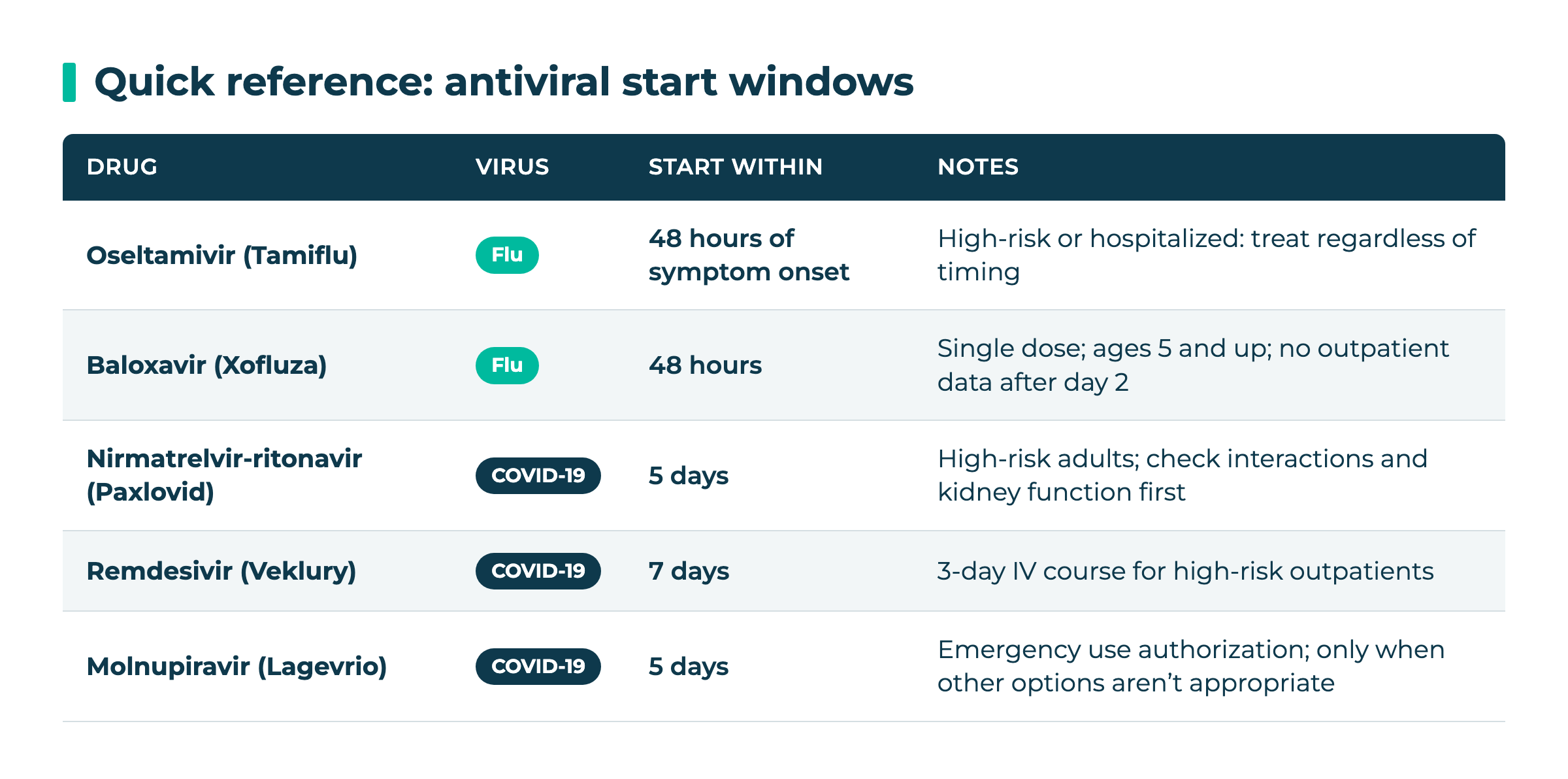
For an otherwise healthy adult, usually yes. The Tamiflu label covers patients who’ve had symptoms for no more than 48 hours¹, and the CDC says healthy outpatients can be treated on clinical judgment if treatment starts within two days of illness onset². We made the short version of this point in our August article on disease after disasters: for flu, a patient doesn’t need a positive test to start treatment. They need a prescriber, and they need to reach one in time.
The 48-hour window comes from how the drug works. Oseltamivir blocks neuraminidase, the enzyme flu needs to spread from an infected cell to healthy ones³, so it can only slow a virus that’s still spreading. In volunteer challenge studies, viral shedding peaked around day two, a day before symptoms hit their worst⁴. By the time a healthy patient feels terrible, the virus is already on its way down.
I know many of my patients have unrealistic expectations for what an antiviral can do. Started on time, Tamiflu gets a typical patient back on their feet about a day sooner¹. That may not sound like much, but ask anyone laid out miserable on the couch with a fever if they’d take one less day of it. So it can shorten the misery, but it isn’t a magical solution that solves a viral illness instantly.
Why doesn’t the 48-hour rule apply to high-risk patients?
For a high-risk patient, the answer does a complete 180: treat them! No matter how long they’ve been sick. CDC recommends antiviral treatment as soon as possible for anyone with suspected or confirmed flu who is hospitalized, has severe, complicated, or progressive illness, or is at higher risk for complications². That last group is way bigger than it sounds because it includes: adults 65 and older, pregnant patients, and anyone with a chronic condition like asthma, diabetes, or heart disease⁵. So now, as I write that out, it feels like half my patient list. Don’t wait on a test, either. A negative rapid test doesn’t rule out flu, and CDC says not to withhold treatment because of one⁶.
And now that we’re talking about high-risk patients please please remember that the goal changes with the patient. In a healthy adult, we’re shaving off a day of misery. In an 80-year-old with heart failure, we’re trying to keep them out of the hospital. And, dang it, the virus doesn’t always work on schedule: critically ill patients can keep replicating the virus longer than healthy patients². The evidence for a late start is observational, not randomized, but it points toward treating².
CDC says even higher-risk patients aren’t always getting prescribed antivirals⁷. So when an older patient asks at the counter, or calls the office on day three, whether it’s too late for Tamiflu, the answer is no. You can still prescribe it, and it can still help.
Why does COVID get 5 days instead of 2?
Because that’s where the trials determined it should be. Paxlovid’s main trial, EPIC-HR, enrolled high-risk patients within 5 days of symptom onset⁸, and the outpatient remdesivir trial enrolled them within 7⁹. COVID also gives us more runway than flu: in early-pandemic data, patients sick enough to be hospitalized usually started struggling to breathe.¹⁰. IDSA’s 2025 update strongly recommends Paxlovid for high-risk adults and keeps molnupiravir as a fallback¹¹.
So a patient on day 3 can be late for Tamiflu and right on time for Paxlovid. And here’s the plot twist: for COVID, you need the test that confirms it is actually COVID. Paxlovid starts after a COVID-19 diagnosis has been made⁸. You can’t pick the drug until you know which virus you’re treating.
Any antiviral a patient keeps on hand is for emergency use only, after first seeking the assistance of a qualified healthcare provider.
What has to be checked before Paxlovid?
Two things. The medication list + the kidneys.
Ritonavir has one job. It blocks CYP3A so the body can’t clear nirmatrelvir as fast, which keeps the antiviral level up⁸. It doesn’t pick favorites, though. It blocks CYP3A for everything else the patient takes, too. The most commonly reported serious interactions involved tacrolimus and cyclosporine, followed by calcium channel blockers⁸, and that last group shows up on a lot of our older patients’ lists. Some conflicts are workable: simvastatin and lovastatin are contraindicated, but they can be held from 12 hours before the first dose until 5 days after the last⁸. St. John’s Wort is on the contraindicated list too, so the medication list you check has to include OTCs and supplements.
Then check renal function. The label reduces the dose when eGFR falls below 60, dialysis included⁸.
How much do antivirals actually help?
Prescribe them for the high-risk patient. And be candid with everyone else about the size of the benefit.
For flu, the clearest benefit is the day of symptoms from earlier. Whether Tamiflu keeps outpatients out of the hospital is less clear: a 2024 meta-analysis of 15 randomized trials found no significant drop in hospitalization, older and high-risk subgroups included¹⁵. That’s why the high-risk recommendation leans on observational data².
For COVID, the gap is immunity. EPIC-HR enrolled only unvaccinated high-risk adults with no prior infection, and Paxlovid cut hospitalization or death from 6.5% to 0.9%⁸. EPIC-SR included vaccinated high-risk adults, and there Paxlovid didn’t shorten symptoms, and the drop in hospitalization or death didn’t reach significance⁸. By late 2022, nearly all US blood donors had antibodies from vaccination, infection, or both¹⁶, so most of our patients today look more like the second trial than the first.
The evidence still points one direction. The benefit is biggest in the patients most likely to end up in the hospital, and those are the patients the 48-hour-or-nothing myth talks us out of treating.
What happens when the patient can’t reach a prescriber in time?
Antiviral care runs all or none. Either the patient reaches a prescriber inside the window, or the clock runs out while they wait for an appointment or for Monday to roll around.
A lot of the clinical work doesn’t need a sick patient, though. You can tell a high-risk patient to call on day one, not day four. You can flag the simvastatin or the tacrolimus that would complicate Paxlovid, and note their kidney function. All of that can happen at a routine visit or a refill call, while everyone’s healthy. That’s the missing middle layer, and it’s what we mean by appropriate medical preparation.
At Jase, we build that layer for the times primary care isn’t there, never as a replacement for it. Tamiflu and Paxlovid are both available as JaseCase add-ons. A licensed provider reviews each request and writes the prescription only when it’s appropriate, and either medication is for emergency use only, after first seeking the assistance of a qualified healthcare provider. If you’d rather not field these requests yourself, you can refer patients to us. We’ll keep publishing the frameworks behind where we draw these lines.
The bottom line
The 48-hour window belongs to healthy outpatients with flu. For a high-risk patient, treat as soon as possible, whatever the day count, and don’t wait on a test. COVID runs on its own clock: 5 days for Paxlovid, after you’ve checked the medication list and the kidneys. The benefit is modest for most patients and biggest for the ones most likely to land in the hospital, so start there. Then go enjoy the holidays…… and wash your hands.
To refer a patient, visit jase.com. A licensed provider reviews every request and writes a prescription only when it’s appropriate.
And a final note from Kristen Carpenter, our PA-C who reviewed this article, “during cold/flu season, the timing is so important to start the medication but there are no appointments in primary care schedules since everyone is sick! The chances of a same day or next day appointment are lower! So having high risk patients prepared ahead of time for these busy seasons can be super helpful!”
Sources
- FDA. Tamiflu (oseltamivir phosphate) prescribing information. Genentech; revised August 2019. https://dailymed.nlm.nih.gov/dailymed/drugInfo.cfm?setid=ee3c9555-60f2-4f82-a760-11983c86e97b
- CDC. Influenza Antiviral Medications: Summary for Clinicians. Updated March 10, 2026. https://www.cdc.gov/flu/hcp/antivirals/summary-clinicians.html
- CDC. Influenza Antiviral Drug Resistance. Updated June 26, 2026. https://www.cdc.gov/flu/treatment/antiviralresistance.html
- Carrat F, Vergu E, Ferguson NM, et al. Time lines of infection and disease in human influenza: a review of volunteer challenge studies. Am J Epidemiol. 2008;167(7):775-785. doi:10.1093/aje/kwm375
- CDC. People at Increased Risk for Flu Complications. Updated September 11, 2024. https://www.cdc.gov/flu/highrisk/index.htm
- CDC. Rapid Influenza Diagnostic Tests. Updated June 22, 2026. https://www.cdc.gov/flu/hcp/testing-methods/clinician_guidance_ridt.html
- CDC. Underutilization of Flu Antivirals. March 20, 2026. https://www.cdc.gov/flu/whats-new/2025-2026-underutilization-of-flu-antivirals.html
- FDA. Paxlovid (nirmatrelvir tablets; ritonavir tablets) prescribing information. Pfizer; revised January 2025. https://www.accessdata.fda.gov/drugsatfda_docs/label/2025/217188s008lbl.pdf
- Gottlieb RL, Vaca CE, Paredes R, et al. Early remdesivir to prevent progression to severe Covid-19 in outpatients. N Engl J Med. 2022;386(4):305-315. doi:10.1056/NEJMoa2116846
- Zhou F, Yu T, Du R, et al. Clinical course and risk factors for mortality of adult inpatients with COVID-19 in Wuhan, China: a retrospective cohort study. Lancet. 2020;395(10229):1054-1062. doi:10.1016/S0140-6736(20)30566-3
- Shumaker AH, Bhimraj A, et al. 2025 Clinical Practice Guideline Update by the Infectious Diseases Society of America on the Treatment and Management of COVID-19: Antiviral Treatment for Mild to Moderate COVID-19 in Adults. Clin Infect Dis. doi:10.1093/cid/ciaf680. Posted October 14, 2025. Nirmatrelvir/ritonavir for high-risk adults: strong recommendation, moderate certainty of evidence. Molnupiravir when no other options exist: conditional recommendation, low certainty of evidence.
- FDA. Xofluza (baloxavir marboxil) prescribing information. Genentech; revised May 2025. https://dailymed.nlm.nih.gov/dailymed/drugInfo.cfm?setid=e49e1a61-1b7c-4be5-ac84-af6240b511e7
- FDA. Veklury (remdesivir) prescribing information. Gilead; revised July 2026. https://www.accessdata.fda.gov/drugsatfda_docs/label/2026/214787s033lbl.pdf
- FDA. Fact Sheet for Healthcare Providers: Emergency Use Authorization for Lagevrio (molnupiravir) capsules. Revised June 2024. https://www.fda.gov/media/155054/download
- Hanula R, Bortolussi-Courval É, Mendel A, et al. Evaluation of oseltamivir used to prevent hospitalization in outpatients with influenza: a systematic review and meta-analysis. JAMA Intern Med. 2024;184(1):18-27. doi:10.1001/jamainternmed.2023.0699
- Jones JM, Manrique IM, Stone MS, et al. Estimates of SARS-CoV-2 seroprevalence and incidence of primary SARS-CoV-2 infections among blood donors, by COVID-19 vaccination status: United States, April 2021 to September 2022. MMWR Morb Mortal Wkly Rep. 2023;72(22):601-605. doi:10.15585/mmwr.mm7222a3
Lifesaving Solutions
Recent Posts
Keeping you informed and safe.

Do You Need Antibiotics for a Sinus Infection? What the New Guidelines Say
Do You Need Antibiotics for a Sinus Infection? What the New Guidelines Say By the Jase Medical Team Do you need antibiotics for a sinus infection? Usually not right away. Even when a sinus infection is caused by bacteria, many people recover without antibiotics....

For Clinicians | Sinusitis: When Antibiotics Are Necessary
For Clinicians | Sinusitis: When Antibiotics Are Necessary By Dr. Jamie Wilkey, PharmD, Director of Clinical EducationMedically reviewed and edited by Kristen Carpenter, PA-C Adult sinusitis guidance changed in July 2025, when the AAO-HNSF published its first...

For Clinicians | New World Screwworm in Humans
For Clinicians | New World Screwworm in Humans: The Wound Check, the Larvae, and the Risk By Dr. Jamie Wilkey, PharmD, Director of Clinical EducationMedically reviewed and edited by Kristen Carpenter, PA-C New World screwworm is the latest health headline. This one...

Five Halloween Hazards That Look Harmless
Five Halloween Hazards That Look Harmless By the Jase Medical Team The scariest things this Halloween might not look scary at all. A bag of black licorice. A pair of costume contacts. A medication you take every night. A mushroom growing in the yard. A bat that...