
For Clinicians | Animal Sting Reactions: Large Local Reaction vs Cellulitis, and When It’s Anaphylaxis
By Dr. Jamie Wilkey, PharmD, Director of Clinical Education
Medically reviewed and edited by Kristen Carpenter, PA-C
This is part two of our Animals + Disaster series. Part one was all about which bites actually need antibiotics. Today we are talking about stings. And stings get a sharper answer (gotta love that pun, right!): almost none of them. The drug that matters in stings isn’t an antibiotic at all. Today we’re sorting all of this out, plus what fire ant pustules are doing and the two stings that need something other than an antibiotic.
What a sting does to the body
A sting is venom, injected on purpose, by an animal defending itself. A bite is a wound with mouth bacteria in it. A sting inoculates almost nothing, so infection isn’t really that likely.
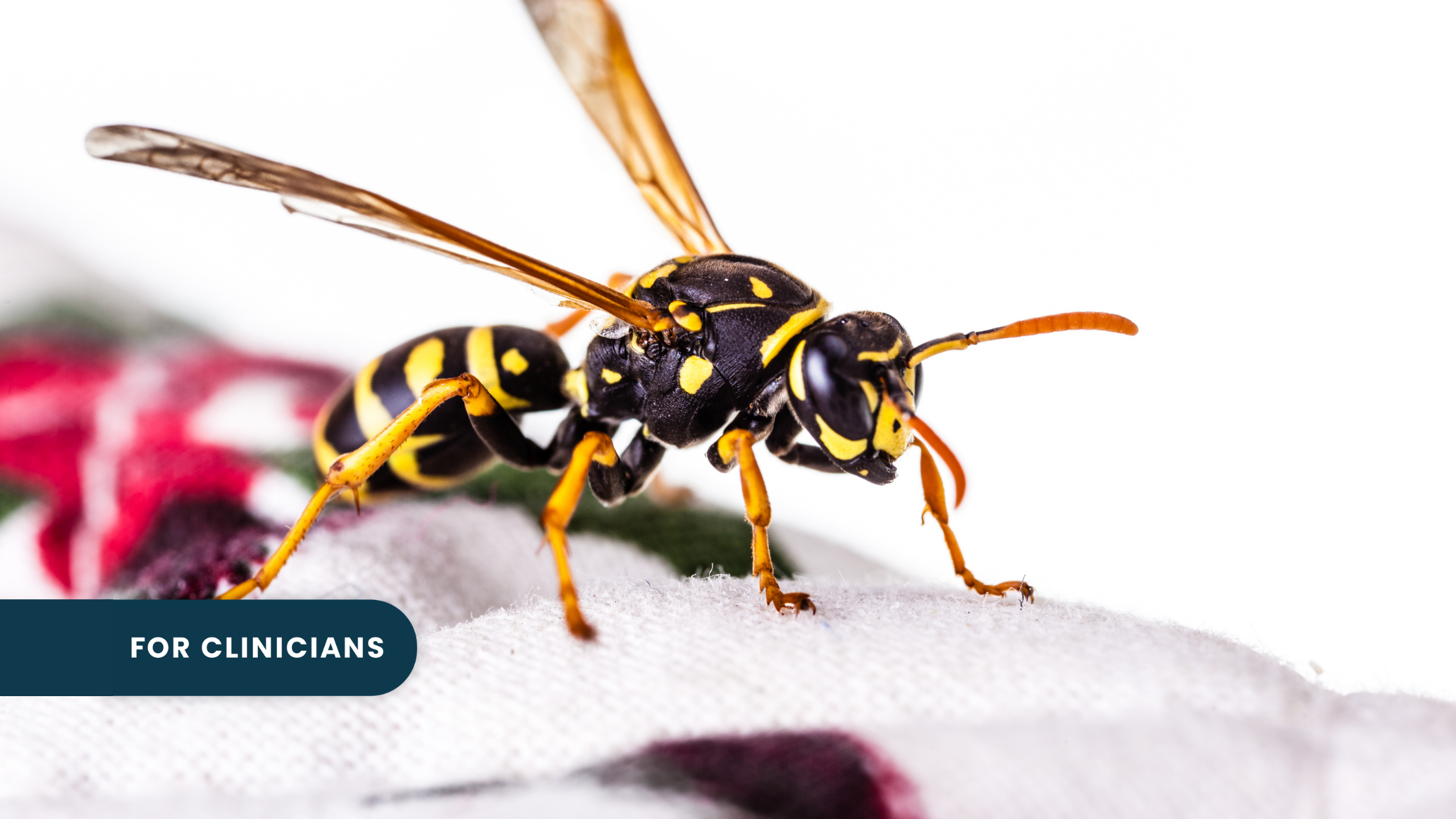
Almost everything that stings you is female because stingers are modified ovipositors. The 3 bugs that are most likely to sting you in the US are honeybees and bumblebees, the vespids (yellowjackets, hornets and paper wasps), and imported fire ants. Honeybees leave the stinger behind still pumping venom, so get it out fast. Speed is what matters and technique doesn’t. ¹ Vespids keep theirs and can sting over and over, which is how one disturbed nest becomes a multiple-sting patient. Fire ants bite to hold on, then pivot and sting in an arc, and that’s where the ring of pustules comes from. ²
Bee and vespid venom is mostly protein, and protein is what IgE recognizes, so those are the stings that turn allergic. Fire ant venom doesn’t have much protein and is mostly piperidine alkaloids which are directly cytotoxic. That’s the pustule, and it’s why no Rx you prescribe changes it. ²
So what you’re looking at comes down to which insect, how many stings, and whether that patient has already made IgE. Scorpions and spiders aren’t going to be covered today (hang tight for that article coming up soon!), and scorpion envenomation is neurotoxic rather than allergic anyway.
Is a hot, swollen sting site cellulitis?
Usually not. The clock tells you more than the exam does. A large local reaction is a late-phase IgE response, not an infection. A typical sting will progress normally as swelling over 10 cm that’s still there past 24 hours,³ peaking somewhere in that 24 to 48 hour window, then taking 3 to 10 days to fully settle.⁴ Patients will tell you their whole arm is swollen, and they’re often right. Cellulitis runs on a different clock. It shows up later, and instead of peaking and receding it keeps spreading past the sting site. So check out which direction the site has been moving, not how angry it looks on the day you see it. A site still spreading after 48 hours is the one to treat.
You’re probably wondering how an anaphylactic reaction plays in here, and whether it relates to these exaggerated sting sites. They might relate a little. The guideline puts the risk of a systemic reaction under 10%, and anaphylaxis under 5%. It also says these patients usually just get another big local reaction.⁴ So the swollen arm by itself isn’t what makes you refer or write for epinephrine. A systemic reaction is.
Fire ant pustules are supposed to look like that
Leave them alone. That’s the whole intervention. Easy, huh!?
Fire ants create their own community raft on floodwater, with thousands locked together, and they sting on contact when somebody wades into one.⁵ So stings climb after heavy rain and flooding across the Southeast and Gulf. Dozens of stings on the feet and ankles, in rings, is fire ants and nothing else.⁶
24 to 48 hours post-sting the sting sites become sterile pustules. ² They really are sterile! They look exactly like infection and nothing reverses them, because the alkaloid already killed the cells. ² The skin over a pustule is protecting the tissue underneath. Lancing one creates a wound that may need an antibiotic. Therefore, just good ‘ol soap and water plus an antibiotic cream if a pustule opens on its own. ² Fire ant anaphylaxis does happen, but is pretty uncommon. Serious systemic reactions run around 2% of fire ant stings in people who seek care. ²
When is a sting an emergency, and how long do you watch?
There’s really only one sting emergency, and it’s anaphylaxis. You recognize it one of two ways: either two+ organ systems are involved, or the blood pressure drops (a systolic < 90 in an adult or a fall of more than 30% from their own baseline). Hives plus vomiting counts, and so does hives plus wheezing. A drop in blood pressure after a sting is enough on its own, without a second system getting involved at all. ⁷
When you see these symptoms give epinephrine. Must be epinephrine! An antihistamine and a steroid aren’t a substitute here and they don’t keep the reaction from coming back a few hours later, which is the thing we all hope they’ll do. ⁷
How long do you watch? We all learned 4 to 6 hours for everybody. Well, the 2023 practice parameter cut that down. If the reaction wasn’t severe, one hour with no symptoms after it resolves is enough, because nearly every biphasic reaction has declared itself by then. ⁷ Only a severe reaction, or one that took more than one dose, needs longer.
And just keep in mind a second epinephrine dose may be needed. In a 2021 systematic review, 17% of venom-triggered reactions needed one when a health care professional was there to give it.⁸ That’s more than most of us would guess, so don’t discount it.
When it’s the venom, not the allergy
A patient with 50 or more stings is a different problem entirely. There’s enough venom on board at that point to do direct damage, so what you’re watching for is rhabdomyolysis, acute kidney injury and hemolysis rather than an allergic reaction.⁹ Tolerance runs about 22 stings per kilo, which means roughly 500 can kill a child.¹⁰ Management of being a human sting pin cushion is aggressive fluids with an eye on urine output, and plenty of people add bicarbonate, though it has never been shown to beat saline alone.¹² Either way it needs a hospital and not an autoinjector. All of it comes from case reports, though. There’s no guideline here.
The referral almost nobody makes
Anyone who has had a systemic reaction to a sting should be referred for venom immunotherapy. Untreated, about 40% of those patients have another systemic reaction the next time they’re stung. On immunotherapy it’s under 3%. ¹¹ Patients know this as allergy shots for bee stings, and that’s the phrase to use at the counter, because “venom immunotherapy” means nothing to them. After a disaster sting the referral almost never gets made, and it’s the only thing on this list that changes what the next sting does to them.
Where this fits
Nearly everything in this article is a decision rather than a prescription. Is the arm swelling or spreading? Is the pustule intact or opened? Those calls are all or none right now. Either a patient reaches a clinician who reads the clock, or they’re home staring at a hot red arm with a search bar and a leftover antibiotic.
Jase works the layer in between, and for stings that mostly isn’t a drug. It’s the thinking done in advance: which reaction is expected, which one is spreading, and which one means the epinephrine comes out. Where a prescription is part of it, a licensed provider reviews the request and writes it, for emergency use only and after first trying to reach a qualified provider. That’s what we mean by appropriate medical preparation, and it’s in no way a replacement for primary care. It’s for the days primary care isn’t reachable.
Part one of this series was about bites, and how few of them actually need an antibiotic. And as you’ll see in part two, stings need one even less often. We’ll keep publishing how we make these calls for appropriate medical preparation.
The bottom line
Antibiotics really don’t help with stings. The hot swollen arm that looks infected almost never is, and the sting that actually needs a drug needs epinephrine.
So read the clock instead of the redness. Leave the pustules alone from those fire ants. When two systems are involved or the pressure drops, give epinephrine and watch the hour. And when a patient has already had a systemic reaction, make the referral, because it’s the only thing you’ll do that changes what the next sting does.
Sources
- Visscher PK, Vetter RS, Camazine S. Removing bee stings. Lancet. 1996. PMID 8709689.
https://www.thelancet.com/journals/lancet/article/PIIS0140-6736(96)01367-0/abstract - Kruse B, Anderson J, Simon LV. Fire Ant Bites. StatPearls. Treasure Island (FL): StatPearls Publishing. Updated August 7, 2023. Venom is 95% water-insoluble alkaloid with a 5% aqueous protein fraction. Vesicles form within 4 hours and become sterile pustules by 24 hours. Serious systemic reactions occur in about 2% of fire ant stings among patients who seek care.
https://www.ncbi.nlm.nih.gov/books/NBK470576/ - Tripolt P, Arzt-Gradwohl L, Čerpes U, Laipold K, Binder B, Sturm GJ. Large local reactions and systemic reactions to insect stings: similarities and differences. PLoS One. 2020;15(4):e0231747. Large local reaction defined as swelling exceeding 10 cm lasting more than 24 hours. Median duration 7 days, range 1 to 21 days, in 310 patients.
https://journals.plos.org/plosone/article?id=10.1371/journal.pone.0231747 - Golden DBK, Demain J, Freeman T, et al. Stinging insect hypersensitivity: a practice parameter update 2016. Ann Allergy Asthma Immunol. 2017;118(1):28-54. Large local reactions increase in size for 24 to 48 hours, exceed 10 cm contiguous to the sting site, and take 3 to 10 days to resolve. Patients with large local reactions have less than 10% chance of a systemic reaction and less than 5% chance of anaphylaxis, and usually have large local reactions again on subsequent stings.
https://www.aaaai.org/Aaaai/media/Media-Library-PDFs/Allergist%20Resources/Statements%20and%20Practice%20Parameters/Stinging-insect-hypersensitivity-2016.pdf - NIOSH. Hurricane and Flood Key Messages for Employers, Workers, and Volunteers, Third Edition. Atlanta, GA: US Centers for Disease Control and Prevention, National Institute for Occupational Safety and Health, DHHS (NIOSH) Publication No. 2025-106; 2025. Fire ants “can cling together and float along in floodwaters,” sting aggressively when disturbed, and red bumps “within a day or two become white fluid-filled pustules.”
https://www.cdc.gov/niosh/docs/2025-106/pdfs/2025-106.pdf - Diaz JH. The impact of hurricanes and flooding disasters on hymenopterid-inflicted injuries. Am J Disaster Med. 2007;2(5):257-269. PMID 18491841.
https://doi.org/10.5055/ajdm.2007.0034 - Golden DBK, Wang J, Waserman S, et al. Anaphylaxis: a 2023 practice parameter update. Ann Allergy Asthma Immunol. 2024;132(2):124-176. PMID 38108678. Reduced blood pressure defined as systolic below 90 mm Hg in adults or a decrease greater than 30% from that person’s baseline. Biphasic anaphylaxis is unlikely when the reaction is not severe and the patient remains symptom-free for one hour after resolution, a 95% negative predictive value (95% CI 90.9%-97.3%), and is likelier with increasing severity and in patients given more than one epinephrine dose.
https://www.aaaai.org/Aaaai/media/Media-Library-PDFs/Allergist%20Resources/Statements%20and%20Practice%20Parameters/Anaphylaxis-Practice-Paramaters-2023.pdf - Patel N, Chong KW, Yip AYG, et al. Use of multiple epinephrine doses in anaphylaxis: a systematic review and meta-analysis. J Allergy Clin Immunol. 2021. PMID 33862009. Across 86 studies and 36,557 events, 7.7% of anaphylaxis events from any cause required more than one dose. Among venom-induced reactions in which a health care professional administered the subsequent dose, 17.1% (95% CI 11.3-25.0).
https://www.ncbi.nlm.nih.gov/pmc/articles/PMC8588837/ - Osman UMA, Turfan S, Mohamud MFY. Multi-organ dysfunction due to envenoming syndrome following a massive bee attack: a fatal case study and comprehensive literature review. Int Med Case Rep J. 2024;17:353-357. PMID 38646457. More than 50 stings is categorized as massive envenomation, with rhabdomyolysis, acute kidney injury, hemolysis, DIC and myocardial injury described. Case report with literature review.
https://doi.org/10.2147/IMCRJ.S456777 - Insect Stings. Merck Manual Professional Version. The average unsensitized person tolerates 22 stings/kg body weight, so an adult can withstand more than 1,000 stings whereas 500 stings can kill a child.
https://www.merckmanuals.com/professional/injuries-poisoning/bites-and-stings/insect-stings - Boyle RJ, Elremeli M, Hockenhull J, et al. Venom immunotherapy for preventing allergic reactions to insect stings. Cochrane Database Syst Rev. 2012;CD008838. PMID 23076950. Subsequent systemic sting reaction in 3 of 113 treated patients (2.7%) versus 37 of 93 untreated (39.8%). Risk ratio 0.10, 95% CI 0.03-0.28.
https://doi.org/10.1002/14651858.CD008838.pub2
Lifesaving Solutions
Recent Posts
Keeping you informed and safe.

Bites and Scratches in a Disaster: Which Ones Need Antibiotics
Bites and Scratches in a Disaster: Which Ones Need Antibiotics Animals in a Disaster Series: Part 1 of 2By the Jase Medical Team Three days after the storm, the animal injuries start showing up. A cat got loose during the evacuation and bit someone's hand when they...

For Clinicians | Bite and Scratch Wound Antibiotic Prophylaxis Without a 48-Hour Recheck
Bite and Scratch Wound Antibiotic Prophylaxis Without a 48-Hour Recheck By Dr. Jamie Wilkey, PharmD, Director of Clinical Education Medically reviewed and edited by Kristen Carpenter, PA-C September is National Preparedness Month, and at Jase we love this month. I’d...

Psychiatric Medications Need a Different Emergency Plan
Psychiatric Medications Need a Different Emergency Plan Part 2 of a two-part series on medication readiness during a disruption By the Jase Medical Team In Part 1 of this series, we asked a question most people have never considered: If you suddenly couldn't access...

Which of Your Medications Actually Cannot Wait?
Which of Your Medications Actually Cannot Wait? Part 1 of a two-part series on medication readiness during a disruption By the Jase Medical Team There are five prescription bottles sitting on your counter. You take all five regularly, you have some medication left in...