
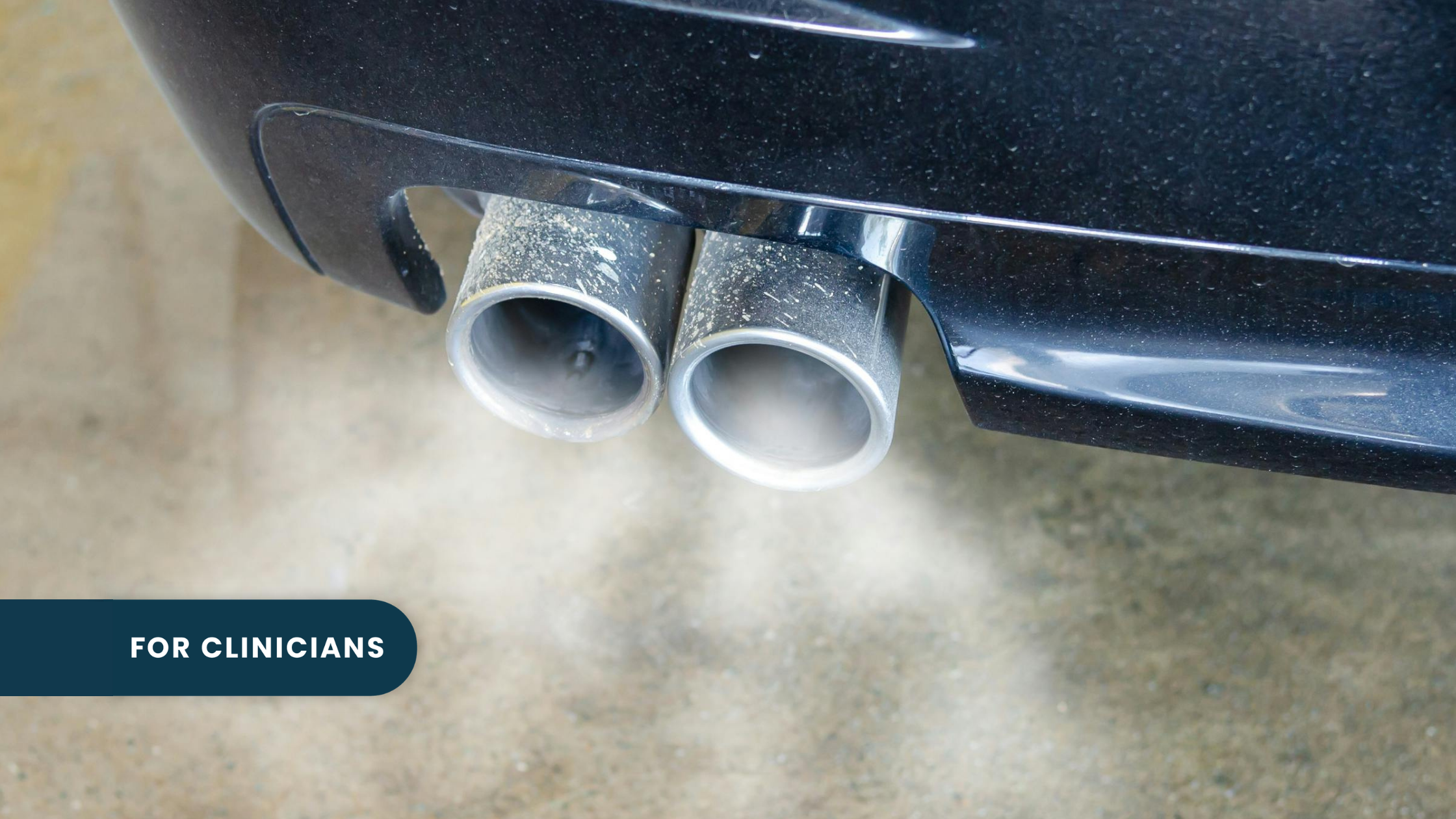
September is National Preparedness Month, so we’re spending it on the disasters that actually turn up in your patients’ lives. One of them arrives with no smell, no color, and no symptom you can trust: carbon monoxide (CO). A family can be getting hurt for days without knowing, because symptoms alone can’t separate it from whatever is going around. Headache, nausea and fatigue are so common that we as clinicians typically match them to whatever is going around then (the flu in late January, heat exhaustion in July, etc). Today you’re going to get a refresher on how CO poisoning works, who is most at risk, where it happens most commonly, and how to help patients who may be experiencing this silent, un-smelly, and deadly gas exposure.
How often does CO exposure actually kill someone?
Rarely, compared to how often it happens. CO sends roughly 50,000 people to US emergency departments every year.¹ In 2021 it killed about 500 people unintentionally, and about 500 more by suicide.²
(Everything that follows uses the unintentional numbers. Intentional poisoning is coded and reported separately, so it isn’t mixed into any figure in this article.)
That difference between 50,000 affected and 500 dead is thanks to physiology and it’s good news. CO binds hemoglobin with about 250 times the affinity of oxygen, and what it forms, carboxyhemoglobin, is reversible.3 Get the patient into fresh air and it clears on its own, with a half-life of about five hours on room air and about an hour on high-flow oxygen.4 Symptoms start around 10% COHb, and killing a healthy adult usually takes levels above 50%.3 Most exposures never come close, because the source was weak, the room wasn’t sealed, or somebody opened a door.
When someone dies it is usually due to concentration, not duration. The power goes out, a generator comes on, and it’s running somewhere it shouldn’t be. For example, a gasoline engine in an enclosed space drives the concentration up fast, and rapid high-level exposure incapacitates a person before they can get themselves out.3
That’s the difference between the household that shows up at your office feeling flu-ish for three days and the person found unconscious on the garage floor. Same gas, but different exposures.
Who is most at risk for unintentional CO poisoning deaths?
When I think of CO poisoning, I picture a young family with babies and toddlers, poisoned in their own house while they sleep. The death data says otherwise. Adults 45 and older are roughly two thirds of it, and children under 15 are 3%.3 Children don’t tolerate CO better. It’s just that risk is around machines, and the person nearest to (or operating) the machine is an adult. Kids still get exposed, but they show up in ED visits instead of death certificates. Children aged 0 to 9 have the highest rates of poison center calls and CO-related ED visits of any age group.5
Proximity to the CO-emitting device is the whole ballgame here. In one review of disaster-related poisonings, two thirds of the fatal generator cases involved a generator placed indoors, and another third involved one placed outside but too close to the house. Most of the nonfatal cases traced to an attached garage, or a spot right outside a window.6
That’s also why men are about four out of five of these deaths.3 Those same incidents average two people poisoned each, so the man who dies usually isn’t the only one exposed…he’s the one who was closest to the exhaust.6
So where does it actually happen, and when?
At home, about three quarters of the time.3 Thirteen percent happen in temporary shelters (cabins, campers and trailers people are sleeping in), mostly from a heater or a generator. Eight percent happen inside vehicles, where somebody ran a generator or an LP heater in there, or burned charcoal in the car.3 Another 34 deaths in 2022 were in detached structures like the shed and the detached garage.
And it isn’t always a generator. Most CO deaths happen in the cold months, 55% of them from November through February, and the winter version of this runs on heating equipment: furnaces, room and space heaters, and the vent that quit working. Heating appliances were the second-largest category in CPSC’s 2022 count at 76 deaths, and charcoal accounted for 18 of the 20 solid-fuel deaths.3
Geography decides what happens after. The most rural addresses carry about three times the share of CO deaths you’d expect from their population,3 and those are the same patients sitting furthest from an ED in a real emergency.
What actually raises suspicion for CO poisoning?
Ask, “Who else in the house feels the same way?”
It is simple, short and helps flag CO poisoning separately from other ailments with similar symptoms.
That question has been tested. In the study that validated it, 65 winter patients presented with headache or dizziness and no known exposure. Symptomatic cohabitants alone identified occult CO poisoning with 75% sensitivity and 90% specificity, and the authors called it the most dependable marker they had.7
The second question is, “Does it get better away from the house?”
You can guess why this is helpful: if you get away from the source and feel better then that’s your answer. COHb falls by half in about five hours on room air,4 so the patient who spends a workday out of the building feels better by afternoon and gets re-dosed the moment they walk back in. Headaches that lift in the car and return overnight are the pattern. Ask about the dog, too. The dog doesn’t leave for long the way you and your kids do for work and school.
The exposure window is days, not hours. In a New York study of pediatric CO poisoning, four hours without power raised the odds of an ED visit by at least 50%, and by 150% or more when the outage was large-scale, with the risk tracked across the days that followed.8
Why a normal pulse ox proves nothing
The bedside tool, aka a pulse ox, most of us reach for first fails hard on CO poisoning. You see, in a case of poisoning:
- Standard pulse oximetry still reads falsely normal. A two-wavelength oximeter can’t tell carboxyhemoglobin from oxyhemoglobin, so it counts the poisoned blood as saturated.4,5 That 99% on the monitor is measuring the wrong molecule.
- Pulse CO-oximetry, the seven-wavelength kind that reports an SpCO, is better and still can’t clear the patient. Performance is good, not perfect, and it isn’t adequate to exclude CO poisoning when you already suspect it.4 A normal SpCO with a suspicious history means you still draw the blood.
- The COHb level doesn’t tell you how sick someone is. There’s no validated relationship between the number and the symptoms.4 Treat the patient and the history, not the number.
- Cherry-red skin is a postmortem finding. It’s in every review and it is not a bedside sign because your patient is still alive.5
Two extra notes: a COHb level runs on venous blood, so nobody needs an ABG for this.4 And a smoker’s baseline can sit as high as 10%, which is enough to blur real exposure at the low end.5
The test that helps the most and is free is so simple. It is as we just learned above: asking who else in the house feels this way.
What to do when you suspect it
Get everyone out of the building first, into outdoor air, and call 911 if anyone has symptoms. Fresh air starts the clock by itself, and high-flow oxygen speeds it up: about five hours to clear half the COHb on room air, about one hour on 100% oxygen.4 Oxygen is the treatment.
Then evaluate everyone who was inside, including the ones who say they feel fine. Those incidents average two people poisoned each.6 Before anyone goes home, tell the family what to watch for. New neurologic or cognitive symptoms can show up 2 to 40 days after the exposure, and delayed sequelae appear in something like a quarter to a half of hospitalized patients.1,5 The risk runs higher with loss of consciousness, a longer exposure, a COHb at or above 25%, or abnormal imaging.¹ Neuropsychological testing belongs a month or two out…not at discharge.5
If you confirm CO poisoning in an adult who was alone, with nobody else affected and no obvious source, you really need to consider intent here. Roughly half of American CO deaths are suicides,² and that patient does not look different when they appear in your office from the one who parked the generator too close.
What to tell them before the next outage
Almost everyone already knows not to run a generator indoors. In a study of 32 generator owners in North Carolina, people ran them in attached garages, screened porches, covered patios, basements and sheds, and many of them did not count an attached garage or a covered porch as being “in the house.”9 Only half of them had a CO alarm.9
So the counseling point for you to remember with your patients isn’t a warning, it’s a distance and a direction. Outside only, at least 20 feet from the house, exhaust pointed away from doors, windows and vents. Never a garage, a basement, a crawlspace, a shed or a porch, and opening the door doesn’t fix it. Never leave a car running in an attached garage.10
Then, get the alarm! A CO alarm that is battery-operated or with battery backup, one on every level outside the sleeping areas, tested monthly.10 Most states require them in homes now.²
We publish regularly about what supplies to have on hand to be prepared in a disaster. There’s nothing to stock for carbon monoxide other than a working alarm on every floor and making sure there is a minimum of 20 feet between the generator and the house. What prepares us is asking who else in the house feels the same way.
That’s appropriate medical preparation too. We’re in no way a replacement for primary care. We’re the clinicians who would rather you catch this before it even happens.
The bottom line
CO doesn’t announce itself, and the symptom list won’t separate it from other sicknesses. The household will. One sick person is usually a virus. A whole household that feels better away from the house is a building problem. The pulse ox won’t tell you which one is in front of you.
So when the power has been out a couple of days and a family turns up feeling wrung out, ask who else feels it and whether it lifts when they leave. If the answer points at the house, get everyone outside and call 911 for anyone symptomatic.
Sources
- American College of Emergency Physicians Clinical Policies Subcommittee (Writing Committee) on Carbon Monoxide Poisoning; Shih RD, Tomaszewski CA, Kaji A, Diercks DB. A Critical Issue in the Management of Adult Patients Presenting to the Emergency Department With Acute Carbon Monoxide Poisoning: Approved by the ACEP Board of Directors January 22, 2025. Annals of Emergency Medicine. 2025;85(4):e45-e59. https://pubmed.ncbi.nlm.nih.gov/40118649/
- Hampson NB. Carbon monoxide poisoning mortality in the United States from 2015-2021. Clinical Toxicology. 2023;61(7):483-491. https://doi.org/10.1080/15563650.2023.2237667
- U.S. Consumer Product Safety Commission. Non-Fire Carbon Monoxide Deaths Associated with the Use of Consumer Products: 2022 Annual Estimates. May 2026. https://www.cpsc.gov/s3fs-public/Non-Fire-Carbon-Monoxide-Deaths-Associated-with-the-Use-of-Consumer-Products-2022-Annual-Estimates.pdf
- Internet Book of Critical Care (EMCrit). Carbon monoxide poisoning. https://emcrit.org/ibcc/co/
- McMahon K, Launico MV. Carbon Monoxide Toxicity. In: StatPearls [Internet]. Treasure Island (FL): StatPearls Publishing. Updated April 19, 2025. https://www.ncbi.nlm.nih.gov/books/NBK430740/
- Iqbal S, Clower JH, Hernandez SA, Damon SA, Yip FY. A review of disaster-related carbon monoxide poisoning: surveillance, epidemiology, and opportunities for prevention. American Journal of Public Health. 2012;102(10):1957-1963. https://pmc.ncbi.nlm.nih.gov/articles/PMC3490658/
- Heckerling PS, Leikin JB, Maturen A. Occult carbon monoxide poisoning: validation of a prediction model. American Journal of Medicine. 1988;84(2):251-256. https://pubmed.ncbi.nlm.nih.gov/3407653/
- Northrop AJ, Do V, Flores NM, Wilner LB, Sheffield PE, Casey JA. Power Outages and Carbon Monoxide Poisoning in Children. Pediatrics. 2025;155:e2024068213. https://pubmed.ncbi.nlm.nih.gov/40320254/
- Damon SA, Poehlman JA, Rupert DJ, Williams PN. Storm-Related Carbon Monoxide Poisoning: An Investigation of Target Audience Knowledge and Risk Behaviors. Social Marketing Quarterly. 2013;19(3). https://pmc.ncbi.nlm.nih.gov/articles/PMC4559492/
- U.S. Consumer Product Safety Commission. What to Know About Generators and Carbon Monoxide (CO). CPSC publication 468. https://www.cpsc.gov/s3fs-public/468-WhattoKnowGenerators_2022.pdf
Lifesaving Solutions
Recent Posts
Keeping you informed and safe.
Wound Infection Signs: When to Use Antibiotics and When to See a Doctor
Wound Infection Signs: When to Use Antibiotics and When to See a Doctor By the Jase Medical Team It’s day three after you cut your forearm. Yesterday, the area around the cut was a little pink. Today, it looks angrier. Maybe it feels warmer, too. So you start...

The Most Common Infections You Can Get in an Emergency or Disaster
The Most Common Infections You Can Get in an Emergency or Disaster By the Jase Medical Team When most people picture getting an infection after a hurricane or flood, they imagine contaminated floodwater, a cut on the leg, and some unusual bacteria they've been warned...

Medication Management During a Hurricane or Flood Evacuation
Medication Management During a Hurricane or Flood Evacuation By the Jase Medical Team The storm track shifts west, and suddenly you have an hour to load the car. Clothes are easy. Chargers, important documents, water...you know where those go. Then you get to the...
Pink Eye: When You Actually Need Antibiotic Eye Drops
Pink Eye: When You Actually Need Antibiotic Eye Drops By the Jase Medical Team It’s Monday morning, and your child wakes up with one eye crusted shut. You clean it up, get everyone out the door, and hope for the best. By 9:15, the school calls. Your child has pink...