
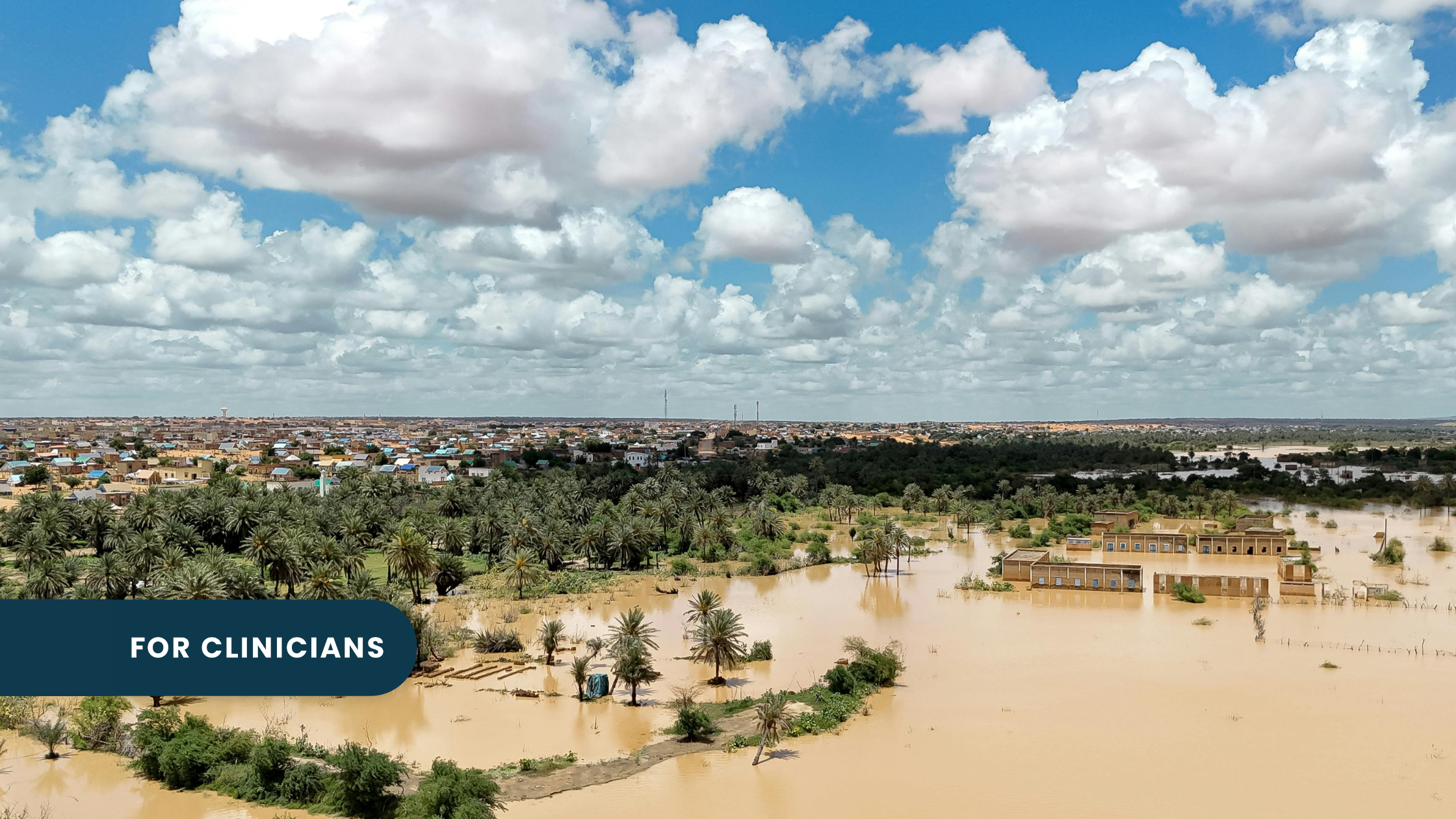
For Clinicians | Medication Exposed to Flood Water
The FDA Rule and Its One Exception
By Dr. Jamie Wilkey, PharmD — Director of Clinical Strategy, Jase
Medically reviewed and edited by Kristen Carpenter, PA-C
Today we are covering three things: what FDA actually recommends for water-exposed medication, the one exception and why two of your patients will quote you different rules about it, and what to do at the counter while the determination is still open.
This is not only a coastal question. The National Flood Insurance Program reports that 29% of its flood claims between 2014 and 2024 came from outside high-risk flood areas.¹ Add burst pipes and a creek that came up over a road, and it reaches practices nowhere near a hurricane track.
Does medication that touched floodwater have to be discarded?
Yep. All of it. FDA recommends discarding any drug that came into contact with flood or contaminated water, including drugs in their original containers with screw-top caps, snap lids, or droppers.² The same goes for medication kept somewhere other than its original bottle: a pill organizer, a baggie, a daily-dose box.
A consumer closure (like child-proof cap) is not a water barrier. It keeps out a curious 4-year-old. It was never built to exclude contaminated water, and FDA is explicit that a tight cap does not change the answer. CDC spells out the dosage forms FDA doesn’t: pills, pill organizers, liquids, drugs for injection, inhalers, and skin drugs.³
This is a discard rule rather than a stability calculation because of what was in the water. CDC’s position is that we don’t know exactly what is in floodwater at any given point in time.5 It can carry human and livestock waste, whatever was under the sink, whatever came out of the garage, and medical and industrial hazardous waste. These are pills someone swallows, and CDC ties eating or drinking anything floodwater touched to E. coli and Salmonella.5 FDA’s trigger is flood or unsafe municipal water, which is broader than flooding alone.
When can a flood-exposed medication still be used?
There is one exception. FDA writes it as a scenario rather than a rule, which is why it reads oddly:
“A drug may be needed to treat a life-threatening condition, but a replacement may not be readily available. Drugs exposed to fire or unsafe water should be replaced as soon as possible. If the drug looks unchanged – for example, pills in a wet container appear dry – the drugs can be used until a replacement is available. If the pills are wet, then they are contaminated and need to be discarded.”²
Read as a rule, all three have to be true:
- The indication is life-threatening.
- A replacement is not readily available.
- The product looks unchanged.
FDA never calls the drug safe. It says exposed drugs may be contaminated, then says a life-sustaining one can be used anyway until a replacement arrives. That’s bridge therapy: once the replacement is in hand, the exposed product gets discarded.
Cost is not one of the three. It’s a real access barrier and it should change how fast you move on a replacement. It doesn’t change whether a contaminated bottle stays in use.
Why the same guidance reaches patients two ways
CDC’s full guidance lines up with FDA’s, and on the stop rule it’s much clearer: take the lifesaving drug if it looks normal and dry, and “stop taking them as soon as replacement medication becomes available.”4
What reaches the public isn’t that page. CDC writes the same guidance as a text-message blast and a television news crawl, and at that length it becomes: “You can use lifesaving drugs stored clean and safe if they look normal and dry.”3 One sentence. Nothing about whether a replacement is available, nothing about when to stop.
So you get two patients working from the same agency. One saw the crawl during storm coverage and figures dry pills settle it. The other read the full page article and knows appearance is the last thing you check, after the drug is life-sustaining and after there is nothing available to replace it. Both got federal guidance.
Appearance is the only condition a patient can check without us. It is also the one that matters the least.
What to do at the counter or clinic
Quarantine rather than discard while the determination is open. Label it clearly as “NOT FOR USE” and keep it separate from everything else. That protects in both directions: you are not throwing out products the patient may have real trouble replacing, and you are not leaving a questionable bottle within reach while the question is still open.
Then give an interim instruction, because “set it aside” is not an instruction until the patient knows what to do about tonight’s dose. Working as a pharmacist I’d say, “Don’t take anything out of that bottle. I’m working on a replacement today and I’ll call you before your next dose is due.“
Document the exposure, what you consulted, the determination you reached, the interim instruction, and when a pending determination closes. An undocumented determination didn’t happen.
For emergency medication replacement when it is hard to reach the provider, check whether your board has issued an emergency dispensing notification. Texas issued one on July 7, 2025 for the Hill Country flooding, authorizing pharmacists to dispense up to a 30-day supply of non-Schedule-II drugs without prescriber authorization for patients in the declared counties.6
The authorization carries conditions. Tell the patient the refill is going out without prescriber authorization and that future refills need it, notify the prescriber at the earliest reasonable time, and keep a record. If the prescription was originally filled somewhere else, the patient needs the container, label, receipt, or other documentation, and you need to have tried to transfer it first.⁶
Mixing a suspension under a boil-water notice
This one’s interesting because no flooding is required. Any time there’s a boil-water notice, medication that needs to be reconstituted gets purified or bottled water only.² And you’re thinking, “The water’s boiled, that was the entire point of the notice! It should be fine…” Maybe. The FDA names purified and bottled and stops there. Boiled tap isn’t on the list, and the guidance never says whether it counts, so the instruction that holds up is FDA’s own: bottled or purified. A simple way to communicate this to patients is: “Don’t mix it with tap water, even boiled. Bottled water only until the notice lifts.”
The powder is a separate question from the water. Sealed and dry, it’s fine, and what you add is the only thing to sort out. If the bottle or the powder itself was in contact with flood or unsafe water, we’re back to the discard rule at the top.
The middle step nobody has built
After water reaches the cabinet, our patients have 2 options and both are bad. Throw everything out and go without until somebody can be reached, or keep it and hope. There is no sanctioned step in between, and that step is the part that needs a clinician: an actual determination, made by someone who knows which of the 3 conditions apply.
That determination is what appropriate medical preparation looks like here. It is not a supply question. Two things that cost a patient nothing before any water shows up, and both sit in FDA’s own guidance: a written list of every prescription with drug, dose, prescriber, and pharmacy, and the bottles kept inside a water-tight container with a lid.² That written list isn’t only for you. A displaced patient seeking an emergency refill at a pharmacy that didn’t fill the original needs exactly that documentation to get one.⁶ Then the determination itself, made with us instead of guessed at off whatever version of the guidance reached them first.
This complements primary care rather than replacing it. We are here for the stretch when primary care is not reachable, which after a flood runs days.
For the acute problems a flood actually produces, the wound care and the infections, we keep contingency medication available for patients whose providers would rather refer than build that conversation from scratch. A licensed provider reviews every request and writes every prescription, and that medication is for emergency use only, after first seeking help from a qualified provider.
We will keep publishing the frameworks as we work them out, including the ones where the full guidance and the short version patients actually see don’t line up.
The bottom line
If it touched flood or unsafe water, discard it. That includes the bottle with the tight cap and the tablets that look perfect. The only route to keeping it is a life-threatening indication, no replacement available, and no visible change, and the exposed product gets discarded once the replacement is in hand. Quarantine while you sort it out, write down what you decided, and reconstitute with bottled water only.
The patient in front of you may have already made this call without us. Ask what got wet and where it was, not how it looks.
Sources
- Federal Emergency Management Agency, National Flood Insurance Program. What is My Flood Risk. https://www.floodsmart.gov/flood-zones-and-maps/what-is-my-flood-risk. Retrieved August 17, 2026.
- U.S. Food and Drug Administration. Safe Drug Use After a Natural Disaster. https://www.fda.gov/drugs/emergency-preparedness-drugs/safe-drug-use-after-natural-disaster. Content current as of August 28, 2019. Retrieved August 17, 2026.
- Centers for Disease Control and Prevention. Drugs Exposed to Water. Natural Disasters public service announcement toolkit. Quoted line appears under Text Messages for Mobile Devices and Related Television Crawls for News Media. https://www.cdc.gov/natural-disasters/psa-toolkit/drugs-exposed-to-water.html. Last updated February 7, 2024. Retrieved August 17, 2026.
- Centers for Disease Control and Prevention. Lifesaving Drugs. Natural Disasters public service announcement toolkit. https://www.cdc.gov/natural-disasters/psa-toolkit/lifesaving-drugs.html. Last updated February 6, 2024. Retrieved August 17, 2026.
- Centers for Disease Control and Prevention. Safety Guidelines: Floodwater. https://www.cdc.gov/floods/safety/floodwater-after-a-disaster-or-emergency-safety.html. Last updated February 6, 2024. Retrieved August 17, 2026.
- Texas State Board of Pharmacy. Hill Country Flooding: Emergency Dispensing of Prescription Medications. Issued July 7, 2025. Authorized under Texas Pharmacy Act Sec. 562.054 and Board rule 291.34(b)(8)(E). https://www.pharmacy.texas.gov/files_pdf/2025-Flood-Notification.pdf. Retrieved August 17, 2026.
Lifesaving Solutions
Recent Posts
Keeping you informed and safe.

For Clinicians | Pediatric Dosing 101: What Parents Need From You Before They’re Dosing Alone
For Clinicians | Pediatric Dosing 101: What Parents Need From You Before They're Dosing Alone By Dr. Jamie Wilkey, PharmD, Director of Clinical EducationMedically reviewed and edited by Aaron Asay, PA-C, DMSc, FIBODM, FAWM Pharmacy school drills one line into you over...

What is Plague?
What Is Plague? By the Jase Medical Team Plague is back in the headlines, and people are suddenly Googling a disease they may not have thought about since history class. A 28-year-old laboratory worker at an anti-plague research institute in Siberia recently died...
For Clinicians | What Is Plague? One Bacterium, Three Diseases
For Clinicians | What Is Plague? One Bacterium, Three Diseases By Dr. Jamie Wilkey, PharmD, Director of Clinical EducationMedically reviewed and edited by Aaron Asay, PA-C, DMSc, FIBODM, FAWM Well, the plague is back in the news. Reports out of Russia in early October...

Nobody Has Your Medication List, Including Your Doctor and Your Pharmacy
Nobody Has Your Medication List, Including Your Doctor and Your Pharmacy By the Jase Medical Team Most of us assume that somewhere in the healthcare system, there is one correct list of every medication we take. Your primary care doctor has a list. Your pharmacy has a...