Antibiotics Won't Cure Your Tooth Infection. Here's What They Actually Do By Cayla McGrath A molar starts throbbing on day two of a ten-day cruise. A crown cracks Friday night and your dentist can't see you until Wednesday. A tooth flares in a rural area where the...
For Clinicians | Counseling Patients on Expired Medications
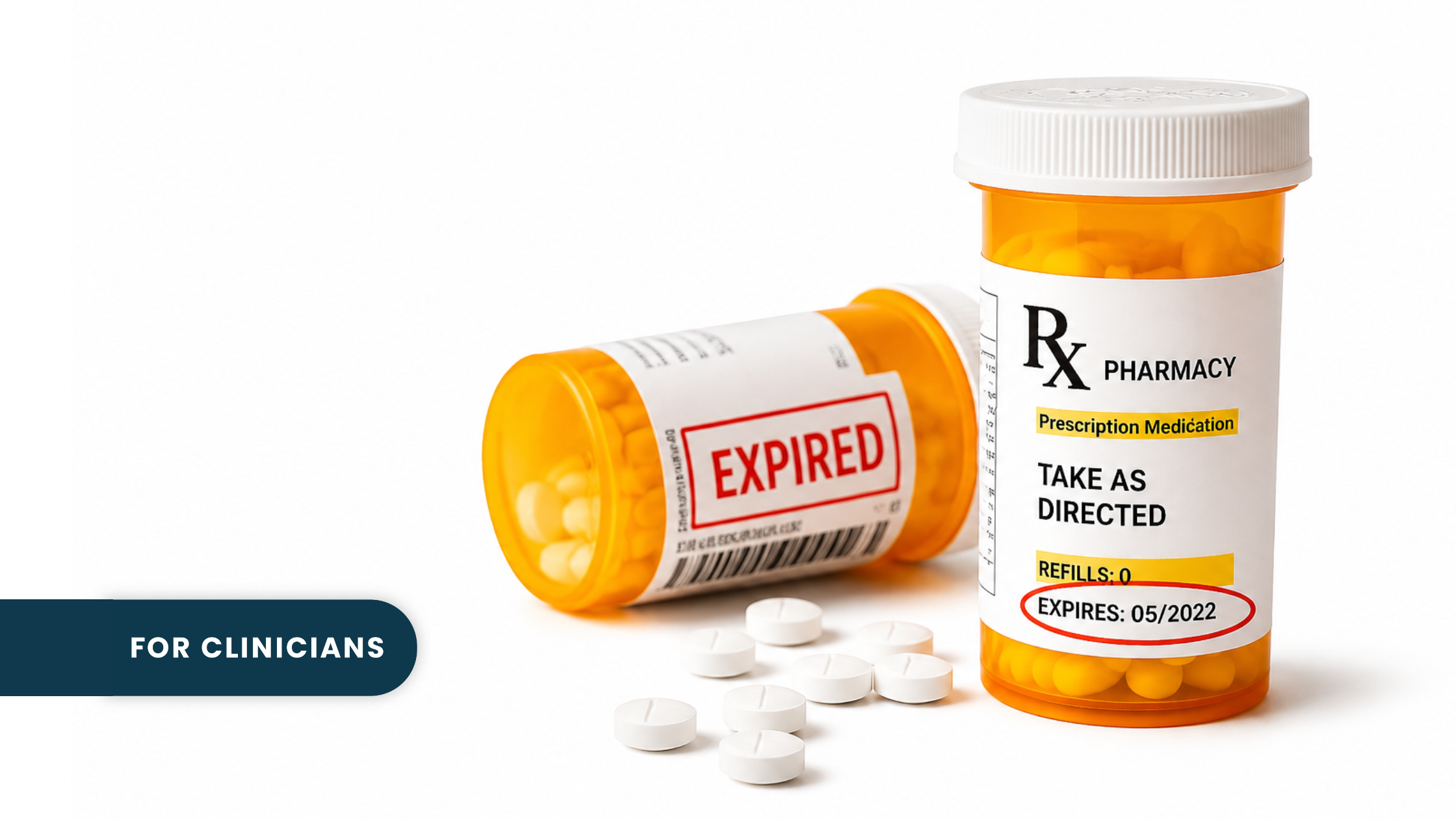
For Clinicians | Counseling Patients on Expired Medications
By Dr. Jamie Wilkey, PharmD — Director of Clinical Strategy, Jase
Medically reviewed by Kristen Carpenter, PA-C — Clinical Advisory Board Member
Clinician notice: A note on expiration dates. This article discusses published research on drug stability, including the FDA and Department of Defense Shelf Life Extension Program (SLEP). SLEP applies to federal stockpiles held under controlled, monitored storage and tested lot by lot. It does not apply to medications stored at home, and its findings do not extend the expiration date of any medication you own. FDA’s guidance to consumers is that expired medications should not be used. This article is written for licensed healthcare professionals to support patient counseling. Jase Medical follows the manufacturer’s printed expiration date on every medication we dispense, and we recommend counseling patients to replace medications at the labeled date and dispose of expired supply following FDA guidance.
A patient holds up a bottle a year or two past the dispense date and asks, “Is this still good?” The counseling answer is the same for every product: replace it. The labeled date is the replacement date.
This article covers the stability research behind the question so you can explain why. The most cited data comes from the FDA and Department of Defense Shelf Life Extension Program, which tested stockpiled lots under controlled storage. Those results do not transfer to medication kept at home, and that limitation is the core of the counseling message.
Why stability varies, and why that makes the label date the answer
Stability differs by drug, formulation, and storage history. Solid oral forms hold up better than liquids, and a small set of products degrade quickly or carry specific risks once degraded. That variation is exactly why a patient cannot judge an expired product at home, and why counseling always lands on replacement at the labeled date. Use the tiers below to decide which products to replace first and which need the closest storage attention.
Tier 1: Solid oral forms
Tablets and capsules, including most oral antibiotics, analgesics, and antihistamines, are the least sensitive to storage. Counsel patients to keep them capped in the original container in a cool, dry place away from the bathroom, and to replace them at the labeled date.
Tier 2: Liquids, suspensions, and reconstituted products
Oral suspensions, eye and ear drops, and anything reconstituted carry short in-use dating. Reconstituted amoxicillin suspension, for example, is labeled for 14 days after mixing. Counsel patients that these are not long-term supply items, to follow the beyond-use date on the label, and to discard leftovers when the course ends.
Tier 3: Narrow therapeutic index and storage-dependent products
Levothyroxine, warfarin, antiepileptics, insulin, epinephrine auto-injectors, and sublingual nitroglycerin need the closest attention. Small potency changes matter clinically, and several of these products degrade with heat, light, or air exposure. Counsel patients to follow storage instructions exactly, inspect for discoloration or particles where the product allows, and replace at the labeled date or sooner if storage was compromised.
Counseling points
- The labeled date is the replacement date for every product.
- Store medications cool, dry, and dark, in the original container. The bathroom cabinet is the worst place in most homes.
- Replace any product with a visible change, such as discoloration, odor, or clumping, regardless of date.
- Dispose of expired supply following FDA guidance.
Closing notice: When a medication reaches its expiration date, replace it. Dispose of the expired supply following FDA’s guidance on expired medicines.
Sources
- FDA, Expiration Dates Questions and Answers
- FDA, Don’t Be Tempted to Use Expired Medicines
- Lyon RC et al. “Stability profiles of drug products extended beyond labeled expiration dates.” J Pharm Sci. 2006;95(7):1549-1560.
- Frimpter GW et al. “Reversible ‘Fanconi syndrome’ caused by degraded tetracycline.” JAMA. 1963;184:111-113.
Lifesaving Solutions
Everyone should be empowered to care for themselves and their loved ones during the unexpected. Check out our recent lifesaving products today.
Recent Posts
Keeping you informed and safe.

When a Tooth Infection Can’t Wait
read more
For Clinicians | The Tooth Infection at Your Counter
For Clinicians | The Tooth Infection at Your Counter: What to Do When the Dentist Is Days Away By Dr. Jamie Wilkey, PharmD — Director of Clinical Strategy, JaseMedically reviewed by Kristen Carpenter, PA-C — Clinical Advisory Board Member Almost none of us trained to...
Your Medications Don’t Tolerate Heat the Way You Do: A Summer Storage Guide
Your Medications Don't Tolerate Heat the Way You Do: A Summer Storage Guide By Cayla McGrath Summer is hard on a lot of things. Car batteries die. Chocolate melts in the grocery bag. Ice cream doesn't survive the drive home. Most of us instinctively adjust for those...

You Don’t Have to Be an Expert to Be Prepared
You Don't Have to Be an Expert to Be Prepared By Cayla McGrath Medical preparation has a branding problem. On one end of the conversation, you have disaster medicine — the world of field manuals, off-grid clinical decision trees, and preparation for scenarios where...