For Clinicians | Traveling With Medical Supplies

For Clinicians | Traveling With Medical Supplies


Getting Weeks of Supplies Where Your Patient Is Going

By Dr. Jamie Wilkey, PharmD — Director of Clinical Strategy, Jase
Medically reviewed by Kristen Carpenter, PA-C — Clinical Advisory Board Member

“My mother-in-law has a PICC line and an ostomy. She wants to fly out to see her sister this summer,…… is that even realistic?”

If you work in an office or a pharmacy, you’ve heard a version of this one, and summer is when it shows up. Notice who’s asking. It usually isn’t the patient. It’s the daughter-in-law who books the flights, the son who does the driving: the family member running the logistics. The question we’re trained to answer (is she stable enough to travel?) usually has a clean answer, and it’s often yes. The question they’re actually asking (how do three weeks of pouches, dressing kits, flushes, and a refrigerated medication get across the country?) mostly doesn’t, because nobody taught us supply logistics in school.

Today we’re talking about exactly that: what travels in the carry-on, what TSA actually allows at the checkpoint, and the ship-ahead options most patients, and most of us, have never heard of.


Can patients with a PICC line, an ostomy, or home infusion travel at all?

Usually, yes. A stable patient with a pre-travel visit on the calendar and their care team in the loop can fly, drive, and even cruise. Travel itself is rarely the contraindication we instinctively treat it as, and a reflexive “better not to risk it” mostly sends the family home to Google.

Right now out there every good resource covers exactly one lane. The UOAA’s travel guidance is excellent, and it’s ostomy-only.¹ The CDC Yellow Book chapter on travelers with chronic illness is thorough, and it’s written to us, not to them.² TSA’s medical screening page covers the checkpoint and stops at the gate.³ The supplier blogs cover whichever product that supplier sells. Nobody maps the whole journey for the patient managing two or three systems at once, which is exactly the patient whose family is calling.

And nearly all of it shares one heavy, bulky assumption: that the patient can carry everything. “Pack extra” is where most guidance ends. When the count is two pouches a day plus weekly sterile dressing changes plus a refrigerated medication, “extra” is a duffel bag. That duffel bag is the actual problem.


The ship-ahead playbook: the supplies don’t all have to ride along

Here’s the part that surprises families most, and plenty of us: weeks of supplies can travel separately from the patient.

What to tell families to ask their suppliers, specifically:

  • Home infusion pharmacies will often ship medications and supplies directly to a destination: a hotel, or better, a family member’s address.
  • Many can arrange a partner pharmacy near the destination, which matters most if a cold-chain medication fails en route.
  • Ostomy suppliers commonly ship next-day in discreet packaging anywhere in the country.
  • Many suppliers offer a travel kit, a compact set of extras sized for delays rather than for the whole trip.

None of this is guaranteed. Policies and coverage vary widely by supplier and by insurance plan, which is why the framing is “ask whether,” not “they will.” But the asking costs a phone call, and it isn’t a clinical decision: the family member doing the logistics can make the calls, or your MA or pharmacy technician can (you can have them do this to save you time). The questions are short. Do you ship to a destination? Do you have a partner network where she’s going? Do you offer a travel kit?

Timing matters more than anything else here. Two to three weeks ahead, ideally raised at the pre-travel visit. And if the package is going to a hotel, the family should confirm the front desk will hold it. Otherwise the box arrives on time and sits in a back room while nobody at the desk knows whose it is.


The door-to-door checklist, by stage of the journey

Organized by stage, not by device, because the patient managing three systems doesn’t get to take three separate trips.

Four to six weeks out:

  • Pre-travel visit on the calendar. The CDC recommends 4 to 6 weeks ahead, and for a patient on home infusion that lead time is not padding.²
  • A letter on your letterhead listing conditions, devices, and medications by generic name. Five minutes of your time, and it answers most questions before they’re asked.²
  • Supply count doubled, then split so no single lost bag takes out the whole reserve.¹
  • The supplier calls from the last section.
  • TSA Cares on the family’s list: 1-855-787-2227, at least 72 hours before the flight.⁴

At the checkpoint:

  • Medically necessary liquids and gels over 3.4 oz are allowed in carry-on when declared at the start of screening.³
  • Ice and gel packs are allowed frozen, partially frozen, or fully melted.³
  • Pouches, ports, catheters, and pumps stay on and stay covered. Screening is a self-pat-down plus trace testing, and private screening is theirs for the asking.³
  • The TSA notification card lets the patient disclose a device without explaining out loud in line. Free, printable, under-known.⁴

In the air:

  • Critical medications and supplies ride in the carry-on. Not checked, ever: cargo holds freeze, overheat, and occasionally send bags to the wrong coast.²
  • Preboarding, boarding assistance, and seating accommodations are theirs to request under the Air Carrier Access Act⁵
  • With a central line, on flights past about four hours: up and walking every hour or two. Confirm specifics with the patient’s own care team.⁶

At the destination:

  • Confirm the shipped box at the front desk before anyone unpacks.
  • Refrigerated medications go into an actual refrigerator on arrival, not the hotel ice bucket. More on heat in a moment.
  • Find the nearest pharmacy before anyone needs it.

The trip home:

The return leg is part of the original count: enough supplies for the trip home plus a delay, not whatever happens to be left.


What about summer heat?

Refrigerated medications want 36 to 46°F, most everything else wants 68 to 77°F, and a parked car in a July heat wave leaves both ranges behind before the family finishes lunch.⁷ So: no meds in the trunk, no meds in the glove box, no meds in the checked bag (cargo holds run hot and cold), and the hotel mini-fridge should get checked with a thermometer before anything important goes in.

The best question the family can ask before leaving is one the pharmacist answers all day: how long does this specific medication tolerate being out of refrigeration? The answer varies enormously by product, and knowing it ahead of time turns a melted gel pack from an emergency into an inconvenience.

We went deep on medication heat stability in our summer storage article; that one is the companion read for this stretch of the trip.


Where this fits

The middle ground this article keeps walking has a name: appropriate medical preparation. Not “too risky, stay home,” and not “throw some extras in a bag and hope.” The same clinical thinking we bring to everything else, pointed at logistics: needs that are predictable, prepared for ahead of time, before the trip instead of mid-crisis in a hotel room.

None of it replaces the patient’s own care team. The infusion pharmacy still owns the line care plan, the GI team still owns the ostomy, and you still make the call on whether she’s fit to travel. This is the layer around those decisions, and right now nobody hands it to families in one place.

That’s the gap we’re working on at Jase: putting frameworks like this one in writing, in public, so the family doing the logistics finds something better than a midnight Google search.


The bottom line

Most families don’t think about supply logistics until they’ve lost a vacation day calling pharmacies in a city they don’t know. The better version of the story starts in your office or at your counter, six weeks out: the visit happens, the letter gets written, the supplier calls get made, and the box is waiting at the front desk before the flight lands.

Travel with a complex condition is usually possible. The supplies are the hard part, and the hard part is solvable: ship ahead what can’t be carried, carry on what can’t be replaced, and put the checkpoint rules in the family’s hands before they’re standing in line. The clinical call is still yours. The logistics now have a playbook.


Sources

  1. United Ostomy Associations of America, Ostomy Travel and TSA Communication Card. https://www.ostomy.org/ostomy-travel-and-tsa-communication-card/
  2. CDC Yellow Book, Travelers with Chronic Illnesses. https://www.cdc.gov/yellow-book/hcp/travelers-with-additional-considerations/travelers-with-chronic-illnesses.html
  3. TSA, What Can I Bring? Medical, and Disabilities and Medical Conditions. https://www.tsa.gov/travel/security-screening/whatcanibring/medical and https://www.tsa.gov/travel/tsa-cares/disabilities-and-medical-conditions
  4. TSA Cares, Passenger Support. https://www.tsa.gov/travel/passenger-support
  5. U.S. Department of Transportation, Passengers with Disabilities (Air Carrier Access Act). https://www.transportation.gov/airconsumer/passengers-disabilities
  6. CDC, Understanding Your Risk for Blood Clots with Travel. https://www.cdc.gov/blood-clots/risk-factors/travel.html
  7. U.S. Pharmacopeia, General Chapter 659, Packaging and Storage Requirements: refrigerated 2-8°C (36-46°F), controlled room temperature 20-25°C (68-77°F).


Lifesaving Solutions

Everyone should be empowered to care for themselves and their loved ones during the unexpected. Check out our recent lifesaving products today.

Recent Posts

Keeping you informed and safe.

What Metronidazole Actually Treats — And What It Doesn’t

What Metronidazole Actually Treats — And What It Doesn’t

What Metronidazole Actually Treats — And What It Doesn't By Cayla McGrath If you've ever been prescribed metronidazole, the first thing most people remember is the warning: no alcohol while you're taking it. The pharmacist usually says it with the kind of gravity that...

read more
When a Tooth Infection Can’t Wait

When a Tooth Infection Can’t Wait

Antibiotics Won't Cure Your Tooth Infection. Here's What They Actually Do By Cayla McGrath A molar starts throbbing on day two of a ten-day cruise. A crown cracks Friday night and your dentist can't see you until Wednesday. A tooth flares in a rural area where the...

read more
For Clinicians | The Tooth Infection at Your Counter

For Clinicians | The Tooth Infection at Your Counter

For Clinicians | The Tooth Infection at Your Counter: What to Do When the Dentist Is Days Away By Dr. Jamie Wilkey, PharmD — Director of Clinical Strategy, JaseMedically reviewed by Kristen Carpenter, PA-C — Clinical Advisory Board Member Almost none of us trained to...


read more

Join Our Newsletter

Our mission is to help you be more medically prepared. Join our newsletter and follow us on social media for health and safety tips each week!

The Search Bar Isn’t a Doctor

The Search Bar Isn’t a Doctor:

Why Medically Reviewed Medication Cards Matter

By Cayla McGrath


It’s 2 a.m. Urgent care closed an hour ago, your doctor’s office won’t reopen until morning, and whatever is going on feels miserable enough that sleep isn’t happening. Maybe it’s the familiar burning sensation of a urinary tract infection you’ve had before. Maybe your child woke up sick while you’re traveling three days from the nearest clinic. Maybe you’re riding out a hurricane, roads are flooded, and getting to a pharmacy simply isn’t an option.

For many people, moments like these end the same way: opening a search bar.

Or opening the medicine cabinet.

You find three leftover azithromycin tablets from a previous illness and wonder if they’ll work. You type your symptoms into an online symptom checker. You search social media. You text a friend who’s “good with medical stuff.” The reality is that when access to healthcare disappears, most people don’t do nothing. They do something.

At Jase, we think it’s important to acknowledge that reality.

We’re not teaching people to self-diagnose, and we’re certainly not encouraging people to play doctor. But we also recognize that the standard advice most patients receive — “Don’t self-treat. See a provider.” — quietly assumes a provider is reachable. It assumes cell service works, urgent care is open, your physician is available, and the nearest pharmacy isn’t two counties away after a disaster.

Sometimes, those assumptions simply aren’t true.

The question then becomes less about whether someone will make a decision and more about what information they’ll use to make it. Will it come from an algorithm designed to keep you clicking? Will it come from a decade-old forum post? Will it come from whatever antibiotics happen to be left in the back of a medicine cabinet?

Or will it come from clinicians?

Interestingly, medicine already acknowledges that there are situations where guided self-treatment makes sense when access is the limiting factor. The CDC’s Yellow Book recommends standby treatment for travelers carrying antibiotics to self-treat moderate or severe travelers’ diarrhea. The American Urological Association supports self-start therapy for select patients who experience recurrent urinary tract infections. Wilderness medicine experts have long recommended that expedition medical kits include medications clearly labeled with indications, dosing instructions, warnings, and circumstances that require evacuation or professional care.

The common thread isn’t encouraging people to guess.

It’s providing guardrails.

Because intuition can be both remarkably accurate and surprisingly unreliable. Research suggests that women with recurrent, culture-confirmed urinary tract infections identify new infections with better than 85 percent accuracy. At the same time, studies suggest only about one in nine women correctly identify a classic yeast infection based on symptoms alone.

Both of those facts can be true.

People often know when something feels familiar. What they may not know is whether the medication they’re considering is the right one, what dose should be taken, how long it should be used, whether there are situations where it should be avoided entirely, or when symptoms have crossed the threshold from “reasonable contingency plan” to “you need medical evaluation.”

That’s exactly why Jase created medically reviewed medication cards.

Rather than asking patients to rely on memory or internet searches, the cards provide condition-specific guidance developed and reviewed by medical doctors, physician assistants, and pharmacists. Each card outlines the medication itself, recommended dosing, duration of use, common side effects, situations where the medication should not be taken, and signs that indicate someone should seek professional medical care instead.

In many ways, the cards spend just as much time talking about limitations as they do permissions. They don’t say, “You’re on your own.” They say, “Here’s what clinicians want you to know if you’re ever in a situation where we can’t immediately be reached.”

The visual itself makes the argument. Instead of relying on guesswork, patients have plain-language guidance already in their hands: the right drug, the right dose, the right duration, when to avoid taking it, and when to stop and seek care instead. For someone who is traveling, weathering a disaster, or facing a 2 a.m. moment without access to healthcare, that distinction matters.

For us, that’s what appropriate medical preparation really means.

It isn’t replacing your primary care physician. It isn’t encouraging people to diagnose complex illnesses at home. It isn’t stockpiling medications for every imaginable scenario.

It’s recognizing that life doesn’t always happen within business hours.

Travel happens. Storms happen. Disasters happen. Backcountry trips happen. Phones lose signal. Clinics close. Pharmacies run out of medications.

And when those moments come, we’d rather people have clinician-written guidance in their hands than a search bar on their screen.

That’s not permission to guess.

It’s permission to be thoughtfully prepared.

At Jase, we call that appropriate medical preparation.


Cayla McGrath is a content strategist with Jase Medical. This post is for informational purposes only and does not constitute medical advice. Always consult a licensed healthcare provider before using any prescription medication.


Lifesaving Solutions

Everyone should be empowered to care for themselves and their loved ones during the unexpected. Check out our recent lifesaving products today.

Recent Posts

Keeping you informed and safe.

What Metronidazole Actually Treats — And What It Doesn’t

What Metronidazole Actually Treats — And What It Doesn’t

What Metronidazole Actually Treats — And What It Doesn't By Cayla McGrath If you've ever been prescribed metronidazole, the first thing most people remember is the warning: no alcohol while you're taking it. The pharmacist usually says it with the kind of gravity that...

read more
When a Tooth Infection Can’t Wait

When a Tooth Infection Can’t Wait

Antibiotics Won't Cure Your Tooth Infection. Here's What They Actually Do By Cayla McGrath A molar starts throbbing on day two of a ten-day cruise. A crown cracks Friday night and your dentist can't see you until Wednesday. A tooth flares in a rural area where the...

read more
For Clinicians | The Tooth Infection at Your Counter

For Clinicians | The Tooth Infection at Your Counter

For Clinicians | The Tooth Infection at Your Counter: What to Do When the Dentist Is Days Away By Dr. Jamie Wilkey, PharmD — Director of Clinical Strategy, JaseMedically reviewed by Kristen Carpenter, PA-C — Clinical Advisory Board Member Almost none of us trained to...
read more

Join Our Newsletter

Our mission is to help you be more medically prepared. Join our newsletter and follow us on social media for health and safety tips each week!

For Clinicians | Standby Antibiotics and Self-Start Therapy

For Clinicians | Standby Antibiotics and Self-Start Therapy


Guideline Case for Guided Self-Treatment

By Dr. Jamie Wilkey, PharmD — Director of Clinical Strategy, Jase
Medically reviewed by Kristen Carpenter, PA-C — Clinical Advisory Board Member

Patients stopped asking me whether they should keep leftover antibiotics years ago. They just tell me they did, usually after the fact, usually at the counter, usually with a little defiance in it: their old azithromycin from last winter went toward what felt like a UTI, aaaand they’re only bringing it up now because the symptoms didn’t budge.

Wrong drug for the likely bug. Wrong duration even if it were the right one. And the standard answer we’re all trained to give: “never self-treat, see a provider!” was never really in the running. It assumes a provider was reachable, and at 2am with no cell service, or three days out from the nearest clinic, nobody is. Patients in those moments will act on something. The only question is whether that something was written by clinicians, by a search bar, or just what is at the back of the medicine cupboard.

So today we’re going to flesh this out: what the guidelines already permit, where patient self-diagnosis is reliable (and where it really isn’t), what patients actually do when they can’t reach us, and what the guidance in their hands should look like.


Can patients accurately self-diagnose?

It depends on the condition, and the spread is wider than most of us would guess.Let’s just start at the encouraging side. In women with prior culture-confirmed UTIs, patient suspicion of a new UTI is more than 85% accurate in predicting culture-positive infection, more accurate than a urine dipstick.¹ This holds for women with an established recurrent pattern whose symptoms match prior confirmed episodes, and accuracy drops when vaginal discharge, pelvic pain, or STI exposure complicates the picture. But within those bounds, these patients know their bodies, and the data backs them.Now the other end. When women self-diagnosed a yeast infection and bought an over-the-counter antifungal, only about one in three actually had vulvovaginal candidiasis. The rest had bacterial vaginosis, mixed vaginitis, trichomoniasis, or normal findings. A prior clinician-confirmed yeast infection did not make them any more accurate the second time.²Hold both results at once. Patient intuition is real, and it is not uniform. It is condition-dependent, and patients have no way of knowing which conditions their intuition is good for. That specificity gap is exactly what a written tool has to close.


The permission already exists

The reflex is to file guided self-treatment under fringe medicine. The guidelines disagree.

  • Recurrent UTIs. The AUA’s guideline lets clinicians offer select patients self-start therapy: the antibiotic waits at home, and the patient starts it when symptoms hit.³
  • Travelers’ diarrhea. The CDC Yellow Book tells travelers to carry an antibiotic and start it themselves when moderate-to-severe symptoms hit. No call required.⁴
  • Expedition medicine. Kits are scaled to how far the group is from care, and every drug is labeled with what it treats and how to take it.
  • Your own exam room. We already prescribe ahead of the emergency: EpiPens, rescue inhalers, nitroglycerin. The patient carries the drug and uses their own judgment on the day.

Every one of these kicks in when care is out of reach. And every one of them assumes a clinician is nearby doing the guiding.

That’s the gap. We trained inside a closed system: one patient, one prescriber, one chart, one pharmacy. Nobody trained us for the patient at 2am, because she was supposed to be somebody else’s problem. There is no somebody else at 2am except maybe an ultra expensive ER with a wait a mile long. The permission for guided self-treatment exists. The plain-language tool it assumes was never built.


What medically-reviewed guidance actually looks like

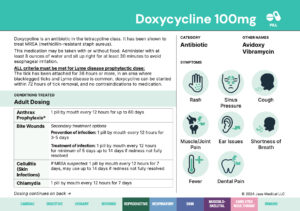
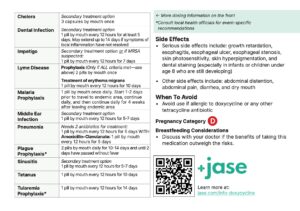
This is where the med card earns its place, and the card makes the argument better than any abstraction does. Take the doxycycline card that ships in a JaseCase. The front opens with the counseling we give at the counter (take it with a full glass of water and stay upright for 30 minutes, your esophagus will thank you), then a conditions-treated table with adult dosing for each indication. The doses are not interchangeable: a single two-pill dose for Lyme prophylaxis, twice daily for 10 days for tetanus, once daily starting before travel for malaria prevention, up to 60 days for anthrax. They differ by condition, which is precisely what patients guess wrong. And the Lyme line won’t even grant that single dose unless every criterion is met: tick attached 36 hours or more, a region where blacklegged ticks are common, started within 72 hours of tick removal, no contraindications. That’s the IDSA’s own prophylaxis standard, printed where the patient can read it.⁷

The back carries the side effects worth watching for, when to avoid the drug entirely, and a red Pregnancy Category D where nobody can miss it. Scattered through the dosing table is a phrase doing quiet stewardship work: secondary treatment option. The card tells the patient when this drug is not the right first choice. For pneumonia it goes further and requires a second antibiotic alongside it, partner drug and dose spelled out: the same combination the ATS/IDSA pneumonia guideline recommends for outpatients with comorbidities.⁸ That is the part the skeptics skip: the card spends as much ink on limits as on permissions.


The stewardship objection deserves a direct answer

The strongest pushback on at-home antibiotic kits, and infectious disease colleagues have made it in print, is antimicrobial resistance: patients shooting from the hip with broad-spectrum drugs. The concern is legitimate, and it deserves engagement rather than a dodge.

But look at what the objection assumes: that the alternative to the kit is a clinic visit. For the no-access moments these kits exist for, it isn’t. The real alternatives are going without, taking whatever antibiotics turn up around the house or from a friend’s leftover stash, or buying whatever they think they need from an online pharmacy. None of those comes with the right spectrum, a full course, or any counseling behind it. Against that baseline, a condition-specific, full-course, clinician-reviewed regimen with explicit do-not-use guidance is better stewardship, not worse.

And sometimes the right answer on the card is no drug at all. The clinical review behind each card draws the fence deliberately: well-understood, self-limiting conditions with predictable treatment paths, screened ahead of time by a clinician who reviewed the patient’s history. That fence is what keeps guided self-treatment from sliding into the free-for-all the skeptics fear.


Charting the grey area in public

Step back and look at how antibiotic access actually works in this country. It is all or none. Either the patient reaches a prescriber and gets the right drug, or they are completely on their own resources: the leftover stash, the search bar, the no-questions-asked website. There is no sanctioned middle step. We built a light switch and then act surprised when patients in the dark go looking for matches.

The guidelines covered above have already sketched what the middle step looks like: a defined, conditional, clinician-controlled layer between “call your doctor” and “you’re on your own.” Self-start therapy is that layer for recurrent UTIs. Standby treatment is that layer for travelers. What we’re building at Jase is the same layer for a short list of common, well-understood infections: the clinical work happens up front, a clinician reviews the patient’s history and prescribes for defined conditions, and the card carries the guidance into the moment it’s needed. That is what appropriate medical preparation means in practice: the basics, decided ahead of time, for the moments care isn’t there.

The boundary holds on both sides. This is in no way a replacement for primary care: anything complex, chronic, or unfamiliar still belongs in the exam room, and the cards say so. And if a patient asks you what they should have on hand just in case and you would rather not chart that middle layer yourself, you can refer them to us at Jase.com. We’re a family team of physicians, PAs, and pharmacists drawing these lines carefully, and we’ll keep publishing where we draw them.


The bottom line

Organized medicine already endorses guided self-treatment when access is the constraint; the existing frameworks just assume a clinician is standing there to do the guiding. At 2am, nobody is. What we can control is whether the information in the patient’s hand that night came from clinicians or from a search bar.

Most people never think about any of this until the night it happens to them.

We are here for them then.


Sources

  1. American Family Physician (AAFP), April 2016. Patient suspicion of UTI is more than 85% accurate in predicting culture-positive infection, more accurate than urine dipstick. https://www.aafp.org/pubs/afp/issues/2016/0401/p560.html
  2. Ferris DG, et al. Obstetrics & Gynecology, 2002. Among women who self-diagnosed vulvovaginal candidiasis and purchased an over-the-counter antifungal, 33.7% had the condition. https://pubmed.ncbi.nlm.nih.gov/11864668/
  3. AUA/CUA/SUFU, Recurrent Uncomplicated Urinary Tract Infections in Women, 2025 guideline amendment. Patient-initiated (self-start) treatment for select patients, conditional recommendation (Moderate, Grade C). https://www.auanet.org/guidelines-and-quality/guidelines/recurrent-uti
  4. CDC Yellow Book, Travelers’ Diarrhea. Standby self-treatment for travelers; antibiotics reduce illness duration by approximately 1 to 2 days for susceptible bacterial pathogens. https://www.cdc.gov/yellow-book/hcp/preparing-international-travelers/travelers-diarrhea.html
  5. IDSA/AAN/ACR, Prevention, Diagnosis and Treatment of Lyme Disease guideline, 2020. Single-dose doxycycline prophylaxis within 72 hours of a high-risk bite: identified Ixodes vector, highly endemic area, attached 36 hours or more. https://www.idsociety.org/practice-guideline/lyme-disease/
  6. ATS/IDSA, Community-Acquired Pneumonia guideline, 2019, summarized in American Family Physician, 2020. Outpatients with comorbidities: amoxicillin/clavulanate plus a macrolide or doxycycline. https://www.aafp.org/pubs/afp/issues/2020/0715/p121.html


Lifesaving Solutions

Everyone should be empowered to care for themselves and their loved ones during the unexpected. Check out our recent lifesaving products today.

Recent Posts

Keeping you informed and safe.

What Metronidazole Actually Treats — And What It Doesn’t

What Metronidazole Actually Treats — And What It Doesn’t

What Metronidazole Actually Treats — And What It Doesn't By Cayla McGrath If you've ever been prescribed metronidazole, the first thing most people remember is the warning: no alcohol while you're taking it. The pharmacist usually says it with the kind of gravity that...

read more
When a Tooth Infection Can’t Wait

When a Tooth Infection Can’t Wait

Antibiotics Won't Cure Your Tooth Infection. Here's What They Actually Do By Cayla McGrath A molar starts throbbing on day two of a ten-day cruise. A crown cracks Friday night and your dentist can't see you until Wednesday. A tooth flares in a rural area where the...

read more
For Clinicians | The Tooth Infection at Your Counter

For Clinicians | The Tooth Infection at Your Counter

For Clinicians | The Tooth Infection at Your Counter: What to Do When the Dentist Is Days Away By Dr. Jamie Wilkey, PharmD — Director of Clinical Strategy, JaseMedically reviewed by Kristen Carpenter, PA-C — Clinical Advisory Board Member Almost none of us trained to...
read more

Join Our Newsletter

Our mission is to help you be more medically prepared. Join our newsletter and follow us on social media for health and safety tips each week!

Why Expiration Dates Matter for Your Medication Supply

Why Expiration Dates Matter for Your Medication Supply

By Cayla McGrath

Consumer notice: A note on expiration dates. This article discusses published research on drug stability, including the FDA and Department of Defense Shelf Life Extension Program (SLEP). SLEP applies to federal stockpiles held under controlled, monitored storage and tested lot by lot. It does not apply to medications stored at home, and its findings do not extend the expiration date of any medication you own. FDA’s guidance to consumers is that expired medications should not be used. Jase Medical follows the manufacturer’s printed expiration date on every medication we dispense. Replace medications when they expire, and dispose of the expired supply following FDA’s disposal guidance.

If you’ve ever stood in front of your medicine cabinet holding a bottle a year past the printed date, you’ve heard two kinds of advice: “it’s probably fine” and “throw it out, it might be toxic.” The useful answer is simpler than either: replace it. Here is why the date matters, and how storage protects your medication until then.


What the expiration date means

The date on a medication bottle is the manufacturer’s commitment: the drug holds at least 90% of its labeled potency under the specified storage conditions up to that date. After that date, the manufacturer makes no guarantee, and there is no way to check a bottle at home.

What the stockpile research shows, and what it doesn’t

The most cited stability research comes from the FDA and Department of Defense Shelf Life Extension Program (SLEP), which tests medications held in federal stockpiles. Those stockpiles sit in climate-controlled warehouses under continuous monitoring, and each lot is tested before its dating is extended. FDA scientists who analyzed the program found wide variation between drugs and between lots of the same drug.

That is why SLEP results apply only to the specific lots tested. A bottle at home has none of those controls, and nobody can tell from looking at it whether it would have passed. FDA’s guidance to consumers is direct: don’t use expired medication.

How medications differ

Medications differ in how sensitive they are to heat, light, and moisture. Knowing which category a medication falls into tells you how to store it and which to replace first as expiration dates come due.

Tablets and capsules, such as ibuprofen, acetaminophen, and most antibiotics in pill form, are the most stable form when kept cool and dry, away from the bathroom.

Liquids, suspensions, and mixed medications are less stable. An amoxicillin suspension, once mixed, is labeled for 14 days. Liquid antibiotics, eye drops, and oral suspensions are not long-term supply items.

Narrow-window and refrigerated medications need the most care. Small potency changes matter clinically, and insulin stored improperly becomes unreliable. Follow their storage instructions exactly.

Storage is what you control

The bathroom medicine cabinet is one of the worst places in your home, with humidity and temperature swings from every shower. A cool, dry closet shelf is better, and an airtight container is better still.

Replace these right away, even before their printed date: mixed liquid suspensions, anything stored in heat or humidity, refrigerated items that may have warmed, and anything with visible changes such as discoloration, odor, or clumping. Replace everything else by its labeled expiration date.

Every Jase kit ships with storage guidance. A JaseCase stored properly and replaced at its labeled expiration dates gives you what you need when you need it. Jase offers refills for expired kit medications.

Learn more at jase.com/

Closing note: When a medication reaches its expiration date, replace it. Dispose of the expired supply following FDA’s guidance on expired medicines.


Cayla McGrath is a content strategist with Jase Medical. This post is for informational purposes only and does not constitute medical advice. Always consult a licensed healthcare provider before using any prescription medication.


Lifesaving Solutions

Everyone should be empowered to care for themselves and their loved ones during the unexpected. Check out our recent lifesaving products today.

Recent Posts

Keeping you informed and safe.

What Metronidazole Actually Treats — And What It Doesn’t

What Metronidazole Actually Treats — And What It Doesn’t

What Metronidazole Actually Treats — And What It Doesn't By Cayla McGrath If you've ever been prescribed metronidazole, the first thing most people remember is the warning: no alcohol while you're taking it. The pharmacist usually says it with the kind of gravity that...

read more
When a Tooth Infection Can’t Wait

When a Tooth Infection Can’t Wait

Antibiotics Won't Cure Your Tooth Infection. Here's What They Actually Do By Cayla McGrath A molar starts throbbing on day two of a ten-day cruise. A crown cracks Friday night and your dentist can't see you until Wednesday. A tooth flares in a rural area where the...

read more
For Clinicians | The Tooth Infection at Your Counter

For Clinicians | The Tooth Infection at Your Counter

For Clinicians | The Tooth Infection at Your Counter: What to Do When the Dentist Is Days Away By Dr. Jamie Wilkey, PharmD — Director of Clinical Strategy, JaseMedically reviewed by Kristen Carpenter, PA-C — Clinical Advisory Board Member Almost none of us trained to...
read more

Join Our Newsletter

Our mission is to help you be more medically prepared. Join our newsletter and follow us on social media for health and safety tips each week!

For Clinicians | Counseling Patients on Expired Medications

For Clinicians | Counseling Patients on Expired Medications

By Dr. Jamie Wilkey, PharmD — Director of Clinical Strategy, Jase
Medically reviewed by Kristen Carpenter, PA-C — Clinical Advisory Board Member

Clinician notice: A note on expiration dates. This article discusses published research on drug stability, including the FDA and Department of Defense Shelf Life Extension Program (SLEP). SLEP applies to federal stockpiles held under controlled, monitored storage and tested lot by lot. It does not apply to medications stored at home, and its findings do not extend the expiration date of any medication you own. FDA’s guidance to consumers is that expired medications should not be used. This article is written for licensed healthcare professionals to support patient counseling. Jase Medical follows the manufacturer’s printed expiration date on every medication we dispense, and we recommend counseling patients to replace medications at the labeled date and dispose of expired supply following FDA guidance.

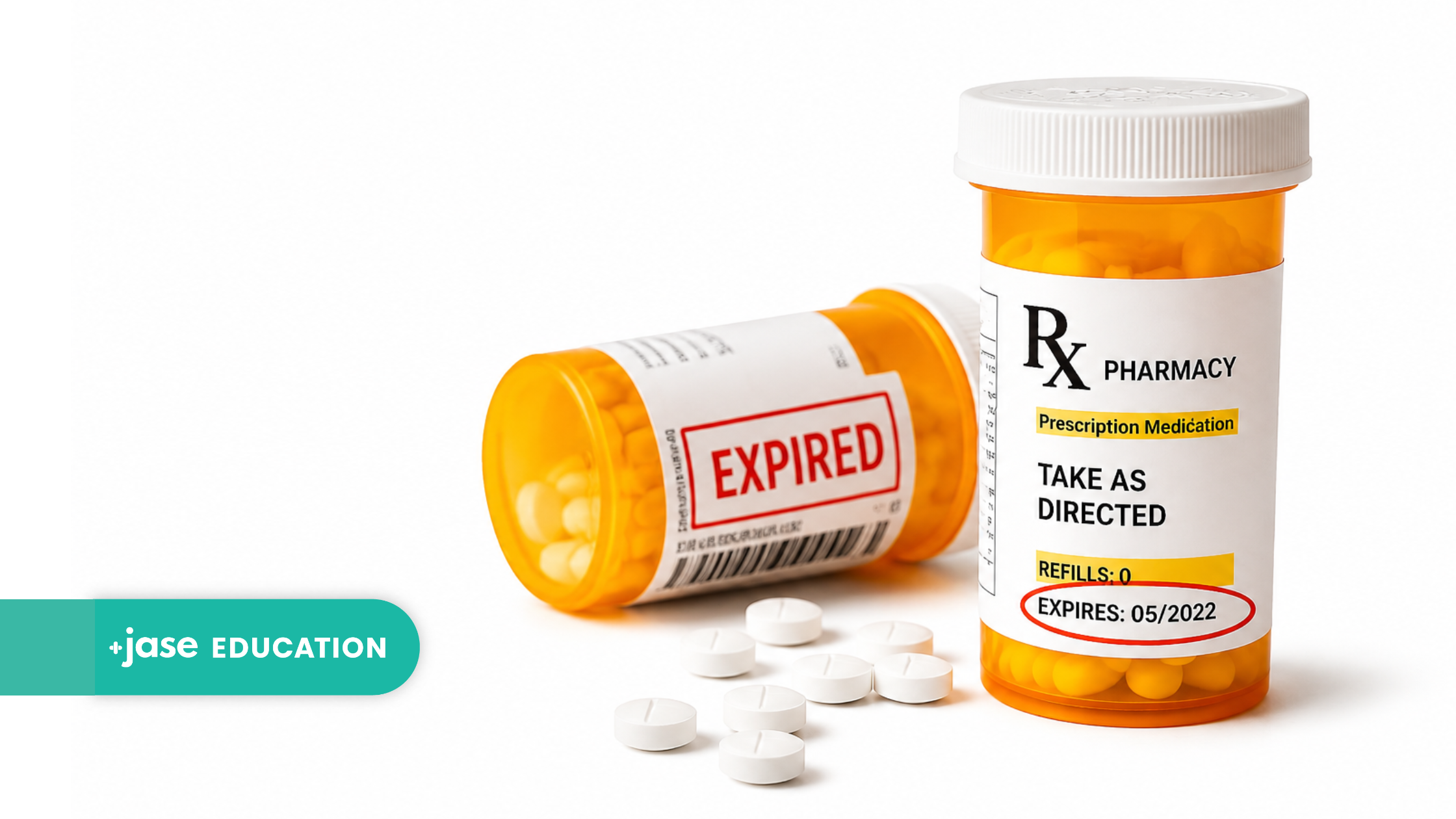
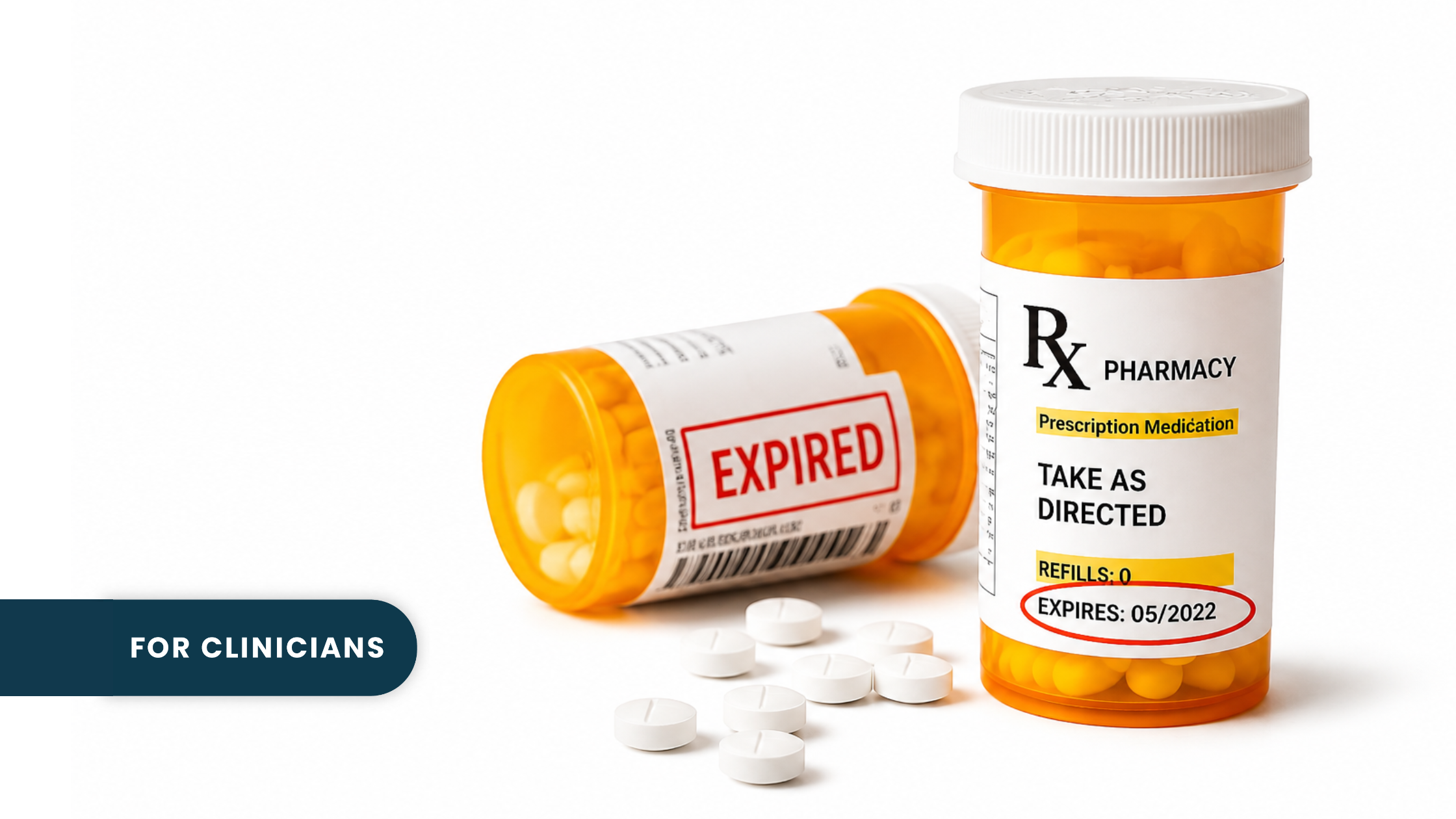
A patient holds up a bottle a year or two past the dispense date and asks, “Is this still good?” The counseling answer is the same for every product: replace it. The labeled date is the replacement date.

This article covers the stability research behind the question so you can explain why. The most cited data comes from the FDA and Department of Defense Shelf Life Extension Program, which tested stockpiled lots under controlled storage. Those results do not transfer to medication kept at home, and that limitation is the core of the counseling message.

Why stability varies, and why that makes the label date the answer

Stability differs by drug, formulation, and storage history. Solid oral forms hold up better than liquids, and a small set of products degrade quickly or carry specific risks once degraded. That variation is exactly why a patient cannot judge an expired product at home, and why counseling always lands on replacement at the labeled date. Use the tiers below to decide which products to replace first and which need the closest storage attention.

Tier 1: Solid oral forms

Tablets and capsules, including most oral antibiotics, analgesics, and antihistamines, are the least sensitive to storage. Counsel patients to keep them capped in the original container in a cool, dry place away from the bathroom, and to replace them at the labeled date.

Tier 2: Liquids, suspensions, and reconstituted products

Oral suspensions, eye and ear drops, and anything reconstituted carry short in-use dating. Reconstituted amoxicillin suspension, for example, is labeled for 14 days after mixing. Counsel patients that these are not long-term supply items, to follow the beyond-use date on the label, and to discard leftovers when the course ends.

Tier 3: Narrow therapeutic index and storage-dependent products

Levothyroxine, warfarin, antiepileptics, insulin, epinephrine auto-injectors, and sublingual nitroglycerin need the closest attention. Small potency changes matter clinically, and several of these products degrade with heat, light, or air exposure. Counsel patients to follow storage instructions exactly, inspect for discoloration or particles where the product allows, and replace at the labeled date or sooner if storage was compromised.

Counseling points

  • The labeled date is the replacement date for every product.
  • Store medications cool, dry, and dark, in the original container. The bathroom cabinet is the worst place in most homes.
  • Replace any product with a visible change, such as discoloration, odor, or clumping, regardless of date.
  • Dispose of expired supply following FDA guidance.

Closing notice: When a medication reaches its expiration date, replace it. Dispose of the expired supply following FDA’s guidance on expired medicines.


Sources

  1. FDA, Expiration Dates Questions and Answers
  2. FDA, Don’t Be Tempted to Use Expired Medicines
  3. Lyon RC et al. “Stability profiles of drug products extended beyond labeled expiration dates.” J Pharm Sci. 2006;95(7):1549-1560.
  4. Frimpter GW et al. “Reversible ‘Fanconi syndrome’ caused by degraded tetracycline.” JAMA. 1963;184:111-113.


Lifesaving Solutions

Everyone should be empowered to care for themselves and their loved ones during the unexpected. Check out our recent lifesaving products today.

Recent Posts

Keeping you informed and safe.

What Metronidazole Actually Treats — And What It Doesn’t

What Metronidazole Actually Treats — And What It Doesn’t

What Metronidazole Actually Treats — And What It Doesn't By Cayla McGrath If you've ever been prescribed metronidazole, the first thing most people remember is the warning: no alcohol while you're taking it. The pharmacist usually says it with the kind of gravity that...

read more
When a Tooth Infection Can’t Wait

When a Tooth Infection Can’t Wait

Antibiotics Won't Cure Your Tooth Infection. Here's What They Actually Do By Cayla McGrath A molar starts throbbing on day two of a ten-day cruise. A crown cracks Friday night and your dentist can't see you until Wednesday. A tooth flares in a rural area where the...

read more
For Clinicians | The Tooth Infection at Your Counter

For Clinicians | The Tooth Infection at Your Counter

For Clinicians | The Tooth Infection at Your Counter: What to Do When the Dentist Is Days Away By Dr. Jamie Wilkey, PharmD — Director of Clinical Strategy, JaseMedically reviewed by Kristen Carpenter, PA-C — Clinical Advisory Board Member Almost none of us trained to...
read more

Join Our Newsletter

Our mission is to help you be more medically prepared. Join our newsletter and follow us on social media for health and safety tips each week!